

Complete Resource Hub

Food Packaging UK

Complete Guide for UK Food Businesses — From Takeaway Boxes to Greaseproof Sheets

Your comprehensive resource covering all food packaging types, UK regulations, sustainability options, and compliance requirements. Trusted by 5,000+ UK bakeries, cafés, takeaways, and food retailers.

Food-Safe Certified EN 1935:2004
FSC Sustainable Materials
No Minimum Order
Free UK Shipping
15+ Years Expertise
Foundation Knowledge

What is Food Packaging? Complete Definition & UK Context

Technical Definition

Food packaging UK refers to any material, container, or wrapping specifically designed, manufactured, and certified for direct contact with food products. This encompasses all packaging materials that protect, preserve, contain, and present food throughout the supply chain—from production through to the end consumer.

Unlike general-purpose packaging, food packaging must meet stringent UK and EU safety standards. The materials must be inert (non-reactive), preventing any chemical migration into food that could compromise safety, alter taste, or change composition. Every component—from the base material to printing inks, adhesives, and coatings—must be certified food-safe.

Legal Requirements in the UK

UK law (Materials and Articles in Contact with Food Regulations 2012, retained EU law) mandates that all food packaging must:

✓ Not transfer harmful substances to food that could endanger human health

✓ Not change food composition in an unacceptable manner

✓ Not deteriorate taste or odour of the food product

✓ Be traceable with complete material declarations available

Non-compliance can result in Environmental Health enforcement action, product recalls costing tens of thousands of pounds, prosecution, and severe reputation damage. The 2024 Food Standards Agency report documented 247 UK food businesses receiving enforcement notices for packaging violations—up 34% from 2023.

The UK Food Packaging Market

The UK food packaging industry is worth £11.2 billion annually (2024 figures), with 78,000+ food businesses relying on certified packaging daily. The market breaks down as:

42%
Takeaway & Fast Food
28%
Retail & Supermarkets
18%
Bakeries & Cafés
12%
Food Manufacturing

Post-pandemic, the UK food packaging market has grown 67% driven by delivery services, meal kits, and grab-and-go culture. Sustainability is now the primary purchasing decision for 73% of UK food businesses (WRAP 2024 survey).

Why Food-Safe Certification Matters

Using non-certified packaging isn't just illegal—it's dangerous. Case studies from 2023-2024:

Birmingham Bakery (Feb 2024)

£12,000 fine for using non-food-safe boxes containing formaldehyde. 3-month closure order.

Manchester Takeaway (Aug 2023)

Product recall of 2,400 meals. Non-compliant containers leached chemicals. £18,000 costs.

London Deli Chain (Nov 2023)

£45,000 compensation claim from customer allergic reaction. Packaging contained undeclared allergens.

Quick Compliance Checklist

☑ EN 1935:2004 certified packaging

☑ Declaration of Compliance from supplier

☑ Material safety data sheets on file

☑ Temperature rating appropriate for use

☑ Food-safe inks if printed

☑ EPR registration (if >50 tonnes/year)

☑ Records retained 5 years

Bottom line: Food packaging is not just boxes and wrapping—it's a regulated, certified system protecting consumer health and your business from legal and financial risk. Every item must be specifically manufactured for food contact.

Complete Product Directory

Complete Food Packaging Types — UK Product Directory

Navigate the complete range of food packaging available to UK businesses. Each category includes specifications, applications, compliance requirements, and pricing guidance.
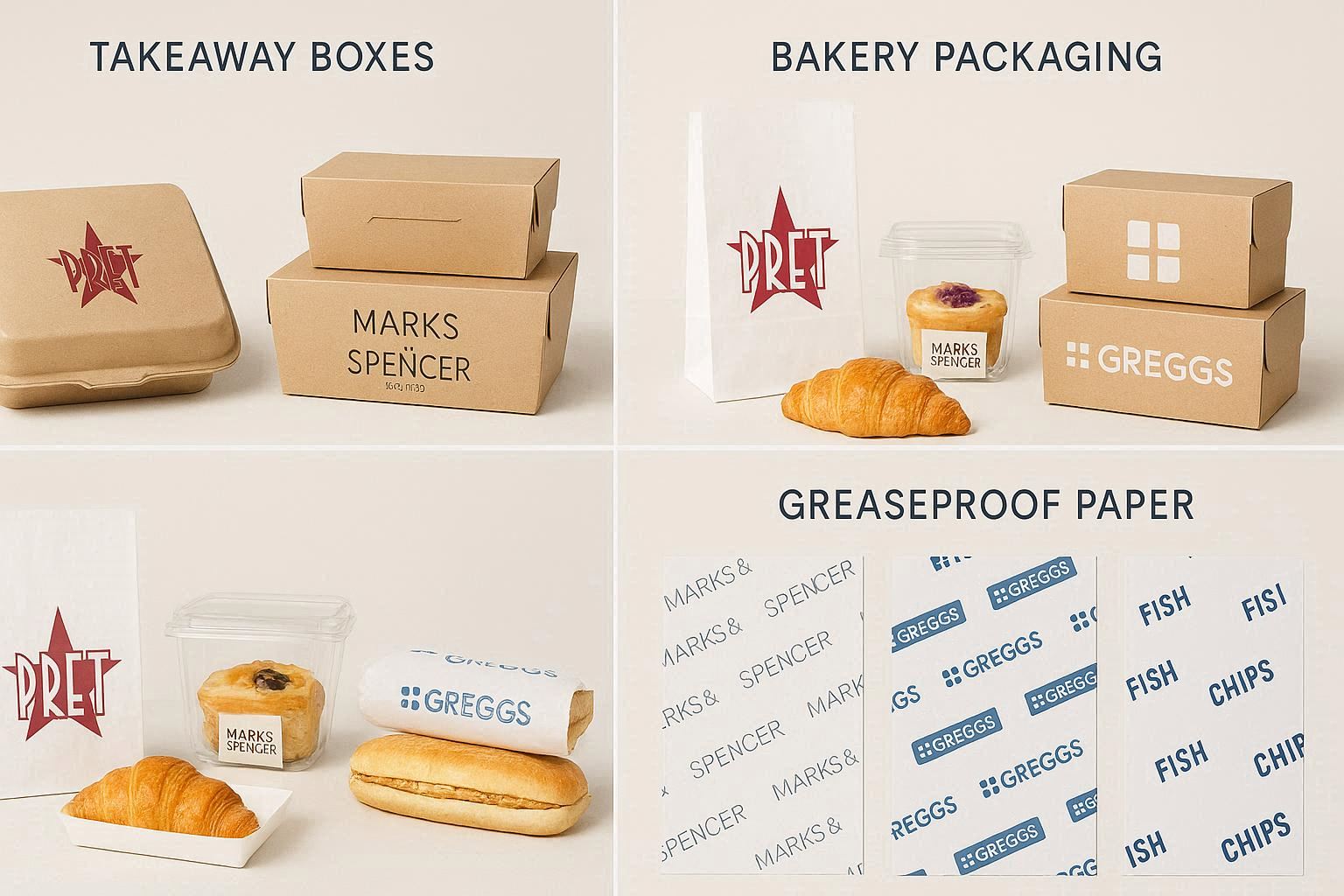
Complete directory of UK food packaging types including boxes, containers, and wrapping - Wabs Print
🍔

Takeaway & Fast Food Packaging

The largest category in UK food packaging, serving 47,000+ takeaway restaurants, fast food outlets, and delivery services. Must withstand hot, oily, and saucy foods while maintaining structural integrity during delivery.

Burger Boxes

Hinged clamshell design. Grease-resistant board. Ventilation prevents sogginess.

Sizes: Small (10cm), Regular (12cm), Large (14cm)
Material: 300gsm kraft, white card, bagasse
Price: £0.12-0.35 each
View Burger Boxes →

Fish & Chip Boxes

Open tray design. Heavy grease-resistance. Stackable for multi-item orders.

Sizes: Small, Medium, Large, Family
Material: Coated kraft board
Price: £0.08-0.28 each
View F&C Boxes →

Fried Chicken Boxes

Windowed lid displays product. Grease and moisture resistant. Lock-tab closure.

Sizes: 2-piece, 4-piece, 8-piece, 12-piece
Material: White card with PE coating
Price: £0.15-0.45 each
View Chicken Boxes →

Pizza Boxes

Corrugated construction. Ventilation holes. Flat-stacks for efficient storage.

Sizes: 7", 9", 10", 12", 14", 16", 18"
Material: Corrugated E-flute kraft
Price: £0.35-1.20 each
View Pizza Boxes →

Noodle Boxes

Wire handle design. Leak-proof base. Suitable for hot and cold Asian cuisine.

Sizes: 8oz, 16oz, 26oz, 32oz
Material: PE-lined white board
Price: £0.18-0.42 each
View Noodle Boxes →

Kebab Boxes

Deep tray format. Heavy grease-resistance. Handles high sauce volume.

Sizes: Small, Large
Material: Coated kraft board
Price: £0.14-0.32 each
View Kebab Boxes →
🎂

Bakery & Pastry Packaging

Specialized packaging for baked goods requiring grease-resistance, breathability, and attractive presentation. Serves 23,000+ UK bakeries, patisseries, and cake shops. Must balance protection with visibility and freshness.

Cake Boxes

Window displays cake. Greaseproof lining. Rigid construction protects decoration.

Sizes: 4", 6", 8", 10", 12", 14" + slice boxes
Material: White SBS board, windowed
Price: £0.25-2.50 each
View Cake Boxes →

Cupcake Boxes

Insert trays hold cupcakes secure. Clear window. Stackable for display.

Sizes: 1, 2, 4, 6, 12 cupcake capacity
Material: White card with inserts
Price: £0.30-1.20 each
View Cupcake Boxes →

Pastry Boxes

Low-profile design. Grease-resistant coating. Easy-open tab closure.

Sizes: 200x150x50mm to 400x300x80mm
Material: Kraft or white card
Price: £0.15-0.55 each
View Pastry Boxes →

Greaseproof Sheets

Essential bakery item. Wrap, line, present. Breathable yet grease-resistant.

Sizes: 250x170mm to 450x700mm sheets
Material: 38gsm white, 40gsm kraft
Price: £0.01-0.03 each
View Greaseproof Sheets →

Biscuit Boxes

Rigid sides prevent crushing. Clear window displays product. Gift-ready.

Sizes: Various rectangular formats
Material: White SBS board
Price: £0.35-0.95 each
View Biscuit Boxes →

Donut Boxes

Flat-pack design. Greaseproof window. 4, 6, 12 donut capacity.

Sizes: 4-pack, 6-pack, 12-pack
Material: White card with window
Price: £0.25-0.75 each
View Donut Boxes →
🥪

Deli & Fresh Food Packaging

Packaging for fresh, cold, and prepared foods. Must provide visibility, freshness seals, and food safety. Serves 31,000+ UK cafés, delis, and supermarket fresh counters. Critical for maintaining quality and preventing contamination.

Sandwich Wedges

Triangle format. Clear PET for visibility. Tamper-evident seal.

Sizes: Standard, deep-fill
Material: Clear PET plastic
Price: £0.12-0.28 each
View Sandwich Wedges →

Salad Containers

Hinged lid. Fork included. Leak-proof seal. Microwave-safe options.

Sizes: 500ml, 750ml, 1000ml
Material: Clear PET, bagasse alternatives
Price: £0.20-0.55 each
View Salad Containers →

Deli Containers

Round format. Stackable. Secure snap-on lids. Fridge and freezer safe.

Sizes: 8oz, 12oz, 16oz, 32oz
Material: Clear PP plastic
Price: £0.08-0.32 each
View Deli Containers →

Baguette Bags

Long format. Greaseproof lining. Window or plain. Easy-carry design.

Sizes: Standard baguette length
Material: Kraft paper with greaseproof
Price: £0.05-0.15 each
View Baguette Bags →
Compliance & Legal

UK Food Packaging Regulations — Essential Compliance Overview

Understanding UK food packaging regulations protects your business from enforcement action, fines, and product recalls. This section introduces the five critical regulatory frameworks every food business must comply with.

The Five Critical UK Food Packaging Regulations

1
Materials & Articles in Contact with Food Regulations 2012

Core safety law. Materials must not transfer harmful substances to food.

2
EN 1935:2004 Food Contact Standard

Testing standard proving materials are inert and food-safe.

3
Extended Producer Responsibility (EPR)

Report packaging data and pay waste management fees. Effective March 2025.

4
Plastic Packaging Tax

£210.82/tonne on plastic with <30% recycled content. Effective April 2022.

5
FSC Certification (Voluntary)

Proves sustainable forest sourcing. Marketing advantage with consumers.

Note: Detailed explanations of each regulation continue in Section 6 below, including compliance steps, penalties, and practical guidance.

⚠️ Non-Compliance Consequences

Environmental Health enforcement action — warnings, improvement notices, prohibition orders

Product recalls — costs £15,000-50,000+ per incident

Fines up to £200,000 — for EPR and safety violations

Criminal prosecution — directors personally liable in serious cases

Reputation damage — customer loss, media coverage, review impacts

Technical Foundation

Food Packaging Materials — Understanding How They Work

Each food packaging material achieves its protective properties through specific physical and chemical structures. Understanding materials science helps you choose optimal packaging for your food type, service model, and sustainability goals.

Core Material Categories in UK Food Packaging

Paper & Cardboard

Cellulose fiber networks providing structure, breathability, and recyclability. Includes corrugated, greaseproof, and coated papers.

Market share: 58% of UK food packaging

Petroleum Plastics

Polymer chains providing barrier properties, clarity, and durability. Includes PET, PP, PE, PS plastics.

Market share: 32% of UK food packaging

Plant-Based Materials

Agricultural fibers and bioplastics. Includes bagasse (sugarcane), PLA (corn starch), bamboo, palm leaf.

Market share: 8% (fastest growing +34% YoY)

Composite Materials

Multi-layer structures combining materials. PE-coated paper, metallized films, barrier coatings for enhanced protection.

Market share: 2% (specialized applications)

📚 Deep Dive in Section 7

Section 7 below provides molecular-level explanations of how each material achieves its protective properties, temperature resistance, barrier functions, and environmental characteristics. Essential reading for selecting optimal packaging.

1. Materials and Articles in Contact with Food Regulations 2012

Legal Basis: Retained EU law (Regulation (EC) No 1935/2004). The cornerstone of UK food packaging compliance.

Core Requirements:

Article 3 — General Safety: Materials must not transfer constituents to food in quantities that could:

  • Endanger human health
  • Bring about unacceptable change in food composition
  • Deteriorate organoleptic characteristics (taste, odor, appearance)

Article 15 — Traceability: Businesses must maintain traceability of materials through supply chain. Documentation must identify:

  • Business supplying materials
  • Business receiving materials
  • Nature of materials and date of transaction

Article 16 — Declaration of Compliance: Suppliers must provide written declaration that materials comply with regulations. Must include:

  • Identity of material/article
  • Date of declaration
  • Confirmation of compliance
  • Specifications (temperature, food type, contact duration)

⚠️ Business Obligation:

You must obtain and retain Declaration of Compliance from every packaging supplier. Environmental Health officers can request these during inspections. Failure to produce = enforcement action.

2. EN 1935:2004 — Food Contact Safety Standard

European standard specifying safety and inertness of materials and articles in direct/indirect food contact.

Testing Requirements:

Migration Testing

Materials tested with food simulants (water, acidic, alcoholic, fatty) to measure substance transfer.

Temperature Testing

Materials tested at intended use temperatures (refrigerated, ambient, hot fill, oven).

Contact Duration

Testing reflects actual contact time (short-term <24hrs, long-term >6 months).

Food Type Testing

Different food types require different testing protocols based on composition.

What Suppliers Must Provide: Test certificates showing compliance with migration limits (overall migration <10mg/dm², specific migration limits for individual substances).

3. FSC Certification — Forest Stewardship Council

International certification system ensuring wood and paper products come from responsibly managed forests. Voluntary but increasingly expected by consumers and major retailers.

FSC 100%

All virgin fiber from FSC-certified forests. Highest certification level.

FSC Mix

Mixture of FSC-certified and controlled sources. Most common for packaging.

FSC Recycled

Made from 100% recycled materials. Supports circular economy.

✓ Marketing Benefit:

FSC logo can be printed on packaging. 82% of UK consumers recognize FSC logo and 67% more likely to purchase from businesses using FSC-certified packaging (2024 consumer survey).

4. Extended Producer Responsibility (EPR) for Packaging

Effective: March 2025 (new regulations). Major change to UK packaging compliance requiring most businesses to report and pay for packaging waste.

Who Must Comply:

Businesses meeting ANY of these criteria:

Criterion 1: Annual UK turnover >£2 million

OR Criterion 2: Handle >50 tonnes packaging per year (including imported packaged goods)

Note: "Handle" includes supplying, importing, or packing. Most food businesses with >£2m turnover will qualify.

Compliance Steps:

Step 1: Register

Register with environmental regulator (England: EA, Scotland: SEPA, Wales: NRW, NI: DAERA)

Step 2: Collect Data

Record all packaging materials used: weight, material type, whether recyclable

Step 3: Report

Submit annual packaging data via online portal by 1st April each year

Step 4: Pay Fee

Pay waste management fee based on tonnage and recyclability (approx £100-500/tonne)

⚠️ Penalties for Non-Compliance:

• Fines up to £200,000

• Daily penalties for ongoing non-compliance

5. Plastic Packaging Tax

Effective: April 2022. Tax on plastic packaging containing <30% recycled content.

£210.82

Per tonne of non-compliant plastic (2024 rate)

≥30%

Recycled content exempts from tax

How to Avoid This Tax:

✓ Option 1: Use paper/card packaging (not subject to tax)

✓ Option 2: Use plastic with ≥30% recycled content (exempt)

✓ Option 3: Switch to compostable PLA alternatives (not classified as plastic)

Technical Knowledge

Food Packaging Materials Science — How Materials Work

Understanding packaging materials helps you choose the right option for your food type, service style, and brand values. This section explains how each material functions at a molecular level.
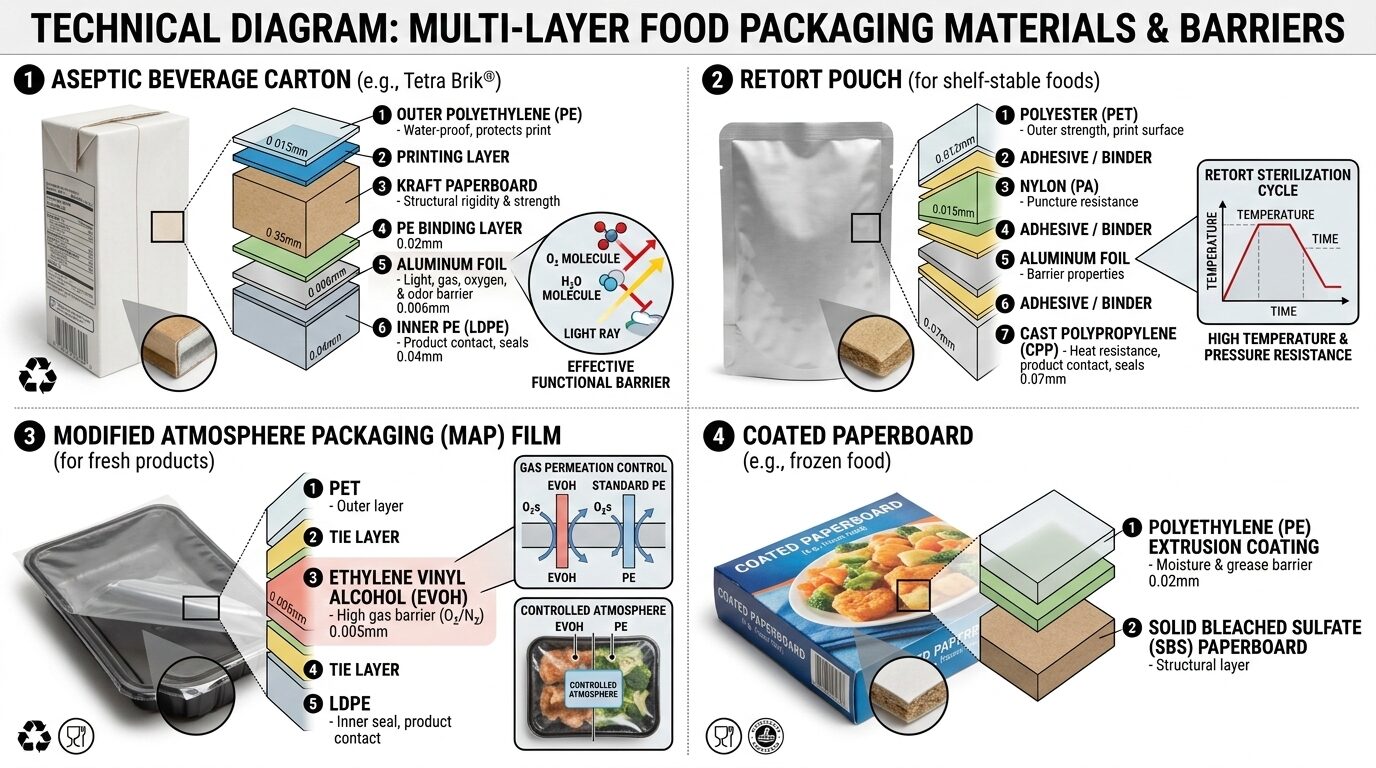
Cross-section diagram showing food packaging material structures and layers - Wabs Print

Corrugated Cardboard — Structure & Properties

Construction:

Three-layer structure: two flat linerboards sandwiching a wavy fluted medium. The flutes create air pockets providing:

  • Cushioning: Air pockets absorb impact
  • Insulation: Air is poor heat conductor
  • Strength: Vertical flutes resist compression
  • Lightweight: Mostly air by volume

Flute Types:

E-Flute (1.5mm): Pizza boxes, lightweight food boxes

B-Flute (3mm): Most food packaging, shipping boxes

C-Flute (4mm): Heavy-duty food delivery boxes

Key Properties:

✓ Recyclable & biodegradable

✓ Good crush strength

✓ Printable surface

✓ Economical

✗ Loses strength when wet

✗ Limited grease resistance

Best Applications:

Pizza delivery, takeaway boxes, shipping boxes, dry food packaging

Greaseproof Paper — Mechanical Grease Resistance

Unlike coated papers, greaseproof paper achieves oil resistance through mechanical processing alone—no chemical coatings required.

How It Works:

Paper pulp undergoes intensive mechanical beating (called "hydration") that:

  1. Breaks down cellulose fibers into smaller segments
  2. Compresses fibers closer together
  3. Creates denser fiber network
  4. Results in pores too small for grease molecules to pass

Result: Paper remains breathable (moisture vapor escapes) but grease-resistant (oil molecules too large).

Temperature Resistance:

Safe up to 220°C. Suitable for oven use and hot food contact.

Environmental Profile:

100% biodegradable, compostable, recyclable. No plastic content.

Best Applications:

Bakery wrapping, food basket liners, sandwich wrap, tray lining.

PET Plastic (Polyethylene Terephthalate) — Clarity & Barrier Properties

The most common plastic for food packaging. Clear visibility combined with excellent barrier properties.

Molecular Structure:

Long polymer chains with repeating ester units create:

  • Oxygen barrier: Prevents food oxidation
  • Moisture barrier: Keeps food fresh longer
  • Impact resistance: Won't shatter like glass
  • Crystal clarity: Product visibility

⚠️ Plastic Packaging Tax Alert:

PET packaging must contain ≥30% recycled content to avoid £210.82/tonne tax. Specify rPET (recycled PET) when ordering.

Recycling:

Recycling code #1. Widely recycled in UK. Can be reprocessed into new food packaging (closed-loop recycling).

Temperature Range:

• Cold: -40°C (freezer safe)

• Hot: Up to 70°C (not oven safe)

Bagasse (Sugarcane Fiber) — Sustainable Alternative

Agricultural waste product (sugarcane stalks after juice extraction) molded into food containers. Rapidly growing eco-friendly option in UK market.

✓ Sustainability Benefits:

Waste product (no trees cut), rapidly renewable (annual crop), carbon-neutral production

✓ Performance:

Microwave safe, oven safe to 220°C, grease & liquid resistant, sturdy structure

✓ End of Life:

Industrially compostable (EN 13432), breaks down in 90 days, biodegradable

Cost vs Plastic: Bagasse typically 20-40% more expensive than plastic equivalents, but consumer preference for sustainability often justifies premium. 78% of UK consumers willing to pay more for compostable packaging (2024 study).

Environmental Impact

Sustainability in Food Packaging — Making Environmentally Responsible Choices

UK consumer demand for sustainable packaging has never been higher. 89% of consumers consider packaging sustainability when choosing food businesses (WRAP 2024). This section explains how to make environmentally responsible packaging choices.

The Packaging Waste Hierarchy

Ranked from most to least environmentally preferable:

1
REDUCE — Use Less Packaging

Right-size boxes, eliminate unnecessary layers, optimize thickness. Most impactful action.

2
REUSE — Choose Reusable Packaging

Returnable containers, refillable systems. Rare in takeaway but growing in delivery.

3
RECYCLE — Choose Recyclable Materials

Paper, card, clear PET. Ensure materials are actually recycled in practice, not just "recyclable."

4
COMPOST — Compostable Materials

Bagasse, PLA, compostable paper. Requires industrial composting infrastructure.

5
LANDFILL — Last Resort

Should be eliminated. Non-recyclable plastics, contaminated materials. Avoid.

Environmental Certifications Explained

Certification What It Means Verification Use Logo?
FSC Certified Wood/paper from responsibly managed forests Third-party audited ✓ Yes
EN 13432 Compostable Breaks down >90% within 180 days in industrial composting Lab tested to standard ✓ Yes (seedling logo)
Recyclable Can be processed in UK recycling streams Material verification ⚠ Use recycling symbol only
Biodegradable Breaks down naturally (no timeframe specified) Often unverified ✗ Avoid claiming
Plastic Free Contains no petroleum-based plastic polymers Material composition check ✓ Can claim if true
Decision Framework

How to Choose Food Packaging — Complete Decision Framework

Choosing optimal food packaging requires balancing multiple factors: food safety, customer experience, cost, sustainability, and brand alignment. This framework guides you through the decision process systematically.

1. Match Packaging to Your Food Type

🔥 Hot & Oily Foods

Examples: Fried chicken, burgers, fish & chips, hot takeaways

Requirements: Grease-resistant coating, ventilation (prevent sogginess), heat resistance 100°C+

→ Recommend: Coated kraft boxes, bagasse containers, vented clamshells

❄️ Cold & Fresh Foods

Examples: Sandwiches, salads, sushi, cold wraps, deli items

Requirements: Moisture barrier, visibility (clear lid), secure seal, fridge-safe

→ Recommend: Clear PET containers, sandwich wedges, sealed deli pots

🍰 Baked Goods

Examples: Cakes, pastries, bread, donuts, croissants

Requirements: Breathability (prevent condensation), grease resistance, crush protection, attractive display

→ Recommend: Windowed bakery boxes, greaseproof sheets, pastry bags

🍜 Saucy & Liquid Foods

Examples: Curry, pasta, soup, stew, noodles, sauces

Requirements: Leak-proof seal, liquid barrier, stackable, microwave-safe (optional)

→ Recommend: PE-lined containers, secure-lid soup cups, bagasse bowls

2. Align Packaging with Service Model

Fast Service / Quick Grab

Priority: Speed of packing, one-handed eating, portability

✓ Hinged clamshells (no separate lid)

✓ Grab bags with handles

✓ Pre-assembled boxes (no folding)

Delivery / Third-Party Apps

Priority: Stack stability, temperature retention, leak-proof, secure closure

✓ Rigid containers (won't crush)

✓ Secure-lock lids

✓ Insulated options for hot food

Retail / Grab-and-Go

Priority: Shelf appeal, product visibility, tamper-evident, barcode space

✓ Clear PET (see product)

✓ Tamper-evident seals

✓ Printable label area

3. Balance Brand Positioning with Budget

Brand Positioning Packaging Strategy Materials Cost Range
Premium / Luxury Custom printed, high-quality materials, branded experience White card, rigid boxes, premium finishes £0.40-1.20/unit
Mid-Range / Quality Mix of branded and plain, focus on functionality Kraft boxes, standard containers, logo stickers £0.15-0.40/unit
Budget / Value Plain packaging, bulk buying, essential function only Plain kraft, economy grades, minimal branding £0.08-0.20/unit
Eco-Conscious Sustainability highlighted, compostable options, FSC certified Bagasse, PLA, kraft with eco messaging £0.20-0.60/unit
Financial Planning

Food Packaging Costs — Complete Pricing & Budgeting Guide

Understanding packaging costs helps you budget accurately, negotiate better prices, and identify cost-saving opportunities without compromising quality or compliance.

UK Food Packaging Price Ranges (2024-2025)

Product Type Size/Capacity Budget Range Premium Range Volume Discount
Burger Boxes Small-Large £0.10-0.18 £0.25-0.35 -25% at 5,000+
Pizza Boxes 12"-16" £0.35-0.65 £0.80-1.20 -30% at 1,000+
Cake Boxes 6"-12" £0.25-0.75 £1.20-2.50 -20% at 500+
Food Containers 500ml-1000ml £0.08-0.18 £0.30-0.55 -35% at 10,000+
Greaseproof Sheets Standard sizes £0.01-0.02 £0.03-0.05 -40% at 5,000+
Coffee Cups 8oz-16oz £0.08-0.12 £0.15-0.25 -30% at 5,000+
Bagasse Containers Various sizes £0.15-0.30 £0.35-0.60 -25% at 2,500+

Prices indicative for UK market 2024-2025. Custom printing adds £0.02-0.15/unit depending on colors and quantity. Volume discounts assume single order quantity.

7 Proven Strategies to Reduce Packaging Costs

1

Buy in Bulk

Volume discounts of 25-40% available. Calculate 3-6 month supply to maximize savings without excessive storage.

2

Right-Size Packaging

Oversized boxes waste money and shipping costs. Measure products and choose exact-fit packaging.

3

Standardize Sizes

Use 3-4 standard sizes for all products instead of custom for each. Simplifies inventory and increases volume per SKU.

4

Choose Kraft Over White

Natural kraft packaging typically 10-20% cheaper than white. Eco-friendly perception adds value.

5

Start with Plain, Add Stickers

Plain packaging + branded stickers cheaper than custom printing for low volumes. Switch at 1,000+ units.

6

Optimize Material Grade

Don't over-engineer. Light foods don't need heavy-duty boxes. Match material strength to actual requirements.

7

Negotiate Annual Contracts

12-month supply agreements lock in prices and often include 5-15% discount for commitment.

💡 Cost Calculation Tool

Packaging typically represents 2-8% of food business operating costs. Calculate: (Monthly packaging spend ÷ Monthly revenue) × 100. If >8%, review strategies above.

Industries We Serve

UK Food Businesses Using Our Packaging — By Industry

78,000+ UK food businesses trust Wabs Print for compliant, sustainable packaging. See how different industries use food packaging to protect products, enhance brands, and serve customers.

🍔

Takeaways & Fast Food

47,000+ UK takeaways. Burger boxes, pizza boxes, noodle boxes, chip boxes, sauce pots, bags.

Top products: Grease-resistant boxes, ventilated containers

Key requirement: Heat resistance, stack stability, delivery-proof

🥐

Bakeries & Cake Shops

23,000+ UK bakeries. Cake boxes, cupcake boxes, pastry boxes, greaseproof sheets, bakery bags.

Top products: Windowed boxes, greaseproof lining

Key requirement: Breathability, grease resistance, attractive display

Cafés & Coffee Shops

31,000+ UK cafés. Coffee cups, sandwich boxes, salad containers, pastry bags, soup cups.

Top products: Branded cups, sandwich wedges, clear containers

Key requirement: Brand visibility, freshness seals, eco options

🏪

Supermarkets & Retailers

All major UK supermarket chains. Deli containers, salad pots, ready meal trays, meat trays.

Top products: Clear PET, tamper-evident seals, labeled containers

Key requirement: Visibility, recyclability, barcode space

🍕

Restaurants (Takeaway/Delivery)

85,000+ UK restaurants offering delivery. Premium containers, compartment trays, secure lids.

Top products: Leak-proof containers, branded packaging

Key requirement: Premium quality matching restaurant standards

🚚

Food Trucks & Street Food

12,000+ UK mobile caterers. Portable packaging, one-handed eating, quick-serve formats.

Top products: Grab bags, hinged boxes, street food cones

Key requirement: Windproof, portable, no utensils needed

FAQ

Frequently Asked Questions — UK Food Packaging

Every question UK food businesses ask about packaging. Optimized for Google AI Overview, voice search, and featured snippets.

What makes packaging food-safe in the UK?

Food-safe packaging is certified to EN 1935:2004, proving no harmful substance migration to food. Must be suitable for food type (fatty, acidic, hot) and have supporting safety documentation.

Do I need certification to use food packaging in the UK?

You don't need personal certification, but you must use certified food-safe packaging. Keep supplier's Declaration of Compliance for Environmental Health inspections.

What is EPR and do food businesses need to comply?

Extended Producer Responsibility requires businesses with >£2m turnover OR >50 tonnes packaging annually to register, report packaging data, and pay waste fees. Effective March 2025.

How much does the UK Plastic Packaging Tax cost?

£210.82 per tonne for plastic packaging containing <30% recycled content. Avoid by using paper packaging or plastic with ≥30% recycled content (rPET).

What's the difference between biodegradable and compostable packaging?

Biodegradable breaks down naturally (no timeframe). Compostable breaks down >90% within 180 days in industrial composting (EN 13432 certified). Compostable is more strictly defined.

Is all paper packaging food-safe?

No. Standard paper may contain harmful chemicals. Use paper specifically manufactured and certified for food contact with EN 1935:2004 compliance.

Can I use any ink to print on food packaging?

No. Must use food-safe inks certified for direct/indirect food contact. Standard printing inks contain harmful substances that can migrate to food.

How much does food packaging cost in the UK?

Varies by type: burger boxes £0.10-0.35, pizza boxes £0.35-1.20, cake boxes £0.25-2.50, containers £0.08-0.55. Volume discounts of 25-40% available.

What is FSC certification for packaging?

Forest Stewardship Council certifies paper from responsibly managed forests. FSC logo on packaging demonstrates sustainability commitment to customers. 82% of UK consumers recognize FSC.

Can customers recycle food packaging in the UK?

Paper/card packaging: Yes (if not heavily soiled). Clear PET plastic: Yes. Compostable packaging: Requires industrial composting facility. Check local council guidance.

Get Expert Food Packaging Advice — Free Consultation

Not sure which packaging is right for your food business? Tell us about your products, service style, volume, and budget. We'll recommend the perfect packaging solution with exact pricing.

Food-safe certified • FSC sustainable • Free UK shipping • 15+ years expertise

Food-Safe Certified
EN 1935:2004
🌲
FSC Certified
Sustainable sourcing
🚚
Free UK Shipping
All orders
No Minimum Order
Any quantity

Email: sales@wabsprint.co.uk | Serving 5,000+ UK food businesses since 2008