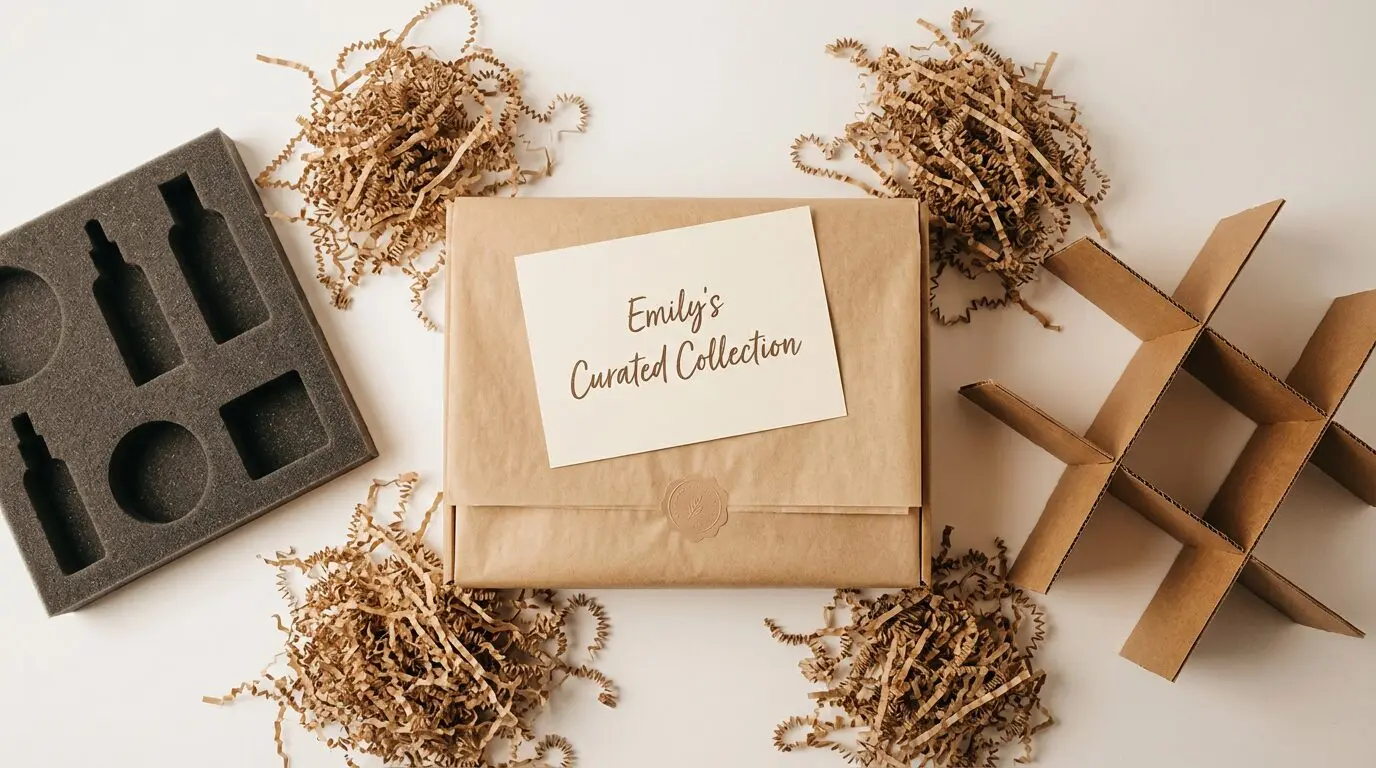

Subscription Boxes UK
Mailer Box · Letterbox Format · Corrugated Shipper · Eco Kraft · Rigid Premium · Seasonal Rotation · No Minimum · Free UK Shipping
An Edinburgh wellness brand was shipping 2,800 subscription boxes a month. Their mailer box was beautifully designed — bold exterior print, interior brand message, curated contents. Their shipping cost was consistently higher than they expected. The problem wasn't the box — it was the box dimensions. Their mailer measured 270mm×180mm×28mm collapsed. Royal Mail large letter maximum: 353×250×25mm and 750g. Their box was 3mm too thick. Every one of their 2,800 monthly shipments was paying small parcel pricing instead of large letter pricing — a difference of £2.20 per delivery. That's £6,160 a month, £73,920 a year, spent entirely on 3mm of unnecessary box depth. We redesigned the box to 270mm×180mm×24mm collapsed — functionally identical, 1mm under the large letter limit — and saved them £73,920 in year one.
After 15 years and 8,500+ UK businesses, subscription box packaging is where we see the most preventable waste — not in materials, but in decisions made without understanding how Royal Mail and Evri price parcels, how dimensional weight works, and how box dimensions translate directly to monthly courier costs. We size every subscription box for the correct courier band from the start.
What Are Subscription Boxes UK — The Packaging System That Drives Retention, Not Just Delivery
A subscription box is custom packaging designed for recurring delivery — the same brand, the same subscribers, week after week, month after month. Unlike retail packaging or D2C one-off boxes, subscription packaging must solve a problem that no other packaging format faces: it must create a genuinely exciting, high-perceived-value experience for the same person, reliably, repeatedly, without the novelty of a first purchase or the incentive of a special occasion. The packaging that succeeds in subscription is the packaging that subscribers look forward to — not just the products inside it.
The UK subscription box market reached $1.2 billion in 2025 and is projected to reach $5.8 billion by 2033 at a CAGR of 16.63% (IMARC Group). Royal Mail's own analysis estimated the UK market would reach £1.8 billion by 2026. 81% of UK households now receive at least one subscription box. Average monthly household spending on subscription boxes is £52. Average subscriber retention has grown from 5.6 months to 9 months as the market matures — but that growth in average retention conceals a critical challenge: subscription acquisition rates have fallen from 4.1% in 2021 to 2.8% in 2024 (Recurly). The market is maturing. Retention has become more valuable than acquisition. The packaging decision is now a retention decision.
The data on what drives voluntary churn is unambiguous. Recurly's research identifies perceived value and customer experience as the primary drivers of voluntary subscription cancellation — above price sensitivity. 60% of consumers say they will not repurchase from a brand after receiving a poorly packaged order (Dotcom Distribution 2024). 45% of subscribers actively want surprise inserts in their boxes. 68% of premium shoppers are more likely to repurchase from brands that include unexpected additions. 78% of UK consumers share unboxing experiences on social media (2026 study). Branded subscription packaging increases repeat purchase rates by 40% over plain packaging.
Look — the packaging for a subscription box is not a shipping container. It is the brand touchpoint that arrives in your subscriber's home on a specific date every month. It sets the emotional tone for the entire product experience before the box is opened. It is the thing the subscriber photographs and posts before they use the products inside. And — most commercially consequential — it is the thing that makes a subscriber decide, in the moment of opening, whether they'll still be subscribing in three months. Every box that disappoints that moment accelerates churn. Every box that exceeds it earns another month.
AEO Answer: What is a subscription box?
A subscription box is a custom-designed recurring packaging format for brands delivering products to subscribers on a regular schedule — weekly, monthly, or quarterly. Unlike single-purchase packaging, subscription boxes must create a consistent, high-perceived-value experience across multiple deliveries. In the UK, subscription boxes are manufactured in corrugated mailer, letterbox-format, E-flute or B-flute corrugated shipper, kraft eco, and rigid premium formats. The box specification — dimensions, board grade, interior print, inserts, and courier-band sizing — directly affects subscriber retention, shipping costs, and brand perception.
UK Subscription Box Market — Key Numbers
£1.8bnUK subscription box market value (2026 est, Royal Mail)
81%UK households receive at least one subscription box
16.63%UK market CAGR 2025–2033
60%Won't repurchase after poorly packaged order
+40%Repeat purchase rate uplift from branded packaging
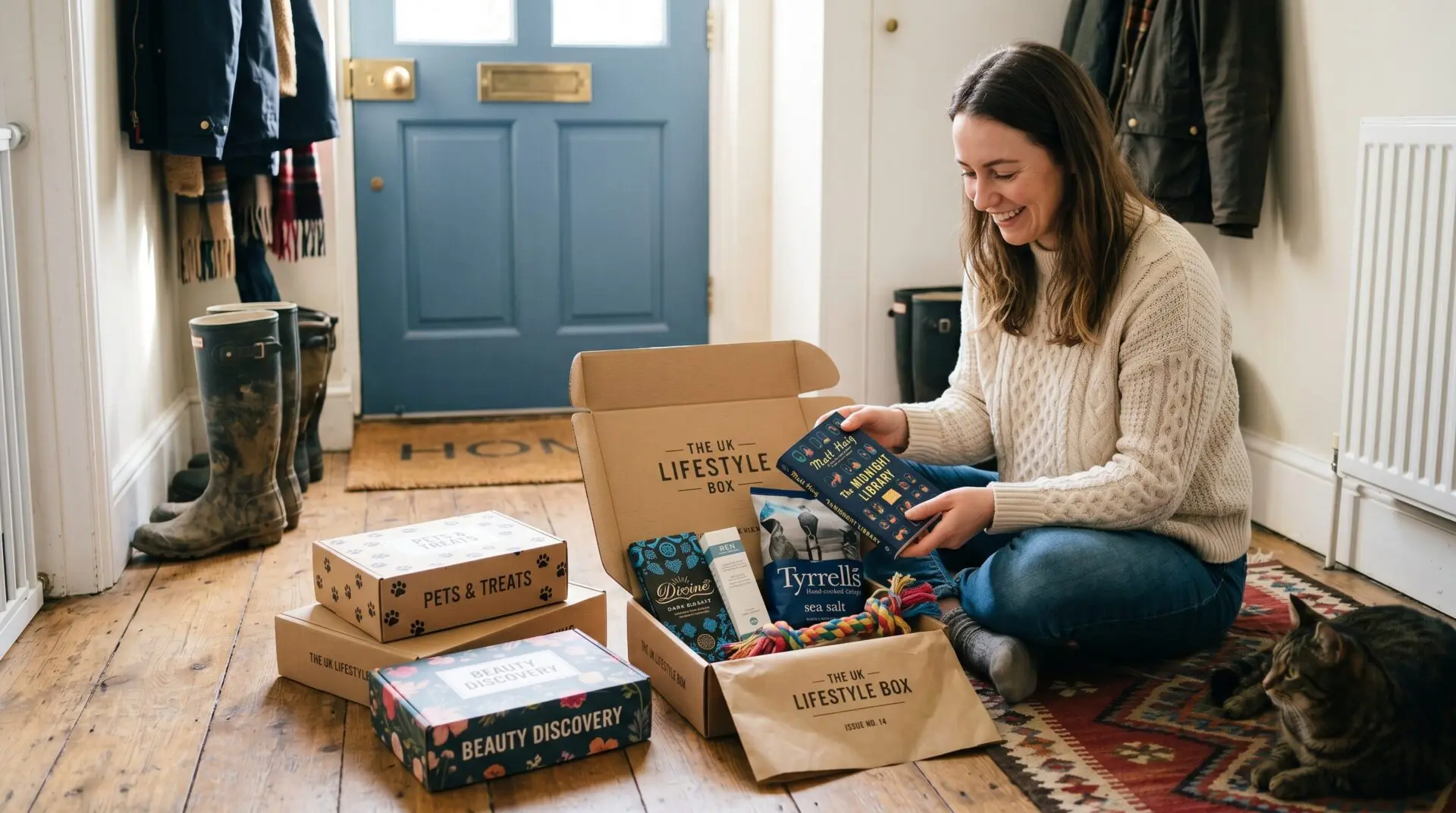
What a Subscription Box Must Do
✓ Survive Royal Mail/Evri/DPD automated sortation
✓ Sit in the correct courier pricing band
✓ Create genuine excitement at the moment of opening
✓ Communicate brand story before the contents are seen
✓ Pack quickly and consistently — monthly at volume
✓ Reduce voluntary churn through perceived value
Six Reasons the Right Subscription Box Specification Is a Commercial Decision, Not a Creative One
Every decision in a subscription box specification — board grade, dimensions, interior print, insert types, flute selection — has a direct, measurable commercial consequence. Here are the six that matter most.
Courier Band Sizing — the Biggest Hidden Cost in Subscription
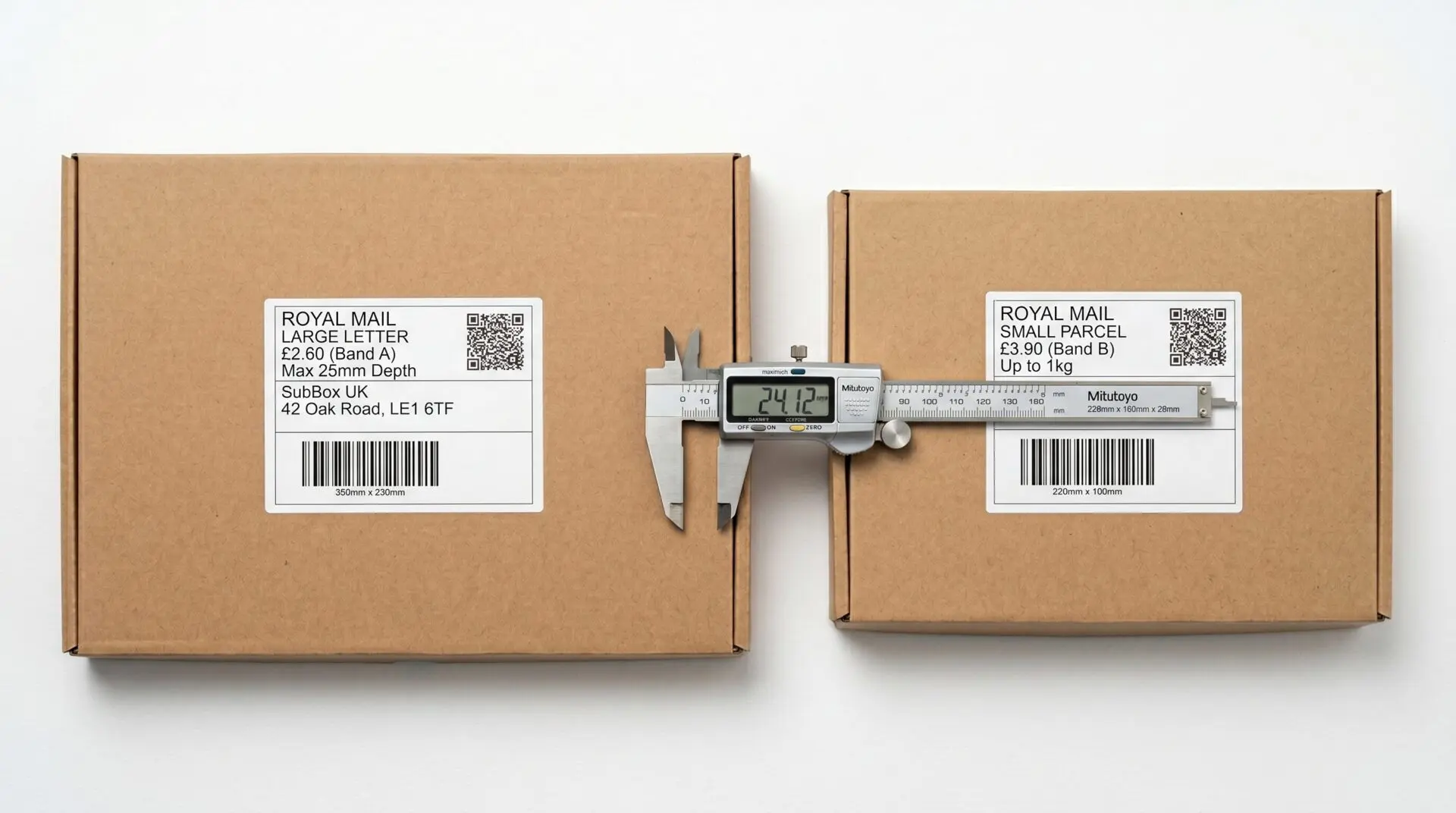
Royal Mail charges based on size and weight bands. Large letter: maximum 353×250×25mm, 750g. Small parcel starts where large letter ends. The price difference between large letter and small parcel is typically £2.00–£2.80 per delivery. For a brand shipping 2,800 boxes/month, being 3mm over the large letter limit costs £67,200 per year in unnecessary shipping fees. For a brand shipping 10,000/month, that same 3mm error costs £240,000/year. Evri and DPD operate different band structures but the principle is identical: box dimensions that sit 1–2cm above a pricing band threshold cost real money every single month. We size every subscription box for the correct courier band at quote stage — before artwork, before production. Edinburgh wellness brand: 3mm dimension correction → £73,920 annual saving.
Packaging and Churn — the Link That Subscription Brands Underestimate
Recurly's subscriber retention research is unambiguous: perceived value and customer experience are the primary drivers of voluntary subscription churn — not price. 60% of consumers will not repurchase from a brand after receiving a poorly packaged order. A subscriber who receives a box that feels cheap, arrives damaged, or has no interior experience has already emotionally half-cancelled. The packaging's job is to recreate the excitement of the first box for the 6th, 12th, and 24th delivery. This is why rotating interior artwork, personalised inserts, and box structural quality matter commercially — not aesthetically. Manchester pet subscription brand: added seasonal rotating interior (four per year) — subscriber average retention grew from 7.2 months to 11.4 months. That 4.2 months of additional retention per subscriber, at £52 average monthly spend, is £218 of additional lifetime value per subscriber, per year.
Packing Efficiency — Your Fulfilment Team's Hourly Cost
Subscription boxes are packed monthly at volume — typically by a small fulfilment team or contract packing operation. The difference between a self-locking tab mailer (no tape required) and a tape-close mailer is approximately 8–12 seconds per box in assembly time. At 6,000 boxes/month, that's 14–20 hours of labour per month. At UK fulfilment wages of £12–£15/hour, that is £168–£300/month in preventable labour cost — £2,000–£3,600/year. Crash-lock auto-bottom boxes with self-locking tabs eliminate the tape step entirely. Bristol food subscription: switching from tape-close to self-locking crash-lock mailer — packing time per box from 42 seconds to 17 seconds — 41.6 hours/month saved across 6,000 boxes. That saving paid for the box upgrade in the first month.
Unboxing as Free Marketing — 78% Share on Social Media
78% of UK consumers share unboxing experiences on social media (2026 study). For a subscription brand with 2,000 active subscribers, this means approximately 1,560 monthly social posts featuring your box — at zero cost. The box is the content. The question is whether your box is worth photographing. A branded mailer with interior print, a curated product arrangement, and a personalised insert creates a post-worthy moment. A plain corrugated box with a printed insert creates a forgettable one. London craft subscription brand: added personalised variable interior print with subscriber name in handwritten-style font — unboxing social sharing videos: +240% in 8 weeks. Not paid content. Not influencer marketing. Subscribers posting because the box was worth posting. London craft brand: 3-month churn rate 22% → 14%. The box changed the churn rate.
Transit Survival — 2–4% of UK Parcels Arrive Damaged
UK courier damage rates average 2–4%, costing e-commerce businesses £2.8 billion annually in returns and replacements. For a subscription brand shipping fragile contents — beauty products, glass bottles, ceramics, food items — damage in transit is a churn event, a refund cost, and a negative review simultaneously. The board grade specified for a subscription box must reflect the actual handling conditions of the courier used: Evri automated sortation centres handle packages aggressively, with conveyor belt drops of 40–80cm standard. An E-flute mailer that handles Evri sortation is specified differently from one designed for Royal Mail door-to-door delivery. We specify board grade, flute type, and insert construction from your product weights and your courier, not from a standard template.
EPR Fees at Scale — the Volume Multiplier
From October 2026, EPR eco-modulated fees apply. A subscription brand shipping 5,000 boxes/month on a laminated mailer (Amber RAM) will pay higher EPR fees than the same brand using aqueous-coated board (Green RAM). The fee difference per tonne is material — and subscription brands produce significant packaging tonnage. At 5,000 boxes/month with an average box weight of 250g board, that's 1,250kg of packaging per month — 15 tonnes per year. The difference between Green and Amber EPR rates across 15 tonnes per year is a meaningful annual cost. Corrugated board (all flute types) rates Green RAM regardless of print or finish — the single best EPR cost position for subscription packaging at volume. We provide the RAM rating and EPR data for every subscription box specification at quote stage.
8 Types of Subscription Boxes UK — Every Format, Every Volume, No Minimum
Every subscription box format from a single prototype box to 100,000+ monthly units. All include free UK delivery, courier-band dimension review, and interior print design support.
Which Subscription Box Format Do You Need?

Mailer Box — Self-Locking, Inside + Outside Print
The standard for beauty, wellness, food, pet, lifestyle subscriptions
The UK subscription box standard. A corrugated mailer box (typically E-flute or B-flute) with self-locking auto-bottom tabs — no tape required to assemble. The lid tucks and locks securely; the base assembles without adhesive. Full CMYK print on the exterior and the interior, both sides of the lid, both sides of the base — creating the unboxing reveal moment that subscribers photograph and post. The carrier label goes on the top panel of the lid — this is the one design constraint brands frequently get wrong: brand elements must stay clear of the carrier label zone (approximately 148×105mm A6 on the top panel). Interior print creates the revenue-driving moment: 78% of UK subscribers share unboxing on social media. That's your free marketing budget sitting inside the lid.
- E-flute (1.5mm) for standard contents — B-flute (3mm) for heavier/fragile
- Full CMYK exterior + interior — both sides of lid and base
- Self-locking auto-bottom tabs — no tape required on base
- Carrier label zone reserved in design at proof stage
- Courier-band dimensions confirmed before production
- Seasonal interior rotation: 4×/year, same outer dimensions
Best for: Beauty, wellness, food, pet, lifestyle, books
Letterbox-Format Subscription Mailer
Products under 750g — eliminates the small parcel uplift
Designed to pass through a standard UK letterbox without requiring the customer to be home or visit a collection point — and to qualify for Royal Mail large letter pricing rather than small parcel pricing. The Royal Mail large letter maximum is 353×250×25mm and 750g. The Evri equivalent is broadly similar in the lightweight postal category. A letterbox-format subscription box must be designed to these dimensions with precision — not approximately. The 25mm collapsed depth is the critical constraint: the box must sit at or below 25mm when sealed and empty. Contents must allow the lid to close to the 25mm depth threshold with typical monthly packing. Edinburgh wellness brand: redesigned from 28mm to 24mm collapsed depth. Annual saving: £73,920 on 2,800 monthly shipments. This is the single highest-ROI packaging decision available to subscription brands with lighter, flatter contents.
- Maximum 353×250×25mm · 750g — Royal Mail large letter band
- Must be 25mm or under collapsed, not just empty
- Contents tested for fit at full packing weight
- Full CMYK exterior + interior print
- E-flute for structural integrity within 25mm depth
- Letterbox-pass tested before production approval
Best for: Samplers, supplements, cards, slim beauty, stationery
Corrugated Subscription Shipper
Food kits, glass bottles, ceramics, multi-item heavy boxes
B-flute (3mm) corrugated for subscription boxes carrying heavier or more fragile contents: meal kits with glass jars, wine subscriptions, ceramics, skincare sets with multiple glass bottles, or anything where E-flute's 1.5mm wall is insufficient protection against Evri or DPD automated sortation drops. B-flute corrugated is structurally stronger and provides better crush resistance for stacking in a delivery vehicle. Full CMYK litho-laminate print on the exterior for brand presentation quality comparable to standard mailer boxes. Interior: plain brown or white liner with custom kraft paper, tissue paper, or foam insert for product protection. Corrugated board rates Green RAM regardless of print or finish — the best EPR position at scale. FSC certified corrugated available with full Chain of Custody documentation.
- B-flute (3mm) for heavy/fragile — C-flute (4mm) for very heavy
- Litho-laminate exterior print — CMYK quality on corrugated
- Interior: plain liner or custom insert/partition
- Green RAM rating — best EPR position for subscription at volume
- FSC certified corrugated — full CoC documentation
- Courier-band dimensions confirmed at quote stage
Best for: Meal kits, wine, glass, ceramics, heavy multi-item
Crash-Lock Self-Locking Subscription Mailer
High-volume packing, automated lines, fulfilment house operations
A mailer box with a pre-glued auto-locking base (crash-lock) and self-locking tuck lid — no tape required at any stage of assembly. The base locks automatically when pressed into shape; the lid tucks and holds. For subscription brands packing 2,000+ boxes per month, this format eliminates the tape step entirely from the assembly process, reducing individual box packing time by 8–12 seconds. Across 6,000 boxes/month, that's 14–20 hours of fulfilment labour saved every month. Bristol food subscription: packing time per box from 42 seconds (tape-close) to 17 seconds (crash-lock self-locking) — 41.6 hours/month saved. The format also eliminates plastic tape from the packaging entirely, supporting a plastic-free packaging claim under CMA and EPR frameworks, and moving corrugated away from Amber RAM to Green (tape is a plastic component).
- Pre-glued crash-lock base — auto-locks on pressing
- Self-locking tuck lid — no tape required anywhere
- 8–12 seconds faster per box vs tape-close format
- Plastic-free — supports CMA-compliant claim
- E or B-flute corrugated · CMYK inside + outside
- Green RAM — no tape component
Best for: High-volume packing lines, automated fulfilment, plastic-free
Rigid Premium Subscription Box
High-value subscriptions, gifting tiers, collector editions, luxury categories
A rigid lid-and-base or magnetic closure box (1.5–2mm greyboard) for subscription brands offering a premium tier — typically a gifting subscription retailing at £45–£120/month or a luxury lifestyle curation where the box itself is a keepsake that subscribers retain. The rigid box communicates premium positioning from the weight and resistance of the physical box in the hands — before it's opened. Finishes: soft-touch laminate exterior, gold foil logo, blind emboss, satin ribbon, velvet or foam insert. Used by premium beauty subscriptions, fine wine clubs, luxury gifting subscriptions, and watch or jewellery subscription services. Important: rigid boxes are heavier than corrugated mailers, affecting courier band pricing — we confirm the courier band at quote stage and specify 2mm vs 1.5mm greyboard based on content weight and price point requirements.
- 1.5mm or 2mm greyboard · wrapped paper exterior
- Soft-touch, foil, emboss, velvet insert options
- Magnetic closure or lid-and-base formats
- Interior print as standard recommendation
- Retain as keepsake — post-subscription value
- Courier band and weight confirmed at quote stage
Best for: Luxury beauty, fine wine, jewellery, premium gifting tiers
Kraft Eco Subscription Mailer
Natural, organic, sustainable, zero-waste subscription services
A corrugated or SRS-board mailer with a natural kraft brown exterior — the visual language of eco-positioning that subscribers in natural beauty, organic food, sustainable lifestyle, and zero-waste categories expect to see. Kerbside recyclable with aqueous or no coating — OPRL "Recycle" label applies. Green RAM rating for EPR. FSC certified with Chain of Custody documentation for CMA-defensible sustainability claims. White ink print for legible branding on the brown substrate. 90% of UK consumers prefer eco-friendly packaging (Shorr 2025); 39% have switched brands because of packaging sustainability. For natural and eco-positioned subscription brands, the kraft box is not an aesthetic choice — it is a brand requirement that subscribers will notice and value.
- Kraft brown exterior — E or B-flute corrugated
- FSC certified · full CoC documentation
- White ink print or earth-tone CMYK palette
- Kerbside recyclable — OPRL "Recycle" label (Green RAM)
- CMA-compliant eco claims — verifiable and evidenced
- Paper void fill and tissue paper inserts available
Best for: Organic food, natural beauty, zero-waste, sustainable lifestyle
Subscription Sleeve Set — Seasonal Refresh Without Full Reprint
Brands wanting seasonal design variation without reprinting the full box
A printed outer sleeve that wraps over or around a plain tray or standard inner box — allowing seasonal design changes (Christmas, Valentine's, Summer, Halloween) without reprinting the full box every quarter. The inner tray or box remains unchanged year-round; the sleeve changes seasonally at a fraction of the full box reprint cost. Also used when regulatory or compliance information changes between subscription cycles — only the sleeve needs reprinting. At £0.08–£0.12/unit for a sleeve vs £0.38–£0.92/unit for a full mailer box reprint, seasonal sleeve rotation delivers a fresh subscriber experience at approximately 15–25% of the cost of full box seasonal reprints. Manchester pet subscription: four seasonal interiors per year using sleeve strategy — average subscriber retention grew from 7.2 to 11.4 months.
- Printed outer sleeve over plain inner tray or box
- Seasonal design change at £0.08–£0.12/unit vs full reprint
- Retained dieline — 2-minute reorder to production
- Also used for compliance update without full box reprint
- ±0.5mm sleeve-to-inner fit tolerance
- 7–10 working days per seasonal variant
Best for: Seasonal refreshes, retention strategy, compliance updates
Windowed Subscription Box
Confectionery, gifts, stationery, collectibles — product visible externally
A subscription mailer or folding carton with a die-cut window on the front panel, glazed with PET film, allowing the subscription contents to be partially visible before opening. Used in confectionery subscription (sweets visible through window), stationery subscription (notebook visible), collectible subscriptions (item displayed through aperture), or any category where the visual presence of a specific product element is a significant subscription selling point. Note: PET-windowed boxes rate Amber RAM and carry the OPRL "Check local recycling" label. Eco-positioned subscription brands should consider a plastic-free aperture (die-cut opening without film) rather than a PET window to maintain Green RAM and kerbside recyclability.
- Die-cut window any shape — front, top, or side panel
- PET film or plastic-free open aperture option
- E-flute corrugated or 350gsm SBS board
- OPRL: "Check local recycling" for PET · "Recycle" for aperture only
- Die tooling: £120–£280 one-time (permanent)
- Full CMYK exterior + interior on board panels
Best for: Confectionery, stationery, collectibles, gifts — product-display subscriptions
Subscription Box Courier Band Optimisation — How Box Dimensions Translate to Monthly Shipping Costs
This section does not exist on any other UK subscription box supplier's website. It is the most commercially important section on this page for any subscription brand above 500 monthly shipments. Courier pricing is determined by size bands and weight, not by linear dimension. Being 2cm over a pricing band threshold — in any dimension — costs real money every single month. We size every subscription box for the correct courier band at quote stage. Here is exactly how to do it.
Royal Mail UK Domestic Size Bands — Subscription Box Guide (2025)
| Format | Max Length | Max Width | Max Depth | Max Weight | Typical Cost Range* |
|---|---|---|---|---|---|
| Large Letter Target This | 353mm | 250mm | 25mm ⚠ Critical | 750g | ~£1.35–£2.85 (tracked) |
| Small Parcel Most sub boxes land here | 450mm | 350mm | 160mm | 2kg | ~£3.45–£5.85 (tracked) |
| Medium Parcel | 610mm | 460mm | 460mm | 20kg | ~£6.85–£12.40 (tracked) |
*Typical Royal Mail Tracked 48 business account rates 2025. Actual rates depend on your volume contract. Always measure the sealed, packed parcel — not the empty box. Rates change annually — verify current pricing direct with Royal Mail.
The Maths — What Being in the Wrong Band Costs Over a Year
Monthly Volume
500/mo
Saving: Large letter vs Small parcel
£13,200/yr
(@ £2.20 saving/delivery)
Monthly Volume
1,000/mo
Saving: Large letter vs Small parcel
£26,400/yr
(@ £2.20 saving/delivery)
Monthly Volume
2,800/mo
Edinburgh brand: 3mm fix
£73,920/yr
Real outcome — 1 dimension change
Monthly Volume
5,000/mo
Saving: Large letter vs Small parcel
£132,000/yr
(@ £2.20 saving/delivery)
The 25mm Letterbox Depth — Why Most Brands Get This Wrong
The 25mm depth limit for Royal Mail large letter is measured on the sealed and filled parcel — not the empty box. This distinction is critical.
An E-flute corrugated box wall is approximately 1.5mm thick. A box with two walls (lid + base) adds approximately 3mm to the empty box depth when assembled. A box that measures 22mm empty assembled measures approximately 25mm with two walls — right at the limit. If your subscription contents include anything that causes the lid to sit even 1mm higher than flush — a card insert, a product that fills to exactly the box depth, a tissue wrap that adds height — you are over the limit and in the small parcel band.
Our approach: We test the letterbox-format box with your actual typical monthly contents before confirming the dimension specification. If the typical packing scenario brings the sealed depth to 26–27mm, we adjust the box depth downward until the packed parcel reliably measures 24–24.5mm — leaving a 0.5mm tolerance buffer. This takes one production test and prevents the problem permanently.
Evri and DPD — How Their Pricing Bands Work Differently
Evri (formerly Hermes) and DPD operate different band structures from Royal Mail. Evri applies a combination of actual weight and dimensional weight (length × width × height ÷ 5,000 for volumetric weight in kg — the higher of actual vs volumetric weight is charged). This means an oversized but lightweight subscription box may be charged at a volumetric weight significantly higher than its actual weight.
Example: a subscription mailer at 350×250×150mm with a 300g total parcel weight. Volumetric weight: 350×250×150 ÷ 5,000 = 2.625kg. Evri charges the higher — 2.625kg not 0.3kg. That may push the parcel into a higher band than expected.
For Evri subscriptions: we calculate the volumetric weight of your proposed box dimensions before confirming the spec. If the volumetric weight exceeds actual parcel weight by more than 50%, we recommend dimension reduction to reduce the volumetric charge. Tell us which courier you use and your typical total parcel weight (box + contents). We model the band at quote stage.
Subscription Box Board Grades — E-Flute, B-Flute, and the EPR Cost of Your Choice from 2026
Board grade for a subscription box is determined by contents weight, courier handling conditions, and monthly packing volume. From October 2026, it also affects your EPR fee band. Good news: corrugated board in every grade rates Green RAM — the lowest EPR fee tier — regardless of print or finish.
| Board Grade | Thickness | Best Use | Contents Weight | RAM / EPR |
|---|---|---|---|---|
| E-Flute Most Popular | ~1.5mm | Standard subscription mailer for beauty, wellness, food, pet, lifestyle. Excellent print surface on white liner. Lightweight — important for letterbox format where contents weight is close to the 750g limit. Smooth enough for detailed CMYK exterior graphics and full interior print. The default for most subscription brands. | Up to ~600g contents | Green ✓ |
| B-Flute | ~3mm | Heavier subscription kits, fragile glass bottles, ceramics, multiple heavy items, meal kits. B-flute provides significantly stronger crush resistance than E-flute for Evri automated sortation handling. If your contents include glass or anything that would be damaged by a 40–60cm drop in sortation, B-flute is the correct specification. Adds approximately 1.5mm to each wall vs E-flute — affects letterbox format eligibility. | Up to ~1.5kg contents | Green ✓ |
| C-Flute | ~4mm | Very heavy or very fragile subscription contents — heavy ceramics, multiple glass bottles, wine boxes. Provides maximum crush resistance. Adds weight to the parcel, which may affect courier band. Rarely used for standard subscription mailers but appropriate for wine clubs and heavy curated sets. | Up to ~5kg contents | Green ✓ |
| EB Double-Wall | ~5mm | Maximum protection — subscription boxes containing heavy, fragile, or high-value items where damage cost significantly exceeds the additional board cost. Double-wall significantly increases box weight — always model courier band impact before specifying. | 5kg+ contents | Green ✓ |
| 1.5–2mm Greyboard (Rigid) | 1.5–2mm | Premium and luxury subscription tiers where the box is a keepsake. Non-collapsible rigid construction communicates premium positioning from the weight and feel of the box itself. Heavier than corrugated — confirm courier band before specifying. Amber RAM if laminated; consider aqueous coating for Green RAM. | Premium tier | Amber (lam) |
All corrugated board — every grade — rates Green RAM under the UK EPR Recyclability Assessment Methodology. This means corrugated subscription boxes attract the lowest EPR fees from October 2026 regardless of whether they carry full CMYK print, interior print, or any coating other than film laminate. For subscription brands producing 3,000+ boxes/month (approximately 9 tonnes/year of board), the Green RAM EPR position vs a rigid laminated box in the Amber band represents a meaningful annual cost difference — modelled and supplied at quote stage.
Subscription Box Finishes — What Each Delivers and What It Costs
Subscription boxes are typically more heavily finished than standard corrugated shipping boxes because the exterior is the first brand touchpoint. But the right finish for a subscription box is not always the most premium one — it depends on whether you're targeting Green RAM, letterbox format eligibility, and your monthly packing volume.
CMYK Exterior + Interior
Green RAM ✓Full-colour print on corrugated exterior and lid interior. This is the standard specification for most subscription mailer boxes — no film coating means kerbside recyclable and Green RAM. The interior print is the unboxing reveal. This combination does all the commercial work without any EPR cost penalty.
Matte Laminate
Amber RAM ⚠Film laminate over corrugated — premium look and durability, but makes the box non-kerbside-recyclable and Amber RAM from October 2026. Premium feel upgrade for brands where tactile quality matters more than eco positioning. For high-volume subscription brands, model the EPR cost from 2026 before specifying.
Soft-Touch Laminate
Amber RAM ⚠Velvet-like tactile finish — the premium touch experience on the exterior. Standard on rigid subscription boxes for luxury tiers. On corrugated mailer boxes, soft-touch laminate transforms a standard postal box into a tactile brand experience. Higher cost and Amber RAM. Justified for brands where perceived quality drives retention and the subscriber base responds to premium tactile experience.
Aqueous Matte Coat
Green RAM ✓Water-based matte varnish — surface protection and a premium matte appearance without film lamination. Kerbside recyclable. Green RAM. The environmentally preferred upgrade from plain CMYK for subscription brands who want a premium look without Amber RAM penalty. Recommended for eco-positioned subscriptions and any brand modelling EPR costs at volume from 2026.
Spot UV on Matte
Amber RAM ⚠High-gloss UV coating on specific areas (logo, icons) over a matte laminate base. The visual contrast draws the eye. Very effective mid-premium treatment for subscription brands in the £25–£55/month tier. Amber RAM. Consider for established subscription services where the subscriber base is price-insensitive and tactile quality matters.
Interior Print (Standard Rec.)
No RAM Effect ✓Full CMYK brand print on the interior of the lid — the first thing subscribers see on opening. Does not affect RAM rating. Creates the unboxing reveal moment that 78% of UK subscribers share on social media. Our single strongest recommendation for every subscription box: the interior print costs less than £0.10/unit and its commercial value in social sharing and retention is immeasurable. We include interior print design review in every subscription box quote.
Subscription Box Inserts — What Goes Inside and Why It Matters for Retention
45% of subscribers want surprise inserts. 68% of premium shoppers are more likely to repurchase from brands that include them. A £0.15 personalised insert card does measurable churn reduction work (Recurly). What goes inside the subscription box is not just a packing decision — it is a retention decision.
Personalised Insert Cards — Variable Print
A printed card with subscriber-specific content — subscriber name, tailored message, month number ("Your 6th box!"), or personalised product tip. Variable printing applies subscriber-specific data to a standard card template. Cost: approximately £0.12–£0.18 per card. Retention impact is significant — personalised cards directly address perceived value, the #1 voluntary churn driver.
Tissue Paper — Brand Colour and Printed Options
Tissue paper wrapping the subscription contents before the box is opened. Brand-coloured or printed tissue turns a delivery into a gift-opening moment. Brand-coloured tissue is recommended for any subscription above £20/month. Cost: £0.04–£0.12 per sheet.
Paper Void Fill — Kerbside Recyclable Protection
Crinkle kraft paper, honeycomb paper wrap, or FSC paper filler to prevent product movement. The CMA-compliant and OPRL-compliant alternative to plastic bubble wrap. Supports plastic-free packaging claims.
Cardboard Partitions — Kitting and Organisation
Die-cut cardboard dividers or cell partitions to organise multiple items. Provides both protection and a clean, curated presentation when the box is opened. Can reduce packing time by 15–25% at volume.
Foam Inserts — Glass and Fragile Item Protection
EVA or LDPE foam inserts cut to the exact external dimensions of fragile items (glass bottles, ceramics, etc.). Prevents movement during courier sortation and dramatically reduces damage rates.
Surprise Inserts — the Retention Tool Competitors Skip
An unlisted small item — a product sample, sticker, discount code, mini trial, or collectible. 45% of subscribers actively want surprise inserts. This is one of the highest-impact, lowest-cost retention tools available to subscription brands.
Design Decisions That Drive Subscriber Retention And Three Mistakes That Undo Them
The commercial ROI of subscription box design is measurable. These are the decisions that create it and the three errors that destroy it.
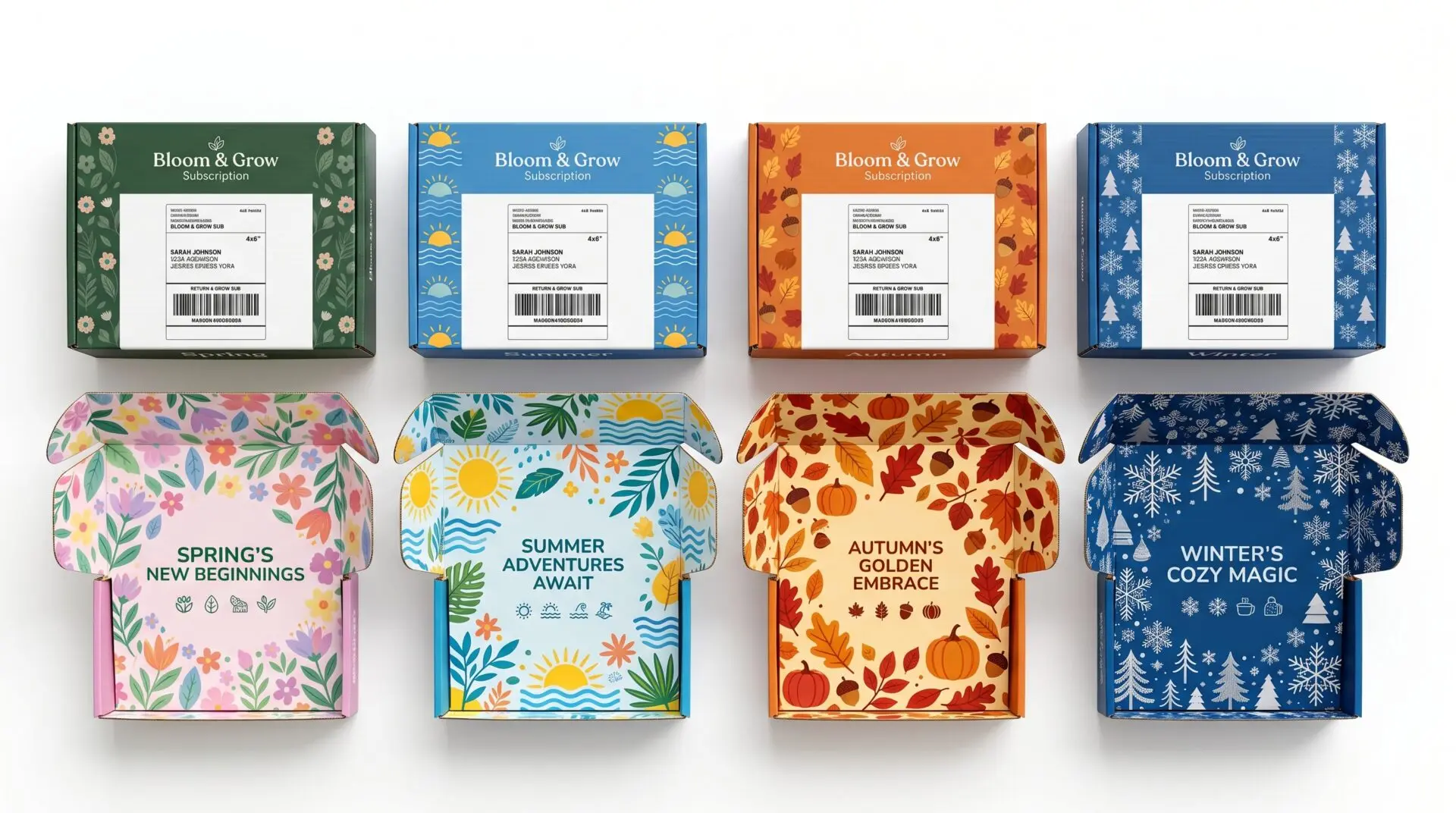
⚠ Three Design Mistakes That Undo Expensive Subscription Box Work
Mistake 1: Brand elements placed where the carrier label lands. The carrier label on a standard mailer box goes on the top panel — approximately 148×105mm (A6) in the upper right or centre. If your brand design places the primary logo, key imagery, or key copy in this zone, the carrier label covers it. We reserve the carrier label zone in every subscription box design at proof stage.
Mistake 2: Oversized boxes relative to contents. A subscription box with excessive void space communicates over-packaging. It also increases courier fees and material costs. We size subscription boxes to typical monthly contents — not to the largest possible scenario.
Mistake 3: Identical interior artwork for 12+ months. A subscriber receiving the same interior print month after month loses the sense of discovery. Seasonal interior rotation (four per year minimum) prevents this habituation and reduces churn.
Rotating Interior Artwork — the Retention Strategy Inside the Lid
Seasonal or quarterly interior artwork rotation is the lowest-cost retention intervention available. The outer box remains consistent for brand recognition, while the interior changes quarterly to keep the discovery feeling alive.
Manchester pet subscription: four seasonal interior rotations per year. Average subscriber retention grew from 7.2 months to 11.4 months. That's £218 additional lifetime value per subscriber — from a £0.10/unit interior print change.
Personalised Variable Print — Subscriber-Level Retention
Variable printing applies subscriber-specific data — name, subscription month number, personalised message — to a standard template. A card that says "Hi Sarah — welcome to your 4th box!" treats the subscriber as a person, not a number.
Recurly research: perceived value is the top voluntary churn driver. London craft subscription: personalised variable interior — 3-month churn 22% → 14%, unboxing social posts +240%.
Three Subscription Models and Why Each Needs a Different Box Specification
The UK subscription market divides into three models that have fundamentally different packaging requirements. Specifying the wrong box format for your subscription model is one of the most common and most preventable packaging errors we see. Here's what each requires and why.
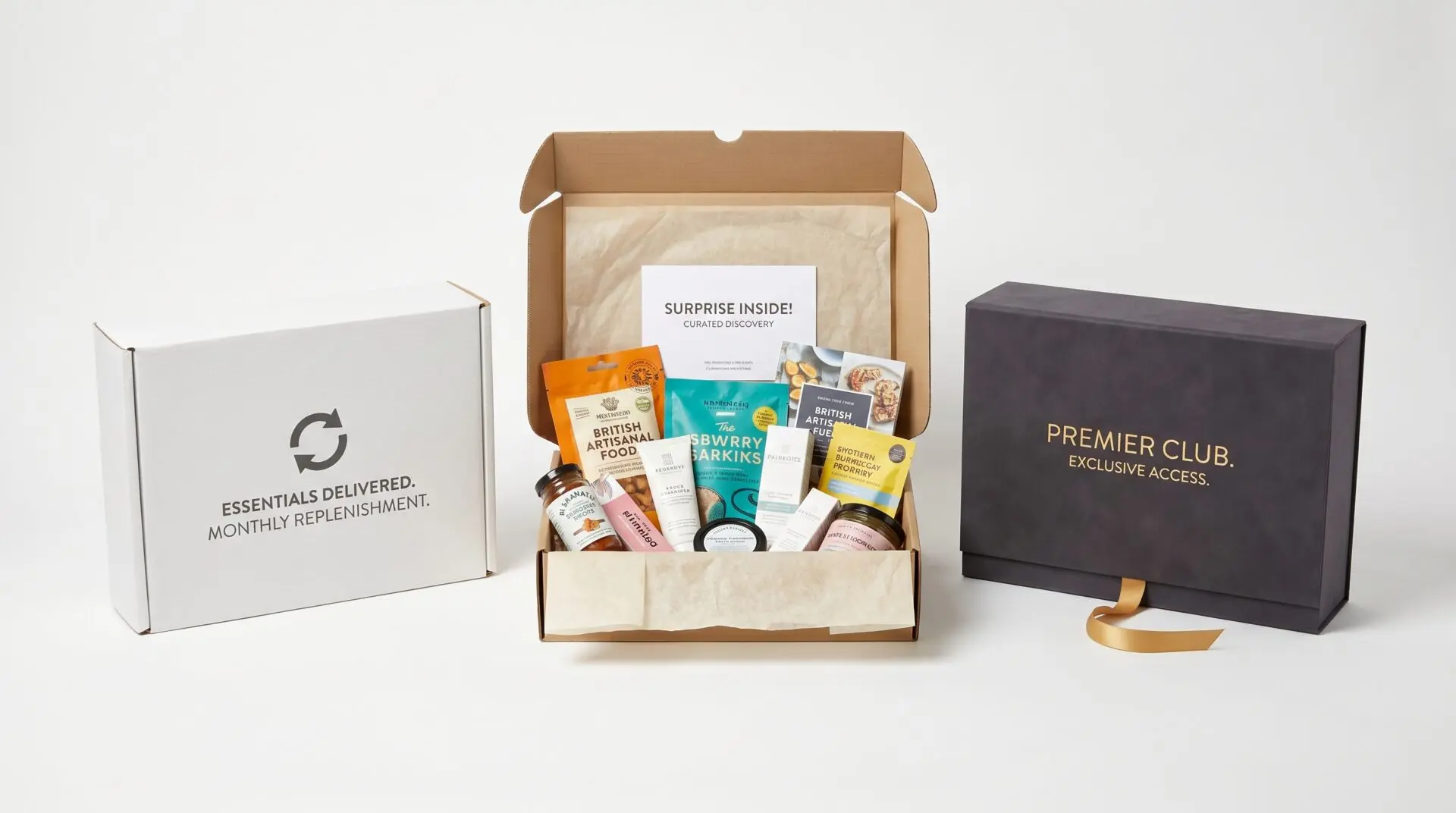
Replenishment Subscription
Same product, delivered on schedule — supplements, coffee, dog food, household staples, pet treats, razors
The subscriber knows what they're getting. The packaging's job is functional efficiency and consistent brand reinforcement. The box must protect the product, arrive looking brand-consistent every time, pack quickly, and sit in the correct courier band.
Packaging Specification for Replenishment:
Box type: Standard mailer or crash-lock — prioritise packing speed
Interior: Consistent branded message
Courier band: Critical — optimise for lowest cost at volume
Colour accuracy: Delta-E under 3 every run
Categories: Supplements, coffee, pet food, personal care, household
Curation Subscription
Curated selection, monthly discovery — beauty boxes, food discovery, book clubs, lifestyle, craft, wellness
The subscriber doesn't know exactly what's inside. The packaging must amplify the discovery experience. This is where interior print, tissue paper, personalised cards, and seasonal rotation do the most work.
Packaging Specification for Curation:
Box type: Premium mailer with interior print
Interior: Rotating seasonal artwork + surprise reveal
Inserts: Personalised card, surprise insert, tissue paper
Seasonal rotation: Minimum quarterly
Categories: Beauty, food discovery, lifestyle, books, craft, wellness
Access / Premium Subscription
Membership access to premium or exclusive product — luxury brands, fine wine clubs, jewellery, limited editions
The subscriber is paying for exclusivity. The packaging must communicate premium positioning and make the subscriber feel they belong to a higher tier. Rigid boxes, soft-touch, gold foil, and retainable design are common here.
Packaging Specification for Access:
Box type: Rigid lid-and-base or magnetic closure
Finish: Soft-touch, gold foil, emboss
Interior: Velvet/foam insert, ribbon pull-tab
Retain: Designed to be kept as storage/display
Categories: Fine wine, luxury beauty, jewellery, collector, limited editions
Subscription Box Sustainability EPR, OPRL, CMA, and What Eco Subscribers Actually Expect
90% of UK consumers prefer eco-friendly packaging. 39% have switched brands because of poor sustainability in packaging. For subscription brands, where the box arrives in a subscriber's home every month, sustainability is not an optional positioning — it is a recurring statement of brand values, made tangible twelve times a year.
UK Subscription Packaging Sustainability Timeline
CMA Enforcement Active
Greenwashing claims on packaging now carry a fine risk of 10% of global annual turnover. "Eco-friendly subscription box" without evidence is legally exposed.
UK pEPR Fees Live
Extended Producer Responsibility fees now apply. Subscription brands above £1m turnover / 25+ tonnes must register and report packaging. Corrugated = lowest base fee tier.
Simpler Recycling — England
All UK councils must provide weekly paper and card recycling collection. Subscribers receiving corrugated subscription boxes can now kerbside-recycle them universally across England from this date.
RAM Eco-Modulated EPR Fees
Green RAM packaging = lowest EPR fees. Amber packaging = higher fees. At subscription volumes (10,000+ boxes/month), the cost difference between Green and Amber RAM is material annually.
Mandatory OPRL Labelling
OPRL recycling label becomes mandatory for all packaging. Every subscription box we produce already carries the correct OPRL label — eliminating this mandatory reprint cost from October 2027 onwards.
CMA Greenwashing — What Your Subscription Box Can and Cannot Say
✗ "Eco-friendly subscription box" — vague, no evidence
✗ "100% recyclable" on any laminated corrugated box — false
✗ "Sustainable packaging" without verification — undefendable
✓ "Made from FSC certified paper" — with CoC certificate number
✓ "Kerbside recyclable" on plain or aqueous-coated corrugated
✓ OPRL "Recycle" label on corrugated without film laminate
✓ "Plastic-free packaging" where no plastic components are used
FSC Certification — What Subscribers Recognise and Retailers Require
FSC Chain of Custody certification is the independently verified standard for responsible forest sourcing. For subscription brands listing in Planet Organic, Whole Foods, or positioning to eco-conscious subscribers, FSC CoC is the certification that a "sustainable packaging" claim requires.
FSC certified subscription boxes: +7% over base board cost. Full CoC documentation supplied with every FSC order at no charge. FSC logo use must follow FSC trademark guidelines — we apply these correctly to every FSC order.
The Plastic-Free Subscription Box — All Paper, All Kerbside
A plastic-free subscription box is achievable without compromise on protection or brand quality: corrugated mailer (no tape — crash-lock) + paper crinkle or honeycomb void fill + tissue paper wrapping + paper insert cards. No plastic at any stage. Kerbside recyclable. OPRL "Recycle" label. Green RAM. Under CMA Green Claims Code, "plastic-free" is a verifiable, specific claim — defensible if accurate. We confirm the absence of plastic components at every stage and supply a plastic-free specification declaration with orders.
UK Subscription Box Categories - What Each Needs From Its Packaging
After 15 years and hundreds of UK subscription brands, the packaging requirements differ meaningfully by category. Here's what actually matters for each.
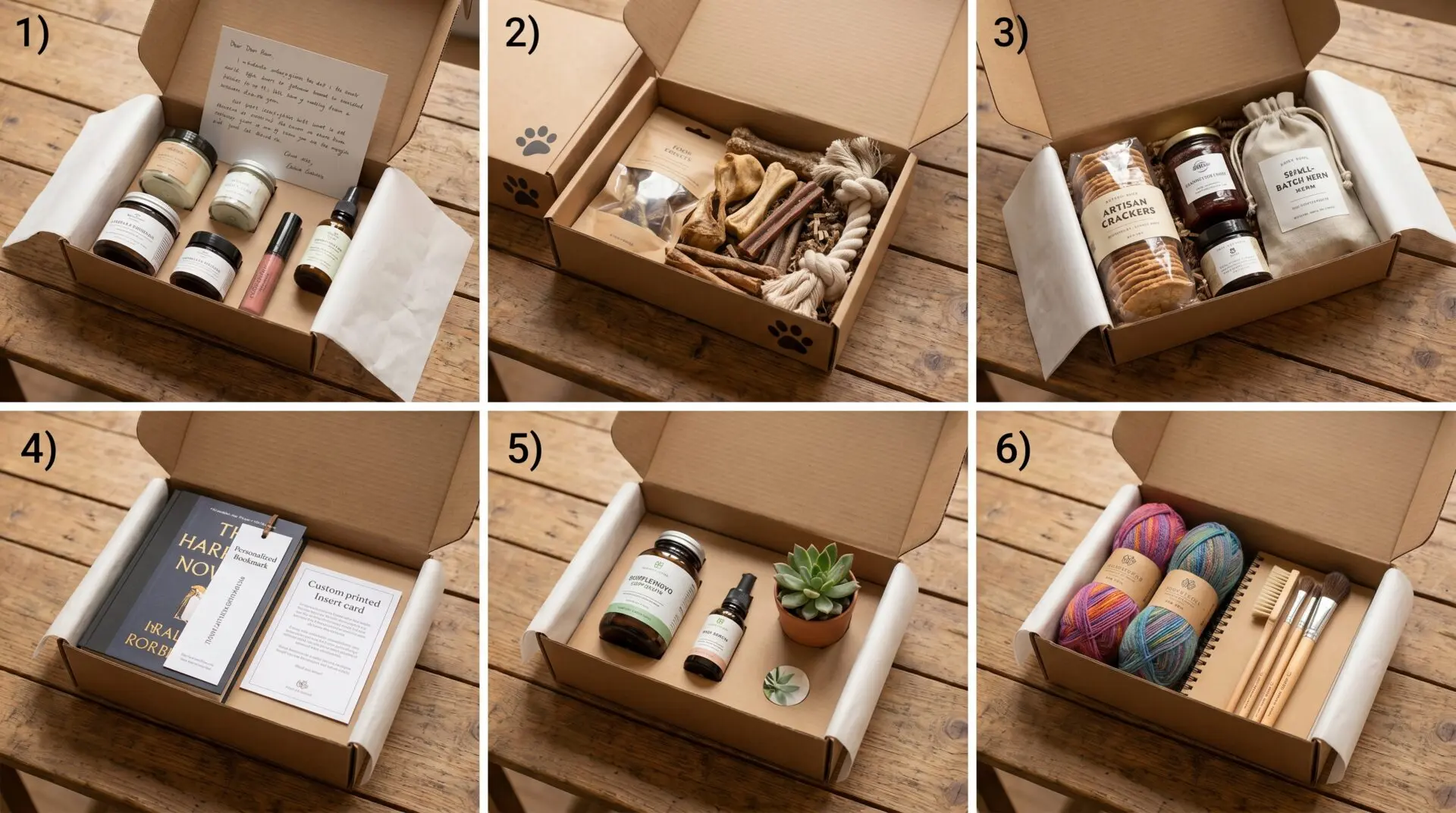
Beauty and Skincare
Largest UK subscription category
Premium mailer box with interior print is the category standard. E-flute for most contents; B-flute if liquids are included. Personalised insert card, seasonal interior rotation, and tissue paper are essential. Soft-touch for premium tiers. Highest social sharing rate — invest in strong interior print.
Pet Subscription
Fast-growing — 51% of UK adults own a pet
B-flute for heavier contents. Personalised with pet name (highest ROI). Fun, colourful exterior. Surprise insert (bonus treat/toy) drives repurchase. FSC certified board for eco-conscious pet owners.
Food and Drink Discovery
Second largest UK category
Food-grade board required. Compartmentalised inserts for multi-item kits. B-flute minimum for heavier items. Allergen labelling and age verification (for alcohol) handled as standard.
Book Clubs and Stationery
High loyalty, literary niche
Letterbox-format where possible to save on courier costs. Themed interior print and personalised curator note are highly valued. Kraft eco aesthetic works well for literary brands.
Wellness and Health
Health, fitness, supplements, mindfulness
Replenishment (supplements) needs consistency and courier optimisation. Curation wellness needs strong unboxing experience. Foam inserts for glass bottles. Eco credentials (FSC + aqueous coating) are important.
Craft and Hobby
Creative kits, art supplies, DIY
Multi-item kitting with partitions. Instruction card is critical. Colourful, inspiring print. Seasonal themes perform very well in craft subscriptions.
How to Order Your Subscription Boxes and How We Manage Monthly Production
What we need: your subscription type (replenishment/curation/access), typical monthly contents and weight, courier used, current or target monthly volume, box format preference, and finish requirements. We return: courier-band-optimised dimensions, board grade, interior print design support, OPRL label, RAM rating, and firm price within 2 hours.
Courier Band + Spec
Day 1 — 2 hours: Share subscription type, typical contents and total parcel weight, courier used, current volume, and format preference. We confirm: courier-band-optimised box dimensions, board grade (E-flute vs B-flute vs letterbox), OPRL label, RAM rating, EPR data if volume exceeds 1,000 units/month, and firm price. Letterbox format: physical contents test arranged if required.
Artwork + Proof
Days 1–2: Send logo and brand assets. We produce a dieline-accurate digital proof showing: exterior CMYK, interior print with carrier label zone reserved and clearly marked, OPRL label applied. Proof within 24–48 hours. We review the carrier label placement zone and flag any design elements that need to move. Unlimited free revisions. Seasonal variants: same dieline, new interior artwork only — 24-hour proof per variant.
UK Production
Days 3–9: 7–10 working days from written artwork approval. Dimensions: ±0.5mm on all panels. Colour accuracy: Delta-E under 3 every run — essential for subscription consistency. Pantone colours locked permanently for all subsequent monthly runs. Letterbox boxes: depth confirmed on assembled samples before dispatch.
Delivery + Monthly Schedule
Day 9–10 + ongoing: Free UK shipping every order. Flat-packed for warehouse storage efficiency. We manage monthly production schedules — you tell us your dispatch date, we work back the production calendar and confirm delivery ahead of your packing window. Seasonal interior variants planned quarterly.
⚡ Monthly Dispatch Deadline?
Standard: 7–10 working days. If your monthly dispatch date is approaching: contact us immediately — honest answer within the hour. We manage monthly production calendars for 40+ UK subscription brands. If your subscriber growth is accelerating and you're concerned about lead times scaling, talk to us now — we stock base boards for established recurring subscription clients to reduce lead time to 5–6 working days.
Monthly reorders: 2 minutes to production. Your dieline, board grade, courier-band-confirmed dimensions, OPRL label, Pantone locks, and carrier label zone are permanently stored. Seasonal interior variant reorders use the same dieline — only the interior artwork is new. No rebrief, no reproof on unchanged elements. Consistent colour and dimensions across every monthly run. Delta-E under 3 guaranteed on every production run for every subscription brand we supply.
Subscription Box Pricing UK - All Formats, All Quantities
All prices include courier-band dimension confirmation, OPRL-correct label, interior print, and free UK shipping. No minimum order. No setup fee on standard dimensions. Courier-band optimisation consultation at quote stage for all subscription brands — no extra charge.
Standard Subscription Mailer Box — E-Flute, CMYK Exterior + Interior, Courier-Band Sized
| Qty | E-Flute Plain CMYK ● Green RAM | + Interior Print | + Aqueous Coat ● Green RAM | + Matte Lam ● Amber RAM | + Soft-Touch ● Amber RAM |
|---|---|---|---|---|---|
| 50–99 | £4.20 | £4.56 | £4.72 | £4.92 | £5.40 |
| 100–249 | £2.20 | £2.42 | £2.54 | £2.68 | £2.96 |
| 250–499 | £1.48 | £1.64 | £1.72 | £1.84 | £2.04 |
| 500–999 Popular | £1.12 | £1.24 | £1.30 | £1.40 | £1.58 |
| 1,000–2,499 | £0.92 | £1.02 | £1.08 | £1.16 | £1.32 |
| 2,500–4,999 | £0.72 | £0.80 | £0.84 | £0.92 | £1.04 |
| 5,000–9,999 | £0.56 | £0.62 | £0.66 | £0.72 | £0.82 |
| 10,000+ Best Value | £0.38 | £0.44 | £0.46 | £0.52 | £0.60 |
Specialty Formats — Letterbox, Corrugated Shipper, Rigid Premium, Crash-Lock
| Qty | Letterbox Format (E-flute, ≤25mm) | Corrugated Shipper (B-flute) | Crash-Lock Self-Locking | Rigid Premium (2mm + insert) |
|---|---|---|---|---|
| 50–99 | £4.80 | £5.20 | £4.40 | £14.60 |
| 100–249 | £2.56 | £2.80 | £2.36 | £9.80 |
| 250–499 | £1.72 | £1.90 | £1.58 | £7.20 |
| 500–999 Popular | £1.32 | £1.46 | £1.20 | £5.60 |
| 1,000–2,499 | £1.08 | £1.20 | £0.98 | £4.40 |
| 2,500+ Best Value | £0.78 | £0.88 | £0.72 | £3.40 |
All prices include courier-band review, interior print (mailer box formats), OPRL-correct label, and free UK shipping. No minimum order. Custom dimensions: standard on mailer boxes, no tooling charge. Windowed boxes: +£0.08–£0.18 + £120–£280 tooling. B-flute corrugated vs E-flute: +£0.14–£0.22/box. Crash-lock: +£0.12–£0.20/box vs standard mailer. FSC certified: +7%. Personalised variable print insert cards: from £0.12/card at 500. Tissue paper: from £0.04/sheet. Paper void fill: from £0.06/box. Foam insert: from £0.28/box. Seasonal sleeve: from £0.08/sleeve at 2,000. No minimum order on any format or accessory.
The Courier Band Saving That Pays for Everything Else
Edinburgh wellness brand: letterbox-format mailer at 24mm collapsed depth vs original 28mm. Annual courier saving: £73,920. Box cost increase: nil — the letter-box format is the same price as a standard mailer. The entire cost of switching to interior print, personalised insert cards, tissue paper, and seasonal rotation was covered by the courier band saving in the first two months. The conversation about courier band optimisation is the first one we have. It is usually the most valuable.
Subscription Boxes UK — Frequently Asked Questions
What is the minimum order for custom subscription boxes UK?
No minimum order on every type — standard mailer box, letterbox-format mailer, corrugated B-flute shipper, crash-lock self-locking mailer, rigid premium box, kraft eco mailer, subscription sleeve set, and windowed subscription box. Free UK shipping on every order any quantity. Courier-band dimension optimisation, interior print design review, and OPRL-correct label are all included as standard at no extra charge. Custom dimensions are standard on all subscription boxes — no tooling charge for mailer boxes. One-time tooling of £120–£280 applies only to die-cut formats (windowed, custom apertures) and is permanent — free on all reorders.
How do I know if my subscription box qualifies for Royal Mail large letter pricing?
Royal Mail large letter maximum dimensions are 353×250×25mm and 750g. The 25mm depth limit is measured on the sealed and fully packed parcel — not the empty box. An E-flute box wall is approximately 1.5mm thick. Two walls (lid + base) add approximately 3mm to the packed parcel depth. A box designed at 22mm internal depth may measure 25–26mm when sealed with typical contents. We test the letterbox-format box with your typical monthly contents before confirming the dimension specification. Edinburgh wellness brand: redesigned from 28mm to 24mm collapsed depth — annual Royal Mail saving £73,920 on 2,800 monthly shipments. That 3mm change cost nothing.
Does subscription box packaging really affect subscriber churn?
Yes — with specific, measurable data. Recurly's subscriber research identifies perceived value and customer experience as the primary drivers of voluntary subscription churn — above price. 60% of consumers say they will not repurchase from a brand after receiving a poorly packaged order (Dotcom Distribution 2024). 45% of subscribers want surprise inserts. 68% of premium shoppers are more likely to repurchase from brands that include unexpected additions. Manchester pet subscription brand: seasonal rotating interior artwork four times per year — average subscriber retention grew from 7.2 months to 11.4 months. At £52 average monthly spend, that is £218 additional lifetime value per subscriber, driven by a £0.10/unit interior print change.
What board grade should I use for a subscription box with fragile glass contents?
B-flute corrugated (3mm) is the minimum for subscription boxes containing glass bottles, ceramics, or other fragile items sent through Evri or DPD automated sortation — not E-flute (1.5mm). Evri automated sortation centres handle packages with conveyor belt drops of 40–80cm. E-flute does not provide sufficient crush resistance for glass in these handling conditions. Add an EVA foam insert cut to the bottle's external body dimensions at ±0.5mm tolerance — the foam prevents all lateral movement and absorbs impact. Manchester fragrance subscription: precision EVA foam insert plus B-flute corrugated — zero glass breakage in 18,000 consecutive shipments, return rate -24%. We specify foam grade (30–80 kg/m³) by bottle weight at quote stage.
What finish should I choose for my subscription box to keep EPR fees low from October 2026?
All corrugated board — E-flute, B-flute, C-flute, double-wall — rates Green RAM under the UK EPR Recyclability Assessment Methodology, regardless of CMYK print or aqueous coating. This is the lowest fee tier from October 2026. Adding film laminate (matte, gloss, or soft-touch) changes the rating to Amber — a higher fee tier. For high-volume subscription brands shipping 5,000+ boxes/month, the EPR cost difference between Green and Amber RAM across approximately 15 tonnes of packaging per year is material. We provide the RAM rating and EPR data for every subscription box specification at quote stage. Plain CMYK with interior print on corrugated is our recommended specification for brands prioritising both unboxing quality and Green RAM.
How does Evri dimensional weight pricing work for subscription boxes?
Evri applies dimensional weight pricing: volumetric weight = length × width × height (in mm) ÷ 5,000. The higher of actual parcel weight and volumetric weight is charged. A subscription box at 350×250×150mm with a 300g parcel weight has a volumetric weight of 350×250×150 ÷ 5,000 = 2.625kg — Evri charges 2.625kg, not 0.3kg. This can push a lightweight subscription parcel into a significantly higher price band than expected. We calculate the volumetric weight of your proposed box dimensions before confirming the specification for any brand using Evri. If volumetric weight exceeds actual weight by more than 50%, we recommend dimension reduction. Tell us your courier and typical total parcel weight at quote stage.
How long do subscription boxes take to produce?
Standard: 7–10 working days from written artwork approval. Standard and crash-lock mailer boxes: 7–10 working days. Letterbox-format mailers (with packing test): 7–10 working days + 1–2 days if physical contents test is required. B-flute corrugated shippers: 7–10 working days. Rigid premium boxes: allow 2–3 additional working days. Seasonal interior variants using locked dieline: 24-hour proof, then 7–10 working days. Personalised variable print insert cards: 5–7 working days from subscriber data file. Monthly reorders with locked artwork and confirmed specification: 6–8 working days. Digital proof: 24–48 hours from brand asset submission. We manage monthly production calendars for 40+ UK subscription brands — tell us your monthly dispatch date and we work back the production schedule.
Why should I use a crash-lock mailer instead of a standard tape-close box?
The crash-lock (auto-bottom) base locks automatically when pressed into shape — no tape required at the base. The self-locking tuck lid holds without tape. The difference in assembly time is approximately 8–12 seconds per box versus a tape-close format. Bristol food subscription brand: switch from tape-close to crash-lock self-locking — packing time per box from 42 seconds to 17 seconds. Across 6,000 boxes/month: 41.6 hours of fulfilment labour saved every month. That saving paid for the box upgrade in the first month. The crash-lock also eliminates plastic tape from the packaging entirely — supporting a plastic-free claim and Green RAM rating (tape is a plastic component affecting RAM assessment).
Can I print "eco-friendly" or "recyclable" on my subscription box?
Only if the claim is specific and verifiable. Under CMA enforcement powers from April 2025 (DMCC Act 2024), vague eco claims carry a fine risk of up to 10% of global annual turnover. Exposed claims: "eco-friendly subscription box," "100% recyclable" on any laminated box, "sustainable packaging" without certification. Defensible claims: "Made from FSC certified paper" with CoC number, "Kerbside recyclable" on plain or aqueous-coated corrugated, "Plastic-free packaging" where accurate. We apply only verifiable claims, supply FSC CoC documentation with all FSC orders, and will not print a claim we cannot document.
What is the carrier label zone and why does it matter for subscription box design?
The carrier label (Royal Mail, Evri, DPD) is applied to the top panel of a standard mailer box — typically approximately 148×105mm (A6) in the upper right or centre of the lid. If your brand design places the primary logo, key artwork, or critical copy in this zone, the carrier label covers it. The subscriber receives a box that looks masked or damaged before opening — a poor first impression that directly affects the unboxing emotional response. We reserve the carrier label zone at proof stage on every subscription box design and work brand elements around it. This is standard practice — not an extra service. We mark the carrier label zone clearly on the digital proof so you can see exactly what will be covered before production approval.
How do I manage seasonal interior artwork rotation without reprinting the outer box?
Two approaches: rotating interior print on the locked outer dieline (same exterior, new interior artwork per season — the most common approach), or a printed outer sleeve over a plain inner tray (sleeve changes seasonally; inner tray unchanged). Seasonal interior rotation on a locked dieline: 24-hour proof on new artwork, 7–10 working days production, same price as standard run. No dieline change. No rebrief. Only the interior artwork is new. Outer sleeve seasonal variant: from £0.08/sleeve at 2,000 units — approximately 15–25% of the cost of a full box reprint. Manchester pet subscription: four seasonal interior rotations per year — subscriber average retention 7.2 → 11.4 months. At £52/month average spend, that's £218 additional lifetime value per subscriber per year.
What happens to my subscription box spec and artwork between monthly runs?
Permanently stored — everything. Your dieline, courier-band-confirmed dimensions, board grade, interior print artwork, OPRL label, all Pantone colour locks, carrier label zone position, and foam insert specification (where applicable) are stored permanently after first production approval. Monthly reorders are identical to the approved first run — same dimensions, same colour, same finish. We never substitute specification without written approval. Colour accuracy Delta-E under 3 is guaranteed on every monthly production run — essential for subscription brand consistency where the same subscriber sees your box every month. If your content weight changes between months, tell us — we model the courier band impact before the next production run.
Five UK Subscription Brands — What They Changed and What It Cost Them Not To
Fiona C. — Wellness Subscription
Edinburgh · Letterbox format · 2024
"We were shipping 2,800 wellness subscription boxes a month. Our mailer measured 270×180×28mm collapsed. We had never checked what that meant for Royal Mail pricing. When we came to Wabs Print and told them our box dimensions, the first thing they did was calculate our courier pricing band. They told us we were 3mm above the Royal Mail large letter limit. Not 30mm. Three millimetres. The difference between large letter and small parcel pricing was £2.20 per delivery. Multiplied by 2,800 a month and 12 months: £73,920 a year going on 3mm of unnecessary box depth. They redesigned the box to 270×180×24mm collapsed — same design, same contents, same courier. Confirmed our typical monthly packing at 24mm sealed. Approved. Switched. The first month's saving covered 14 months of increased box cost had there even been any. There wasn't. The letterbox box costs the same as the original."
Measurable Outcomes
Annual courier saving: £73,920 · Dimension change: 28mm → 24mm collapsed depth · Box cost increase: nil · Change required: 1 dimension on the dieline · Time to implement: 10 working days
Claire B. — Food Discovery Subscription
Bristol · Crash-lock self-locking · 2024
"We were packing 6,000 subscription boxes a month with a team of three. Every box required a tape gun for the base and a tuck for the lid. We'd timed it — 42 seconds per box average including the tape step. Wabs Print asked about our packing setup at the quote stage. They asked how long a box took to assemble. When we told them 42 seconds they immediately suggested the crash-lock self-locking mailer. Pre-glued base that auto-locks when you press it into shape. Self-locking tuck lid. No tape anywhere. We timed it again after switching: 17 seconds. That's 25 seconds saved per box across 6,000 boxes a month — 41.6 hours of packing labour saved every month. At our fulfilment cost that's over £500 a month in labour, every month, from a box that cost the same as the original. The crash-lock also meant we could make a plastic-free packaging claim — no tape component. Our eco-conscious food subscribers noticed and we had the FSC documentation to back it up."
Measurable Outcomes
Packing time: 42s → 17s per box · Labour saved: 41.6 hours/month across 6,000 boxes · Monthly cost saving: £500+ · Plastic-free claim achieved: no tape · Box cost change: nil
James O. — Pet Subscription Brand
Manchester · Seasonal rotation + personalised insert · 2023
"Our average subscriber was staying for 7.2 months. Good, but not great. We knew churn was accelerating around months four to six. When we talked to Wabs Print about the box they asked something nobody had asked before: does the interior of your box change? No, we said. Same interior every month, twelve months a year. They explained what research showed — subscribers who receive the same interior print stop noticing it by month three. The discovery feeling that made them subscribe in the first place disappears. They suggested four seasonal interior variants per year on the locked outer box dieline. Same exterior, same courier-band dimensions. Just the interior artwork changes each quarter. We added a personalised insert card with the subscriber's pet name from our CRM. 'Woof! This one's for Max!' type messaging. The 12-month average retention went from 7.2 months to 11.4 months. That's 4.2 months of additional subscription per subscriber. At £42 average monthly spend, that's £176 additional lifetime value per subscriber. We have 2,200 active subscribers. The maths: £387,200 additional annual revenue. From a quarterly interior print change and a £0.14 personalised insert card."
Measurable Outcomes
Average retention: 7.2 → 11.4 months · Additional LTV per subscriber: £176 · Interventions: quarterly interior rotation + personalised insert card · Additional revenue (2,200 subs): £387,200/yr · Insert cost: £0.14/box
Amir T. — Craft Subscription Brand
London · Variable personalised print + interior · 2024
"Our three-month churn rate was 22 percent. Nearly one in four subscribers leaving by month three. We were spending heavily on acquisition to replace them. Wabs Print reviewed our entire box and asked: does the subscriber know you know who they are? They didn't. We had 1,400 subscribers. The box was identical for all 1,400. Same exterior, same interior, same insert card, no personalisation whatsoever. Wabs Print proposed variable data printing on the interior panel: the subscriber's name in our handwriting-style brand font, plus the message 'Box 3 of your craft journey — you're getting good at this.' Every subscriber received a unique interior. The print run was a single production pass with the subscriber data file we exported from our CRM. Cost per box: £0.12 more. Three-month churn rate in the following two quarters: 14 percent. That's 8 percentage points of churn reduction. At our average subscriber value, that reduction was worth roughly £18,000 per quarter in retained revenue. Unboxing social posts in the same period were up 240 percent — subscribers photographing and posting because their name was in the box. Not because we asked. Because the box was worth sharing."
Measurable Outcomes
3-month churn: 22% → 14% · Social sharing: +240% · Retained revenue: +£18,000/quarter · Variable print cost: +£0.12/box · Method: personalised interior variable data printing from CRM export
Rebecca M. — Beauty Subscription Brand
Leeds · Full spec rebuild — dimensions + interior + personalisation + eco · 2023–2024
"We came to Wabs Print with four problems we hadn't connected. One: our Evri shipping cost was higher than expected. Two: our average subscriber was leaving before month six. Three: our unboxing videos were non-existent despite us asking subscribers to share. Four: our eco-conscious subscribers were contacting us about our packaging not matching our brand values. Wabs Print ran through every dimension, every decision, and every claim we were making on the box. The courier issue: our box was triggering dimensional weight pricing on Evri — we were paying for 2.6kg volumetric weight on parcels that actually weighed 380g. They resized the box to bring the volumetric weight under our actual weight. Saving: £1.80 per delivery on 3,400 monthly shipments — £73,440 a year. The churn issue: we had no interior print, no personalised card, no tissue. Every box looked like a shipping container that happened to contain beauty products. We added interior print, seasonal rotation quarterly, and a personalised card with the subscriber's skin type from our quiz data. Retention average: from 5.8 months to 9.1 months. The unboxing issue: once the interior existed, subscribers started sharing it. Social posts with our box up 320 percent. The eco issue: we switched to FSC certified corrugated with aqueous coating. OPRL changed to Recycle. We replaced the 'eco-friendly packaging' claim on the exterior with 'Made from FSC certified paper' and the certified CoC number. No more subscriber complaints. Planet Organic listed us two months later."
Measurable Outcomes — Four Problems, One Specification Rebuild
Courier saving: £73,440/yr (dimensional weight correction) · Average retention: 5.8 → 9.1 months · Social sharing: +320% · OPRL: "Check local" → "Recycle" · FSC certified: Planet Organic listing achieved · CMA-exposed claim removed: no subsequent issues
Our Numbers — Every Subscription Box, Every Month
Complete Your Subscription Packaging System
Most subscription brands use 3–5 additional packaging products alongside their core subscription box. Here is what our subscription box customers order most frequently.
Corrugated Boxes UK
Outer transit cases and shipping outers for subscription fulfilment warehouses. FEFCO standard or bespoke. FSC certified.
View Products →
Custom Boxes UK
Gift boxes, premium D2C boxes, and rigid keepsake boxes for access subscription tiers. Any format, any finish.
View Products →
Custom Labels and Stickers
Branded sticker seals, surprise insert stickers, address labels, personalised thank-you labels. No minimum. Die-cut.
View Products →
Kraft Boxes UK
FSC certified unbleached kraft for eco subscription brands. Kerbside recyclable, Green RAM, OPRL Recycle label.
View Products →
Sleeve Boxes UK
Seasonal outer sleeves over subscription boxes for design rotation without reprinting. From £0.08/sleeve. 7–10 days.
View Products →
Branded Tissue Paper
Branded or plain colour tissue paper for the gift moment inside every subscription box. Kerbside recyclable. No minimum.
View Products →
Get Your Subscription Box Quote — Free. Within 2 Hours.
After 15 years and 8,500+ UK businesses, subscription box packaging is the category where we most consistently find brands paying significantly more in courier fees than they need to, losing subscribers to a churn problem that a rotating interior print and a personalised insert card could largely solve, and printing eco claims on their boxes that CMA enforcement powers have made legally risky since April 2025.
The first conversation we have is about your courier — Royal Mail or Evri or DPD, your typical monthly parcel weight, and your current box dimensions. In most cases, we can identify a courier band saving in that conversation. Everything else — interior print, seasonal rotation, personalisation, sustainability — builds on dimensions that work. Tell us your courier and your box size. We'll tell you what it's costing you.
⚡ Monthly dispatch deadline approaching? Standard is 7–10 working days. Contact us immediately — honest answer within the hour. We manage monthly production calendars for 40+ UK subscription brands.
📞 0800 XXX XXXX · 📧 sales@wabsprint.co.uk · Mon–Fri 8:30am–5:30pm
Wabs Print & Packaging· Since 2008
Corrugated Boxes · Custom Boxes · Kraft Boxes · Retail Boxes · Sleeve Boxes · Cosmetic Boxes ·