

Corrugated Boxes UK
RSC · Crash-Lock · Double-Wall · Shelf-Ready · Litho-Laminate Printed · No Minimum · Free UK Shipping
A Manchester e-commerce brand was spending £0.62 per shipment on courier dimensional weight surcharges. Their corrugated box was 400×300×300mm. The product inside was 290×200×160mm. The difference between those two sets of numbers — 110mm of void space in each dimension — was costing them £4,680 per year in excess courier charges, plus £1,200 in void fill material. We right-sized the corrugated box to 310×210×175mm. Courier dimensional weight charges: eliminated. Void fill: eliminated. Annual saving: £5,880. The box cost 8 pence more per unit. The saving was 71× the packaging cost increase. This is what corrugated box specification actually means in practice.
After 15 years and 8,500+ UK businesses, corrugated boxes are the single product category where specification decisions have the most direct impact on cost — not packaging cost, but total landed delivery cost. The wrong flute. The wrong wall construction. The wrong internal dimension. All of these cascade into courier charges, damage rates, void fill spend, EPR data weight, and warehouse storage efficiency. We quote every corrugated box with the specification that's correct for your product and courier network, not the cheapest box that fits.
What Are Corrugated Boxes UK — Structure, Strength, and Why Specification Matters
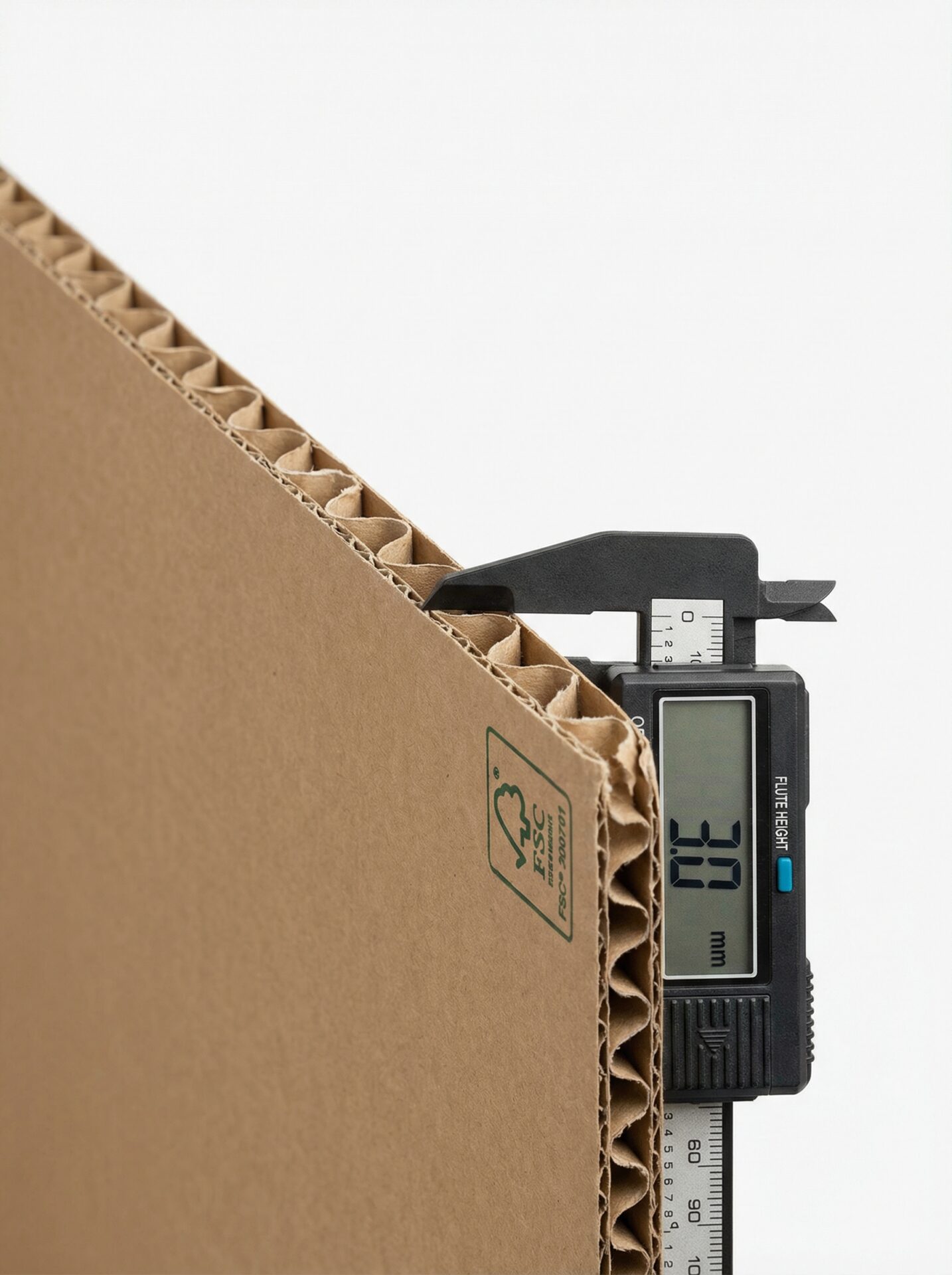
Corrugated boxes are made from corrugated board — a sandwich of two flat linerboards with a fluted (wave-shaped) medium between them. This structure creates rigid air columns between the liner and medium, which is what gives corrugated boxes their exceptional strength-to-weight ratio. The board resists compression from above (stacking strength), impact from the side (crush resistance), and puncture from external objects — without adding the weight or material cost of solid board or wood. Corrugated board is the most widely used packaging material in the world, making up the vast majority of transit packaging for food, FMCG, e-commerce, and industrial goods.
The UK corrugated board packaging market is valued at £11.67 billion in 2026, projected to grow at a CAGR of 3.90% through 2033. E-commerce is the fastest-growing segment within this at a 4.73% CAGR, driven by the fact that online retail reached 27.8% of total UK sales in 2025 — up 15.8% year on year — and that online retail requires approximately 30% more protective packaging per parcel than traditional retail channels. The food and beverage industry accounts for 35.63% of UK corrugated packaging demand. Slotted box styles — the standard Regular Slotted Container (RSC) and its variants — represent 42.43% of the market.
The specification of a corrugated box — flute grade, wall construction, box style (FEFCO code), internal dimensions, and print method — determines far more than just whether the product arrives in one piece. It determines courier dimensional weight charges, void fill spend, stacking height in your warehouse, EPR reporting weight, damage rate, return rate, and the unboxing experience that 78% of UK consumers photograph and share on social media. UK courier damage rates average 2–4%, costing e-commerce businesses £2.8 billion annually in returns and replacements. In most cases, the damage is caused not by excessive abuse in transit, but by boxes that are the wrong size, the wrong flute, or the wrong wall construction for the product they're carrying.
Why EPR is now making corrugated boxes the lowest-cost structural packaging option: From April 2025, UK Extended Producer Responsibility fees apply to all packaging producers above threshold. Corrugated board is assigned a Green Recyclability Assessment Methodology (RAM) rating — the lowest EPR fee band. Plastic alternatives carry significantly higher EPR fees. From 2026, RAM modulation makes this difference materially larger. For any UK business evaluating plastic vs corrugated for transit packaging, EPR fees now make the corrugated choice cheaper by £200+ per tonne annually before any other consideration.
Real Example: The £5,880 Annual Saving From Right-Sizing a Corrugated Box
Manchester e-commerce brand, 2024. Box: 400×300×300mm RSC. Product: 290×200×160mm. Void space: 110mm per dimension. Result: constant dimensional weight surcharges from Evri, £1,200/year void fill material spend.
Right-sized to 310×210×175mm: Dimensional weight surcharges eliminated. Void fill eliminated. Annual saving: £5,880. New box cost: +£0.08/unit. ROI: 71× the packaging cost increase in year 1.
UK Corrugated Market 2026
£11.67bnUK corrugated packaging market (2026)
4.73%E-commerce corrugated CAGR — fastest segment
42.43%Market share of slotted box styles (2025)
74.3%UK household corrugated recycling rate
£2.8bnAnnual UK e-commerce losses from damaged goods
What Corrugated Box Specification Controls
✓ Courier dimensional weight charges
✓ Product damage rate and return rate
✓ Void fill spend
✓ EPR reporting weight and fees
✓ Unboxing experience and social sharing
Six Reasons Corrugated Box Specification Is a Business Decision, Not Just a Packaging Decision
The corrugated box is the only packaging component that touches every major variable in your delivery economics. Every specification decision has a downstream cost or saving that compounds at volume.
Dimensional Weight: The Hidden Courier Cost
UK couriers — Evri, DPD, Royal Mail — charge for dimensional weight (length × width × height ÷ a divisor) when the calculated dimensional weight exceeds the actual weight. An oversized corrugated box is a dimensional weight tax on every single shipment. An RSC 400×300×300mm shipping a 290×200×160mm product has 53% void space. That void space is costing you money on every label you print. Right-sizing to the product's external dimensions plus 20–30mm clearance per side eliminates dimensional weight surcharges entirely. Manchester e-commerce brand: right-sized corrugated box saved £5,880/year in dimensional weight and void fill — 71× the cost increase of the new box specification. We calculate dimensional weight against your courier's specific divisor on every corrugated box quote.
Damage Rate and Return Rate
UK courier damage rates average 2–4%, costing businesses £2.8 billion annually in returns, replacements, and customer service. The majority of transit damage comes from three corrugated specification errors: the box is too large for the product (product moves in transit, corners take impact), the flute is too light for the product weight (box base crushes under stacking), or the box is used in a wet or humid environment without moisture-resistant board (corrugated loses up to 70% of stacking strength when wet — no UK competitor page mentions this). The correct flute, correct wall construction, and correct internal dimension for your specific product and courier route eliminates most transit damage. Our specification process asks about product weight, fragility, courier network, and storage conditions before recommending board grade.
EPR: Corrugated Is Now the Lowest-Cost Structural Packaging
From April 2025, UK EPR fees apply to all packaging producers above threshold. Corrugated board carries a Green RAM rating — lowest EPR fee band. Plastic alternatives are rated Amber or Red — significantly higher fees. From 2026, RAM modulation makes this difference materially larger. EPR fees for plastic packaging: £423/tonne in 2025. Corrugated: substantially lower. For any UK business currently using plastic transit packaging alongside or instead of corrugated, the EPR cost differential is now actively making corrugated cheaper on a total-cost basis — not just per-unit box cost. Yorkshire food manufacturer: switched from plastic to corrugated SRP for Tesco. EPR fees reduced by £180/tonne. First Tesco compliance review: passed.
Unboxing Experience and Social Reach
78% of UK consumers share unboxing experiences on social media. For D2C brands, the corrugated outer box is the first physical touchpoint and the most-photographed moment in the customer journey. A plain brown RSC is not that moment. A litho-laminate printed corrugated box with full-colour exterior, interior print, and a branded crash-lock lid is. London premium D2C brand: switched from plain corrugated to litho-laminate printed. Social posts featuring packaging: +240% in 8 weeks. Return rate (products damaged or misrepresented): -18%. Premium printed corrugated packaging increases repeat purchase rates by up to 40% — not because the box is beautiful, but because the customer's first physical experience of the brand was positive and they shared it. The corrugated box is a marketing asset at the cost of packaging material.
Retail Buyer Compliance — Shelf-Ready Packaging
Tesco, Sainsbury's, Waitrose, Aldi, Lidl, and most major UK retailers require shelf-ready packaging (SRP) — corrugated cases that are designed to be placed directly on the shelf or in a chiller unit, with a tear-away or fold-down front panel that exposes the product without unpacking. SRP specifications are retailer-specific and enforced at compliance review before any product reaches shelf. The corrugated case must meet the retailer's specific SRP dimensions, perforation placement, tear-strip functionality, print specification, and recycling guidance. Yorkshire food manufacturer: moved from generic RSC to our retailer-compliant SRP. Tesco compliance review: first submission approval. SRP is covered in full in the Types section below.
Sustainability Credentials and ESG Reporting
Corrugated board has a measured average carbon footprint of 491 kg CO₂-eq per tonne (FEFCO 2025 data) — a verified figure that UK businesses can reference in Scope 3 emissions reporting and supply chain sustainability audits. 74.3% of UK household corrugated packaging is collected and recycled — the highest recycling rate of any packaging material in the UK. FSC Chain of Custody certification verifies sustainable forest sourcing. For brands with sustainability commitments, corrugated's recyclability, lower carbon footprint vs plastic alternatives, and EPR Green rating make it the structurally strongest case for transit packaging material choice. We supply FSC CoC documentation and EPR data with every qualifying order to support your ESG and sustainability reporting requirements.
10 Types of Corrugated Boxes UK — With FEFCO Codes and Specific Applications
FEFCO (European Federation of Corrugated Board Manufacturers) codes are the international standard for describing corrugated box styles. Understanding which FEFCO code you need — and why — is the difference between a box specification that works and one that doesn't. Here's the complete guide.
Quick Selection Guide — Which Corrugated Box Do You Need?
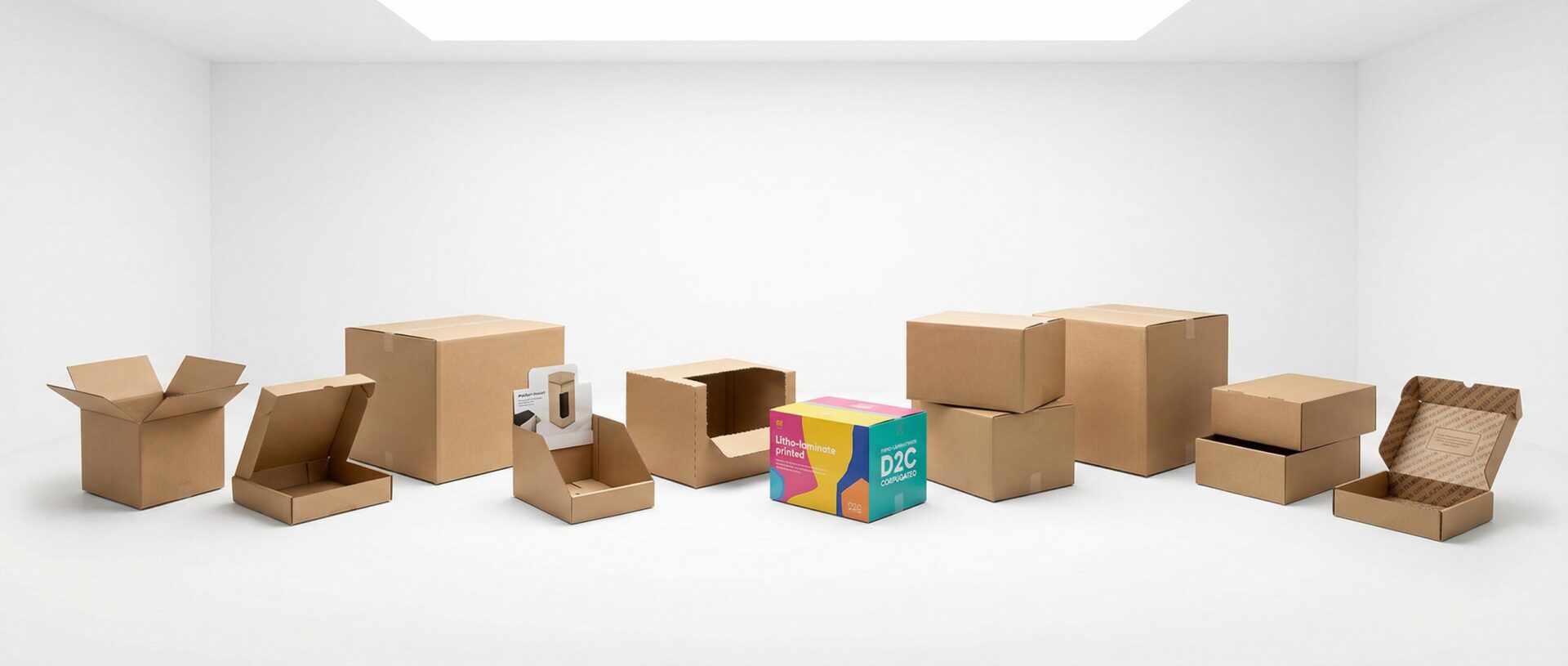
Regular Slotted Container (RSC)
Standard shipping and fulfilment box — 42.43% of UK corrugated market
The RSC (FEFCO 0201) is the most widely used corrugated box design in the world. Four flaps on top and four on the base — the major flaps meet at the centre when folded, sealed with tape. Simple to assemble, efficient to manufacture, cost-effective at any volume. The default transit box for UK manufacturing, warehousing, distribution, and e-commerce fulfilment.
- FEFCO 0201 — flaps meet at centre, top and bottom
- B-flute (3mm) standard · C-flute (4mm) for heavier products
- Requires tape seal — tape budget on high-volume lines
- Brown kraft or white liner options
- Flexo print: up to 3 colours exterior
- Right-size to product for dimensional weight elimination
Best for: Shipping, fulfilment, warehousing, bulk transit
Crash-Lock / Auto-Bottom Box
No-tape self-locking base — fastest D2C assembly
The crash-lock (FEFCO 0427) has a pre-glued base with interlocking ear tabs — when the box is opened flat and pressed into shape, the base locks automatically. No tape required on the base. The lid is a standard tuck-in or dust-flap design. This eliminates tape from the packing process, reduces assembly time by 40–60% on D2C packing lines, removes plastic tape from the packaging footprint, and creates a flat, unbroken base panel that provides significantly better structural integrity than the RSC's centre-join base.
- FEFCO 0427 — crash-lock auto-bottom, no tape required
- Double-thickness end walls — superior crush resistance
- Assembly: 40–60% faster than RSC + tape
- E-flute (1.5mm) for lightweight D2C · B-flute for heavier
- White or kraft liner — premium full-colour print surface
- Interior print option +£0.06 — highest D2C UGC driver
Best for: D2C fulfilment, e-commerce brands, subscription boxes
Full Overlap Slotted Container (FOL)
Maximum base and lid strength — overlapping flaps full width
The Full Overlap (FEFCO 0203) has major flaps that extend the full width of the box, creating a double-layer base and lid. This eliminates the centre-join weakness of the RSC entirely — the base has two complete layers of corrugated board under the product. The FOL is the specification for heavy, dense, or fragile products where the base must not give way under stacking pressure or when placed on packing benches by weight.
- FEFCO 0203 — major flaps full width, double-layer base and lid
- C-flute or double-wall BC for heavy products over 15kg
- No centre-join weakness — strongest standard corrugated base
- Brown kraft standard · white liner for brand print
- Corrugated inserts/dividers available for glass/fragile
- Uses 10–15% more board than RSC — factored into quote
Best for: Glass, ceramics, electronics, dense food, hardware 10kg+
Die-Cut Display and POS Boxes
Retail counter display, point-of-sale, gravity-feed units
Custom die-cut corrugated display units — counter-top units, floor-standing PDQ trays, gravity-feed dispensers, dump bins, and multi-product display cases. Printed full-colour on B-flute for the smooth surface that supports retail-quality graphics on corrugated. Die-cut to any shape that serves the product and retail environment.
- B-flute (3mm) — smooth surface for retail-quality print
- Custom die-cut any shape — counter, floor, gravity-feed
- Full CMYK print — retail-quality offset or litho
- Self-shipping construction — arrives as display
- FSC certified kraft or white liner options
- One-time die tooling: £120–£280 (permanent)
Best for: Counter display, POS, pharmacy, garden centre, FMCG retail
Shelf-Ready Packaging (SRP)
Retail buyer compliance — Tesco, Sainsbury's, Waitrose, Aldi
Shelf-ready packaging (SRP) is a corrugated case that ships the product from your warehouse to the retailer and then becomes the shelf display without any repacking. Major UK supermarkets require SRP compliance before any product reaches buyer review. The front panel tears away or folds down cleanly to expose the products inside in shelf-ready position.
- Tear-away or fold-down front panel — retailer specific
- B or C-flute — dimensions to retailer's planogram spec
- Clean perforation tear — no product damage on opening
- Full CMYK print — brand and product visible in situ
- OPRL label, barcode position — retailer compliant
- Retailer SRP spec reviewed at quote stage — standard
Best for: Supermarket listings, major retailer buyer compliance
Litho-Laminate Printed Corrugated
Offset-print quality on corrugated — premium unboxing
Litho-laminate corrugated is produced by printing a separate full-colour sheet of paper (using offset lithography) and then laminating that printed sheet to the corrugated board. The result is photographic-quality CMYK print on a corrugated box. Used by premium D2C brands, luxury product shippers, and any brand where the corrugated outer box must communicate price point and brand quality at the same level as the product inside.
- Offset-quality full CMYK — photographic print standard
- Laminated printed sheet onto E or B-flute corrugated
- Matte, gloss, soft-touch laminate, spot UV options
- Interior print — brand reveal on unboxing
- Any FEFCO style — crash-lock, RSC, display
- Higher unit cost than direct flexo — lower than rigid box
Best for: Premium D2C, luxury brands, cosmetics, subscription boxes
Double-Wall Corrugated Boxes
BC, EB, or BE flute · 5–7mm total board thickness
Double-wall corrugated has two layers of fluted medium between three linerboards — producing 5–7mm total board thickness. This approximately doubles the stacking strength and crush resistance compared to single-wall construction. Used for heavy goods (20–60kg), dense products, products shipped on rough routes, industrial packing lines, and any application where single-wall performance is insufficient.
- BC flute standard — ~6mm, best stacking + cushioning balance
- EB flute — ~4.5mm, excellent print + heavy goods
- Supports products 20–60kg (varies by ECT rating)
- All FEFCO styles available in double-wall specification
- Moisture-resistant board option for cold-chain/outdoor
- ECT rating specified to your stacking height requirement
Best for: Heavy goods 20–60kg, industrial, dense products
Triple-Wall Corrugated Boxes
Maximum structural strength — replaces wooden crates
Triple-wall has three layers of fluted medium between four linerboards — total board thickness 10–15mm. The closest corrugated equivalent to a wooden crate, used for machinery, automotive parts, large electrical equipment, bulk agricultural produce, and export shipments requiring maximum compression and impact resistance.
- Three fluted layers, four linerboards — 10–15mm total
- Replaces wooden crates for machinery and bulk goods
- ECT rating specified to your stacking requirement
- Supports products 60kg+ / palletised loads
- Fully recyclable — kerbside OPRL "Recycle" applies
- Export ISPM-15 compliant (no fumigation required)
Best for: Machinery, automotive, bulk export, palletised industrial
Telescoping Lid and Base Boxes
Adjustable depth — art, frames, garments, irregular sizes
A telescoping box has a separate base and lid — the lid slides over the base to any required depth. This makes the box adjustable in height without a new tooling die. Used for picture frames, artwork, canvases, clothing, folded garments, flat-pack products, and any application where product height varies run-to-run.
- Separate lid slides over base to variable depth
- Double-wall overlap at join — maximum side strength
- B or C-flute — matched to product weight
- No void space at top — product fills to lid
- Same base, different lid depths from one die
- Flat-packs for efficient warehouse storage
Best for: Art, frames, garments, variable-height products
E-Flute Corrugated Mailer Boxes
1.5mm board · best print surface · crash-lock assembly
E-flute corrugated at 1.5mm is the thinnest structural corrugated format. The very fine flute profile creates 90+ flutes per foot, producing a smooth print surface that supports the finest CMYK print quality of any corrugated board. E-flute crash-lock mailer boxes are the standard format for premium D2C postal shipping of cosmetics, lifestyle products, clothing, and any product up to approximately 5kg.
- E-flute 1.5mm — finest corrugated print surface
- 90+ flutes/foot — smooth, photographic CMYK quality
- Crash-lock base (0427) — no tape, fast assembly
- 30–40% thinner than B-flute — dimensional weight saving
- Interior print +£0.06 — highest D2C UGC driver
- White liner standard — bright print base
Best for: Premium D2C, cosmetics, lifestyle, clothing up to 5kg
Corrugated Flute Types — E, B, C, A, BC, EB: Which One for Your Product?
The flute is the wave-shaped medium between the linerboards. Its height, density, and profile determine stacking strength, cushioning, printability, and total board thickness. Most UK packaging suppliers list "single wall" and "double wall" without explaining which flute — here's the full guide that changes your specification decisions.
| Flute | Thickness | Strength | Print Surface | Best Applications | Product Weight |
|---|---|---|---|---|---|
| E-Flute Print | 1.5mm | Moderate crush resistance · excellent rigidity | Excellent ✓ | Premium D2C mailers, cosmetics, lifestyle products, subscription boxes, retail display boxes. Finest corrugated print surface — 90+ flutes/foot creates smooth base for CMYK. | Up to ~5kg |
| B-Flute Standard | 3mm | Good crush + puncture resistance · good stacking | Good ✓ | RSC shipping boxes, crash-lock mailers, retail display, SRP, canned goods, beverage trays. Most versatile single-wall flute for standard UK e-commerce and retail shipping. | Up to ~20kg |
| C-Flute Most Used | 4mm | Excellent stacking strength · good cushioning | Moderate ✓ | Standard shipping cases, SRP, glass products, dairy, furniture, heavier D2C. C-flute is the most widely used globally — ~80% of all corrugated boxes worldwide. Best balance of stacking strength and cost. | Up to ~25kg |
| A-Flute | 5mm | Maximum cushioning · fragile goods · stacking | Poor ✗ | Glassware, ceramics, fragile items, long-distance transit, cold-chain. Best cushioning of any single-wall flute — larger air pockets absorb impact. Coarser texture limits print quality. | Up to ~30kg |
| BC Double-Wall Heavy | ~6mm | Excellent stacking + cushioning · double protection | Moderate ✓ | Heavy goods 20–60kg, industrial distribution, dense food products, export. Best balance of stacking strength and cushioning in double-wall. Most common heavy-duty corrugated specification in UK. | 20–60kg |
| EB Double-Wall | ~4.5mm | Good stacking strength · better than BC on print | Good ✓ | Premium heavy D2C where print quality matters as well as strength. Thinner profile than BC — lower dimensional weight. Good for branded heavy-goods shipping with print requirement. | 15–40kg |
⚠ The Hidden Strength Killer: Moisture
Corrugated board can lose 40–70% of its rated stacking strength when exposed to moisture — whether from damp warehouses, cold-chain condensation, outdoor storage, or humid delivery vehicles. This is not a defect in the board. It is a physical property of paper fibre under moisture. A box rated at 32 ECT in dry conditions may be performing at effectively 10–19 ECT after hours of humidity exposure. For cold-chain products (chilled food, flowers, some pharmaceuticals), outdoor storage, or products shipped to humid climates, moisture-resistant board is mandatory — not optional. We assess your storage and transit environment at every corrugated box enquiry and specify moisture-resistant board where the transit conditions require it. We will not deliver a standard board specification into a cold-chain or outdoor application without flagging the moisture risk in writing.
ECT Rating vs Mullen Burst — The Two Strength Tests and Why They're Not Interchangeable
This is the corrugated specification topic that confuses almost every UK buyer — and none of our competitors explain it. ECT and Mullen burst measure completely different things. Specifying the wrong one for your application is either wasting money (over-specified board) or risking failure (under-specified for the actual load).
ECT — Edge Crush Test (Stacking Strength)
ECT measures how much vertical compressive force a corrugated box can support when stacked — the weight of other boxes pressing down on it from above. Expressed in kN/m (kilonewtons per metre of board edge) or pounds-force per inch in the US system (e.g., 32 ECT). This is the rating you need when your boxes will be stacked in a warehouse, on pallets, in delivery vehicles, or in retail stockrooms.
When ECT matters most: Palletised distribution. Warehouse stacking. Retail backroom storage. Export shipping where boxes are stacked in containers. Any application where boxes are vertically compressed under other boxes for extended periods.
Rule of thumb: A standard RSC B-flute box with 32 ECT supports approximately 240kg of stacking load in dry conditions. At 70% humidity, this drops to approximately 72–96kg. Moisture-resistant board maintains 60–80% of its dry ECT rating at high humidity.
Mullen Burst — Puncture and Rupture Resistance
Mullen burst measures how well a corrugated box resists puncture and rupture — the force required to push through the wall of the box from outside. Expressed as a burst factor (e.g., 200# Mullen). This is not the same as stacking strength. A box with high Mullen burst may have mediocre stacking strength. A box with high ECT may have mediocre burst resistance.
When Mullen matters most: Products with sharp edges or corners that could rupture the box from inside. Rough handling environments where the box exterior takes impact from forklifts, conveyor edges, or chute loading. Products prone to shifting that create point loads on box walls.
Do not confuse them: A 200# Mullen rating does not mean the box supports 200 pounds of stacking load. They are completely different tests measuring completely different failure modes. Most UK D2C shipping applications are ECT-driven, not Mullen-driven. We specify the correct rating for your application at quote stage.
ECT Selection Guide — Stacking Height to Board Specification
| Application | ECT Rating | Board Specification | Typical Use |
|---|---|---|---|
| Light D2C, not stacked | 23–26 ECT | E-flute single wall | Cosmetics, clothing, light subscriptions. Couriered direct, not palletised. |
| Standard e-commerce/retail | 32 ECT Most Common | B-flute or C-flute single wall | Standard RSC and crash-lock. Products up to 20kg. Moderate stacking in warehouse. |
| Retail palletised / SRP | 44 ECT | C-flute reinforced or double-wall BC | Supermarket SRP, distribution centre pallets, multiple layers of stacking. |
| Heavy goods / industrial | 51–71 ECT | Double-wall BC or EB | Products 20–60kg. High-bay warehouse stacking. Dense food or industrial distribution. |
| Export / very heavy | 87–120 ECT | Triple-wall | 60kg+ products. Container export. Machinery, automotive, bulk agricultural. |
How We Specify Corrugated Strength at Wabs Print
We ask for: (1) product weight; (2) number of boxes in a pallet or stacking layer; (3) maximum stacking height; (4) storage and transit environment (indoor dry / cold-chain / outdoor); (5) courier network. From these five data points we calculate the required ECT rating, recommend the flute and wall construction, and specify moisture-resistant board where the environment requires it. We do not quote a standard "B-flute single wall" without checking whether it will perform. Getting this wrong in the field — crushed boxes, damaged products, failed retail compliance — costs more than any per-box pricing difference.
Corrugated Box Print Methods — Flexo vs Digital vs Litho-Laminate
Print quality on corrugated boxes varies enormously based on the print method. Understanding which method suits your quantity, budget, and brand standard prevents the single most common source of corrugated box disappointment — ordering a printed box and being surprised by the output quality.
Flexographic Print (Direct to Corrugated)
The standard corrugated print method — ink applied directly to the corrugated board using flexible printing plates. Fast, cost-effective at volume, and suitable for simple logos, product codes, and brand colour blocks. The limitation is print quality: the rough corrugated surface and the compression of the flute during printing prevents fine detail, small text, and photographic imagery from reproducing well. Best for: plain branded cases with 1–3 colour print, product codes, warehouse handling text, and simple logos.
Best for: High-volume plain branded cases, distribution, industrial
Digital Print (Direct to Corrugated)
Digital inkjet printing direct to corrugated board — no plates, full CMYK, variable data capability (different graphics per box, personalisation, QR codes). Superior to flexo for quality at short run and mid-run volumes. The print surface is still the corrugated board, so fine detail and photographic imagery are limited by the board texture — better than flexo, not as good as litho-laminate. Best for: personalised D2C boxes, limited editions, subscription box variants, small e-commerce brands needing full-colour without plate investment.
Best for: D2C personalisation, short runs, limited editions, QR codes
Litho-Laminate (Offset Quality on Corrugated)
A separate sheet is offset-printed at photographic quality (the same press as premium folding cartons) and laminated to the corrugated board. The result is retail-quality print on a corrugated structure — fine detail, gradients, photography, metallic finishes, soft-touch all available. The only corrugated print method where the print quality is limited by design, not by the board surface. Best for: premium D2C, branded retail cases, cosmetics, lifestyle products, luxury gifting, and any application where the corrugated box must communicate a price point at carton quality.
Best for: Premium brands, D2C luxury, cosmetics, lifestyle retail
How to Choose Your Print Method
Volume is the primary driver: Under 500 units with full-colour brand print → digital. Over 2,000 units with logo/brand colour only → flexo. Any volume where print quality must match folding carton standard → litho-laminate. Premium D2C with photography or fine brand detail → litho-laminate regardless of volume. Food manufacturer's SRP with retailer-compliant print → digital or litho depending on quality requirement. We recommend the method at quote stage based on your quantity, artwork complexity, and target print quality — not the method with the lowest plate cost.
Corrugated Box Sizes — Common Dimensions, UK Courier Bands, and Right-Sizing
Every corrugated box we produce is custom-sized to your product's external dimensions plus the correct clearance for protection and void fill. These are the most common sizes in UK e-commerce and retail, and the courier band they sit within — which determines your delivery cost.
Common UK E-Commerce Corrugated Box Sizes
| Box Size (Internal L×W×H) | Common Application | Evri Band | Royal Mail Band | Board Spec |
|---|---|---|---|---|
| 150×100×80mm | Small cosmetics, single supplement pot, accessories, phone cases | Small / postable | Small parcel | E-flute crash-lock |
| 220×160×80mm | Books, small clothing items, flat accessories, two-product subscription | Small parcel | Small parcel | E or B-flute |
| 310×210×175mm Popular | Mid-size e-commerce, clothing folded, small hardware, beauty sets | Medium parcel | Medium parcel | B-flute RSC or crash-lock |
| 400×300×200mm | Larger clothing, footwear, homeware, multi-product sets, gifting | Large parcel | Medium parcel | B or C-flute RSC |
| 500×350×250mm | Bulky clothing, kitchenware, tools, small appliances | Large parcel | Large parcel | C-flute RSC |
| 600×400×400mm+ | Large appliances, furniture components, bulk distribution cases | XL / check size | Large parcel | C-flute or double-wall |
How to Give Us Your Dimensions — and What We Do With Them
Measure your product at its external dimensions including any primary packaging (jar, bottle, bag). Add 20–30mm clearance per side if no insert is used. Add 10–15mm per side if a corrugated insert or foam insert is used. Send us: product L×W×H + weight + courier network + stacking requirement. We confirm exact internal box dimensions, board specification, FEFCO style, flute grade, and ECT rating, and check the resulting outer box dimensions against your courier's dimensional weight bands — within 24 hours. No standard sizes. Every box is sized to your product and costed to your courier economics.
Who Uses Our Corrugated Boxes — Industries and What Actually Differs
Corrugated boxes serve every industry in the UK — but the specification requirements differ enormously. What a supermarket needs from a corrugated SRP case is completely different from what a D2C cosmetics brand needs from a crash-lock mailer. Here's the breakdown.
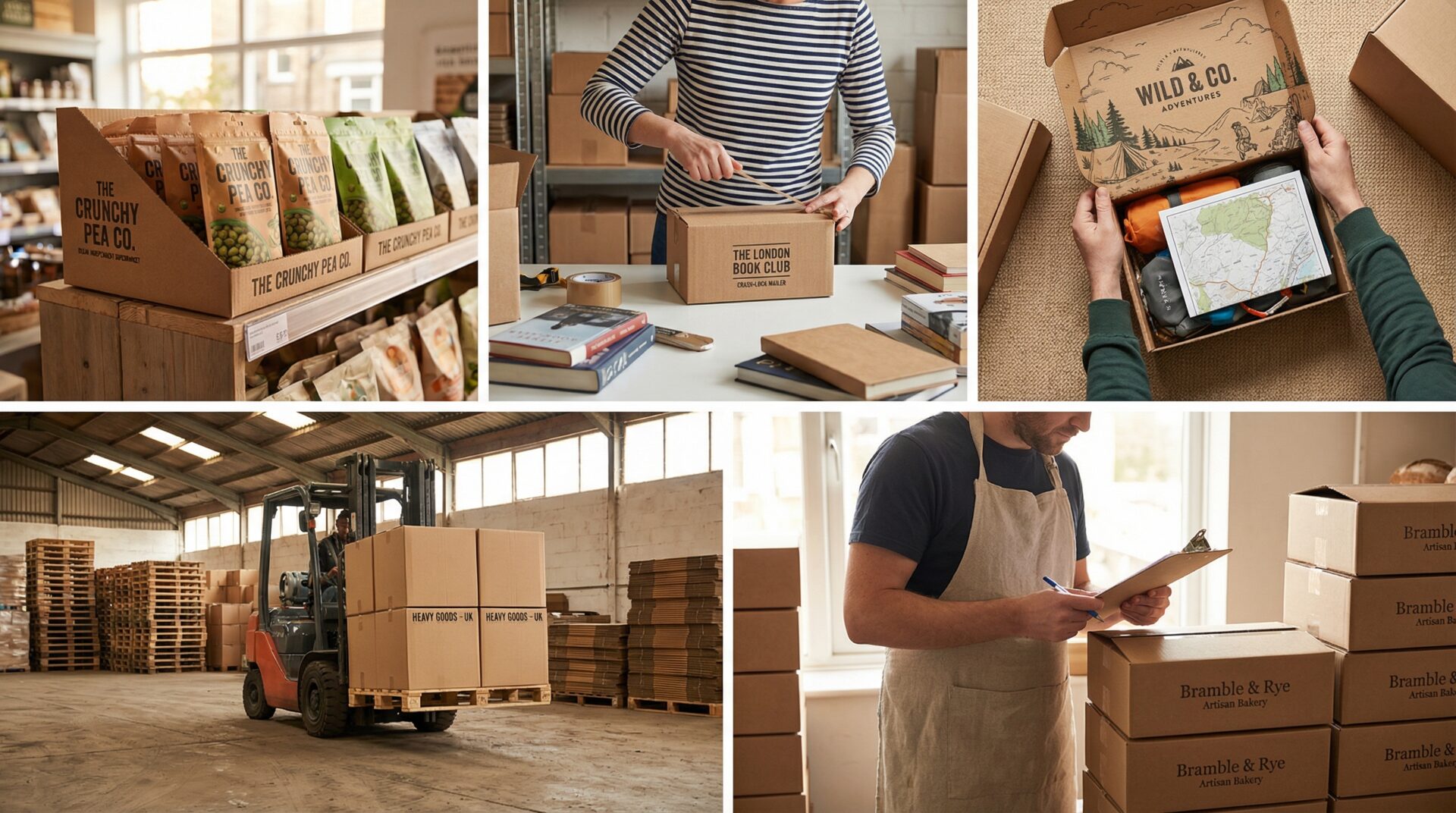
Food and FMCG
35.63% of UK corrugated demand (Mordor 2025)
The largest UK corrugated sector. RSC distribution cases for wholesale and distribution. Shelf-ready packaging (SRP) for supermarket listings — retailer-specific perforation placement, tear-strip functionality, planogram dimensions. Cold-chain: moisture-resistant board mandatory — corrugated loses up to 70% stacking strength when wet. Food-safe board for any application with direct food contact. Flexo print for branded distribution cases.
E-Commerce and D2C
4.73% CAGR — fastest-growing segment
UK e-commerce grew 15.8% in 2026 — online retail now 27.8% of all UK sales. Crash-lock (0427) and E-flute mailers are the primary formats: no tape, fast assembly, superior base strength, digital or litho-laminate print. Dimensional weight optimisation is critical — every millimetre of void space is a courier surcharge. 78% of UK consumers share unboxing experiences. Premium printed corrugated with interior print drives repeat purchase and social reach.
Industrial and Manufacturing
Growing as plastic surcharges bite
Heavy-duty double-wall and triple-wall corrugated for machinery, automotive parts, electronics, chemicals, and bulk industrial distribution. ECT-rated to specific stacking height and load. Export specifications including ISPM-15 compliance (corrugated is exempt from fumigation requirements unlike wood packaging). FSC certified for sustainability commitments. EPR Green rating significantly cheaper than plastic packaging alternatives from 2026.
Subscription and Fulfilment
Fastest-growing at-scale segment for print corrugated
Monthly subscription services shipping branded corrugated boxes to every subscriber every month — beauty subscriptions, food kits, hobby boxes, book clubs, pet product subscriptions. Branded crash-lock corrugated with litho-laminate or digital print, interior print standard. Standing order management — same spec every month, automated reorder. Right-sized to the contents of each month's products.
Retail and Wholesale Distribution
SRP compliance is retailer-driven and enforced
FMCG brands supplying supermarkets, independents, garden centres, pharmacies, and convenience stores via wholesale distribution. SRP for major supermarkets — retailer planogram dimensions, perforated tear front, OPRL labelling, barcode position. Counter display units (CDUs) for independent retail — self-shipping, self-displaying. Branded wholesale cases for distributor identity.
Cosmetics, Health and Beauty
High print demand, EPR compliance critical
E-commerce beauty brands, subscription beauty services, pharmacy and health supplement distribution. E-flute or B-flute crash-lock mailers with digital or litho-laminate print. UK Cosmetics Regulation compliance panels carried on the inner carton — corrugated outer must carry OPRL label and barcode. For fragile glass primary packaging (serums, bottles, jars), corrugated inserts or corrugated cell dividers specified to prevent glass-to-glass contact in transit.
Corrugated Box Sustainability — EPR Green Rating, FSC Certification, and Carbon Data
Corrugated board has always been the most recyclable transit packaging material in the UK. From 2025, it's now also the lowest-EPR-cost structural packaging option — making sustainability and cost reduction the same decision for the first time.
EPR Green Rating — Why Corrugated Is Now the Cheapest Structural Packaging by Total Cost
From April 2025, UK Extended Producer Responsibility (pEPR) fees apply to all packaging producers above thresholds. In the first year (2025–2026), producers pay flat base fees per tonne. From 2026–2027, fees are adjusted using a Red–Amber–Green (RAG) recyclability rating system.
Corrugated board: Green rating. Lowest EPR fee band. Kerbside recyclable, mono-material, no composite construction barriers.
Plastic packaging: £423 per tonne in 2025 (for plastic with less than 30% recycled content under Plastic Packaging Tax) plus EPR fees significantly higher than corrugated equivalents. From 2026 RAM modulation, Amber and Red packaging incurs higher fees.
For any UK business currently using plastic transit packaging alongside or instead of corrugated, the combined EPR + Plastic Packaging Tax differential is now making corrugated cheaper on a total annual cost basis — independent of any per-unit box cost comparison. Yorkshire food manufacturer: switched plastic SRP to corrugated SRP. EPR fees: -£180/tonne. Retailer compliance: passed. Zero material performance trade-off.
FSC Certification — Verified Sustainable Sourcing
FSC (Forest Stewardship Council) Chain of Custody certification verifies that the paper used in corrugated board comes from responsibly managed forests with documented supply chain traceability. For brands with supplier sustainability audits or ESG reporting commitments, FSC CoC is the only credible documentation for sustainable paper sourcing claims — self-declaration is no longer sufficient for most major retailer and corporate buyer sustainability reviews.
FSC Mixed: At least 70% FSC-certified fibre — standard for commercial corrugated. FSC 100%: Fully certified chain. FSC Recycled: 100% recycled certified fibre. FSC certification: +7% over base board cost. Full CoC documentation supplied with all FSC orders at no extra charge.
Carbon Data for Scope 3 ESG Reporting
FEFCO 2025 data confirms the average carbon footprint for corrugated board at 491 kg CO₂-eq per tonne — a verified, published figure UK businesses can reference directly in their Scope 3 supply chain emissions reporting, sustainability audits, and ESG disclosures.
74.3% of UK household corrugated packaging is collected and recycled — the highest recycling rate of any packaging material in the UK. We supply per-order carbon data (weight in tonnes × 491 kg CO₂-eq) and EPR data (material type, unit weight, RAM rating) with every order over 1,000 units at no charge.
What "Recyclable" Actually Means for Corrugated Boxes — and When It's Not True
Plain corrugated board (no coatings, no windows, no tape left inside): kerbside recyclable — OPRL "Recycle" label correct. Corrugated board with wax or plastic moisture-resistant coating: not kerbside recyclable — OPRL "Check local recycling." PET-windowed corrugated: not kerbside recyclable. Corrugated with significant adhesive residue or contamination: not recyclable. A corrugated box with flexo or digital print and no laminate coating: kerbside recyclable. A litho-laminate corrugated box: "Check local recycling" because the laminate prevents straightforward fibre separation. Under CMA enforcement from April 2025, printing "100% recyclable" on a laminate-coated corrugated box is a legally exposed claim. We apply OPRL-correct labelling to every corrugated box based on its actual specification — never a default claim.
Corrugated vs Plastic for Transit Packaging — The 2025/2026 Total Cost Comparison
Corrugated EPR Rating
Green — lowest EPR fee band. Kerbside recyclable. Mono-material. No composite surcharge.
Plastic EPR Rating
Amber or Red. £423/tonne Plastic Packaging Tax on top. Higher EPR fees from 2026 RAM.
Corrugated Recyclability
74.3% UK household recycling rate. OPRL "Recycle" kerbside. FSC certified available.
Plastic Recyclability
Widely varied by plastic type. Most transit plastics not kerbside. Consumer perception negative.
Dimensional Weight and UK Courier Band Optimisation — The Corrugated Specification That Pays for Itself
Dimensional weight charging means couriers charge for the space a parcel occupies in their vehicle, not just its physical weight. An oversized corrugated box is a courier surcharge tax on every single shipment. Right-sizing is the single highest-ROI corrugated specification decision for UK e-commerce brands.
How UK Courier Dimensional Weight Works
UK couriers calculate dimensional weight as: Length (cm) × Width (cm) × Height (cm) ÷ divisor. The divisor varies by courier (typically 4000–5000 for most UK parcel couriers). If the dimensional weight exceeds the actual weight, the courier charges the higher of the two. This means a 600g product in a 400×300×250mm box has a dimensional weight of approximately 6kg — you pay for 6kg, not 0.6kg.
The practical fix: size the corrugated box as close to the product's external dimensions as your protection requirement allows. The general rule is 20–30mm clearance per side for products without an insert, 10–15mm per side when a corrugated or foam insert takes up the remaining space.
The Manchester example in numbers: 400×300×300mm box → dim weight: 7.2kg. 310×210×175mm right-sized box → dim weight: 2.84kg. On Evri's standard rate card, moving from a 7.2kg dimensional weight to a 2.84kg band saves approximately £1.20–£2.40 per shipment. At 4,000 shipments per year, that's £4,800–£9,600 in annual savings — before void fill cost reduction.
UK Courier Size Limits — At a Glance
| Courier | Max Weight | Max Length | Size Threshold for Surcharge | Optimal Corrugated Box Strategy |
|---|---|---|---|---|
| Evri | 15kg | 120cm | Volume-based pricing bands. Keep total volume (L+W+H combined) within the cheapest applicable band. | E-flute or B-flute crash-lock sized tight to product. Low-cost lightweight shipping. |
| DPD | 31.5kg | Dims: max 3m | Oversized surcharge: parcels exceeding 61cm L or 46cm W. Weight-based pricing with dimensional weight calculation. | Keep L under 61cm and W under 46cm for standard pricing. B or C-flute RSC or crash-lock. |
| Royal Mail | 30kg parcels | 600mm | Small parcel: max 600×450×400mm. Medium: 610×460×460mm. Pricing tiers by weight and size band. | Keep within small parcel band (600×450×400mm max) for lowest pricing. Royal Mail small parcel RSC sizes well-mapped to standard e-commerce. |
| Parcelforce | 30kg | 1.5m | Length + girth pricing. Surcharges for over-size. Best for heavy goods where DPD would surcharge on size. | Double-wall corrugated for 10–30kg products using Parcelforce. Right-size to minimise girth. |
How We Optimise Your Corrugated Box for Your Courier
Tell us: your product external dimensions and weight, and which courier(s) you use. We calculate the right-sized box internal dimensions, check the resulting outer box dimensions against your courier's dimensional weight calculation and size bands, and confirm whether you sit in the optimal pricing tier. If you're borderline between two Evri bands or close to DPD's 61cm surcharge trigger, we can often find 10–15mm of board optimisation that drops you into the cheaper tier. This analysis is included in every corrugated box quote at no charge — because the saving on courier costs typically exceeds the packaging cost improvement by 10–70×.
How to Order Corrugated Boxes — Process and Timeline
What you need: product external dimensions and weight, courier network, FEFCO box style (or tell us the use case and we'll recommend it), target quantity, and print requirement. We handle board grade, flute selection, ECT rating, dimensional weight check, dieline, and OPRL labelling.
Spec and Quote
Day 1 — within 2 hours: Share product dimensions, weight, courier network, box style (or use case), and quantity. We confirm FEFCO style, flute grade, ECT rating, internal dimensions, outer box dimensions (checked against your courier's bands), print method, and firm price. Dimensional weight analysis included. Moisture assessment included for cold-chain or outdoor applications.
Dieline and Proof
Days 1–2: Send logo and brand assets in any format. We create the dieline to confirmed dimensions and produce a digital proof. Proof within 24–48 hours. Unlimited free revisions. OPRL-correct label applied. Barcode space confirmed if required. SRP perforation placement confirmed against retailer specification if applicable.
UK Production
Days 3–9: 7–10 working days from written artwork approval. Dimensions verified against dieline before dispatch: ±2mm tolerance on all corrugated box dimensions. Colour checked against approved proof: Delta-E under 3 on every run. Pantone locks stored for reorders.
Free UK Delivery + Docs
Day 9–10: Flat-packed. Tracked courier. Free UK shipping every order. FSC CoC documentation for FSC orders. Carbon footprint data for ESG reporting on request. Same-day dispatch notification with tracking.
Urgent or Seasonal Peak?
Standard is 7–10 working days. Urgent: contact us immediately — honest answer within the hour. Seasonal planning: Christmas and peak corrugated orders — place by end of October. Q4 volume pressure on corrugated production is significant. Brands that plan with us from September avoid delays entirely.
Reorders: 2 minutes to production. Your FEFCO style, dieline, board grade, ECT rating, flute specification, all print positions, OPRL label, Pantone locks, and dimensional weight check results are permanently stored. Reorders go to production in 2 minutes — no reproof, no re-brief, no re-dimension check. The saved specification also means any standing-order volume discount is applied automatically to reorders at the confirmed quantity.
Corrugated Box Pricing UK — All Formats, All Quantities
All prices include OPRL-correct recycling label and free UK shipping. No minimum order. No setup fees. Die tooling and flexo plates are completely free on every order (first or repeat). FSC certified: +7%.
Corrugated Box Pricing — Standard RSC 0201, 310×210×175mm Internal, B-Flute Single Wall
| Qty | RSC 0201 Plain Brown | Crash-Lock 0427 Plain | RSC Flexo 1-3 Colour | Crash-Lock Digital CMYK | Double-Wall BC Plain | Litho-Laminate CMYK |
|---|---|---|---|---|---|---|
| 100–249 | £1.88 | £2.40 | £2.80 | £3.40 | £3.20 | £6.80 |
| 250–499 | £1.42 | £1.82 | £2.10 | £2.60 | £2.45 | £5.20 |
| 500–999 Popular | £1.02 | £1.32 | £1.56 | £1.96 | £1.82 | £3.90 |
| 1,000–2,499 | £0.76 | £0.98 | £1.18 | £1.48 | £1.36 | £2.95 |
| 2,500–4,999 | £0.58 | £0.74 | £0.88 | £1.12 | £1.02 | £2.28 |
| 5,000–9,999 | £0.44 | £0.58 | £0.68 | £0.88 | £0.78 | £1.75 |
| 10,000+ Best Value | £0.32 | £0.44 | £0.52 | £0.68 | £0.60 | £1.40 |
Prices for standard RSC 0201, 310×210×175mm internal, B-flute single wall. All include OPRL-correct label and free UK shipping. No minimum order. Die tooling and flexo plates are completely free on every order. White liner: +15% over brown kraft. FSC certified: +7%. Double-wall: +60–80% over single-wall equivalent. Litho-laminate: depends on design complexity — quote provided within 24 hours. Interior print: +£0.06/box.
The ROI Calculation That Changes the Conversation
Manchester e-commerce brand, 2024. Previous box: RSC 0201, 400×300×300mm, brown, no print. Cost: approximately £0.52/box at 5,000 quantity. Right-sized RSC 0201, 310×210×175mm, brown, no print. New cost: approximately £0.60/box. Box cost increase: £0.08/box. Annual saving from eliminated dimensional weight charges: £4,680. Annual saving from eliminated void fill: £1,200. Total annual saving: £5,880. ROI on the £0.08/box specification change: 71× in year 1.
Corrugated Boxes UK — Frequently Asked Questions
What's the difference between B-flute and C-flute corrugated?
B-flute is 3mm thick with 47–50 flutes per foot — excellent crush and puncture resistance with a smooth print surface. Used for most standard UK e-commerce RSC and crash-lock boxes, retail display, and SRP. C-flute is 4mm thick with 39–41 flutes per foot — better cushioning and stacking strength for heavier products. For most D2C e-commerce under 15kg, B-flute gives the better combination of strength, print quality, and dimensional weight efficiency.
What does ECT rating mean and how do I know which one I need?
ECT (Edge Crush Test) measures a box's vertical compression resistance — how much stacking weight it can support before collapsing. A standard B-flute single-wall box typically has a 32 ECT rating. Double-wall BC flute starts at approximately 44–51 ECT. Corrugated can lose 40–70% of its rated ECT when wet — cold-chain and outdoor applications require moisture-resistant board. We specify the correct ECT for your stacking height and environment at quote stage.
What is the minimum order for corrugated boxes UK?
No minimum order. Free UK shipping on every order, any quantity. No setup fees on standard-size boxes. Die tooling and flexo plates are completely free on every order (first or repeat).
How do I work out if I'm paying dimensional weight surcharges?
Measure your current box external dimensions (L×W×H in cm). Multiply the three dimensions together and divide by your courier's dimensional weight divisor (Evri ~5000, DPD ~4000, etc.). If this result exceeds your actual product weight, you're paying dimensional weight charges. Manchester e-commerce brand right-sized from 400×300×300mm to 310×210×175mm and saved £5,880/year in dimensional weight charges alone.
What is shelf-ready packaging (SRP) and does my corrugated case need to comply?
SRP (retail-ready packaging) is a corrugated case that ships the product and becomes the shelf display without repacking. All major UK supermarkets require SRP compliance. Specifications are retailer-specific (perforation placement, tear-strip, planogram dimensions, etc.). We review your target retailer's SRP specification at quote stage for every food and FMCG corrugated enquiry.
Can corrugated boxes be printed with full colour photography?
Yes — using litho-laminate printing. A separate sheet is printed at offset-quality with full CMYK photography, then laminated onto the corrugated board. Standard flexo cannot reproduce fine photographic imagery. London D2C brand: switched to litho-laminate — social posts featuring packaging increased 240%, return rate dropped 18%.
Why do my corrugated boxes crush in the warehouse even though I ordered the right weight rating?
The most common cause is moisture. Corrugated board can lose 40–70% of its ECT-rated stacking strength when wet or in high humidity. The solution is moisture-resistant board, not necessarily a higher ECT rating. We assess your storage environment and specify moisture-resistant board where required.
What FEFCO code should I use for a D2C e-commerce box that doesn't need tape?
FEFCO 0427 — the crash-lock or auto-bottom box. The base locks automatically when pressed into shape. No tape required. Crash-lock boxes assemble 40–60% faster than RSC + tape and have stronger base integrity. For D2C brands dispatching 50+ orders per day, the assembly time saving usually pays for the slight premium quickly.
How long do corrugated boxes take to produce?
Standard: 7–10 working days from artwork approval. Digital proof: 24–48 hours. Reorders with locked dieline: 6–8 working days. Litho-laminate: allow 2–3 additional days. Urgent: contact us immediately.
Are corrugated boxes EPR compliant and what's the fee impact?
Corrugated board receives a Green RAM rating under UK pEPR — the lowest fee band. From 2026, fees are modulated by recyclability. Corrugated is significantly cheaper than plastic on total cost including EPR and Plastic Packaging Tax.
What information do I need to provide to get a corrugated box quote?
Product external dimensions (L×W×H in mm), product weight, courier network, FEFCO style (or describe use case), target quantity, and print requirement. We respond with confirmed specification, dieline, dimensional weight analysis, and pricing within 24 hours.
What if my corrugated boxes arrive wrong or products are damaged in transit?
We replace the order, cover return logistics, and address consequential losses where the error is ours. Your dieline, board grade, flute, ECT rating, print positions, and all specifications are permanently stored. Every reorder is identical to the approved first run. For specification-related damage, we review and correct at no charge before reorder.
What UK Businesses Actually Experienced — With Specific Numbers
James O.
E-Commerce Brand, Manchester · Corrugated right-sizing · 2024
"We'd been shipping in 400 by 300 by 300 millimetre boxes for two years. Our products were 290 by 200 by 160. I assumed the box cost was the packaging cost. Wabs Print showed me the dimensional weight calculation. We were paying Evri the dimensional weight rate for a 7.2 kilogram parcel every single shipment. Our actual products weigh 600 grams. They right-sized the corrugated box to 310 by 210 by 175 millimetres. The new box costs eight pence more per unit. The dimensional weight band dropped us by over four kilograms per shipment. At four thousand orders a year, the annual saving is five thousand eight hundred and eighty pounds. Just from the box dimensions. Nothing else changed."
Measurable Outcomes
£5,880/year saved in dimensional weight + void fill · Box cost: +£0.08/unit · ROI: 71× in year 1 · Zero product changes required
Claire B.
Artisan Food Manufacturer, Yorkshire · SRP + EPR · 2025
"We were using plastic transit trays for Tesco distribution. Our EPR advisor told us the costs were going to increase significantly from 2026 with the RAM modulation. We also had a Tesco buyer pushing for shelf-ready packaging. Wabs Print built us a corrugated SRP case that met Tesco's specific perforation and planogram requirements. We submitted to Tesco's compliance review. First submission approval. Then we ran the EPR numbers. Switching from plastic to corrugated SRP reduced our EPR fee liability by approximately one hundred and eighty pounds per tonne of packaging. At our annual volume, that's a material saving. The corrugated SRP costs fractionally more per unit than the plastic tray. On total annual cost, the corrugated is cheaper."
Measurable Outcomes
Tesco compliance: first submission approval · EPR fees: -£180/tonne vs plastic · FSC documentation supplied · Total cost: lower than plastic on annual basis
Amir T.
Premium D2C Brand, London · Litho-laminate corrugated · 2024
"We'd been sending our products in plain brown corrugated with a sticker label. We knew it wasn't premium but we thought a plain box was a plain box. Wabs Print suggested litho-laminate corrugated with our full brand design and interior print. I was nervous about the cost — the new boxes cost about two pounds forty more per unit. We tracked what happened. Social posts featuring our packaging increased two hundred and forty percent in eight weeks with no paid promotion. Our return rate dropped eighteen percent. We ran the numbers. The reduction in returns saved us more in the first three months than the entire additional packaging cost for the same period. The box was generating returns reduction and marketing reach simultaneously. We've never gone back to plain."
Measurable Outcomes
+240% social posts featuring packaging in 8 weeks · -18% return rate · Box upgrade: +£2.40/unit · Returns saving > total additional packaging cost within 3 months
