
Chocolate Box Packaging UK: Luxury Finishes, Food Compliance and Gift Design

Your chocolate box is doing three jobs simultaneously, and most brands only think about one of them when they place their first order. It protects the chocolate from temperature, humidity, and impact. It communicates the quality and price point of what is inside before the lid is lifted. And it performs in the gifting and retail context it is designed for, whether that is a shelf at a farm shop, a hotel turndown service, or a D2C subscription box landing through a customer’s letterbox.
This guide comes from the team at Wabs Print, a UK-wide packaging supplier that has produced custom chocolate boxes for UK businesses since 2008. We supply 8,500 plus UK businesses across artisan chocolatiers, confectionery manufacturers, D2C subscription brands, corporate gifting agencies, and wedding favour specialists, and the technical decisions that actually matter for a chocolate box are more specific than most buyers realise at the point of ordering. Wabs Print supplies custom chocolate boxes to food businesses across the UK, from independent chocolatiers in Chester and Derby to gifting agencies in Coventry and Plymouth. By the end of this guide you will know which board grade suits your product weight, why Delta-E colour accuracy matters for chocolate branding, and what each finish upgrade actually costs and returns. If you want a price now, custom chocolate boxes UK will get you a quote within 24 hours. Free design support is included on every order, and delivery is free to any UK address.
What Is Chocolate Box Packaging UK?
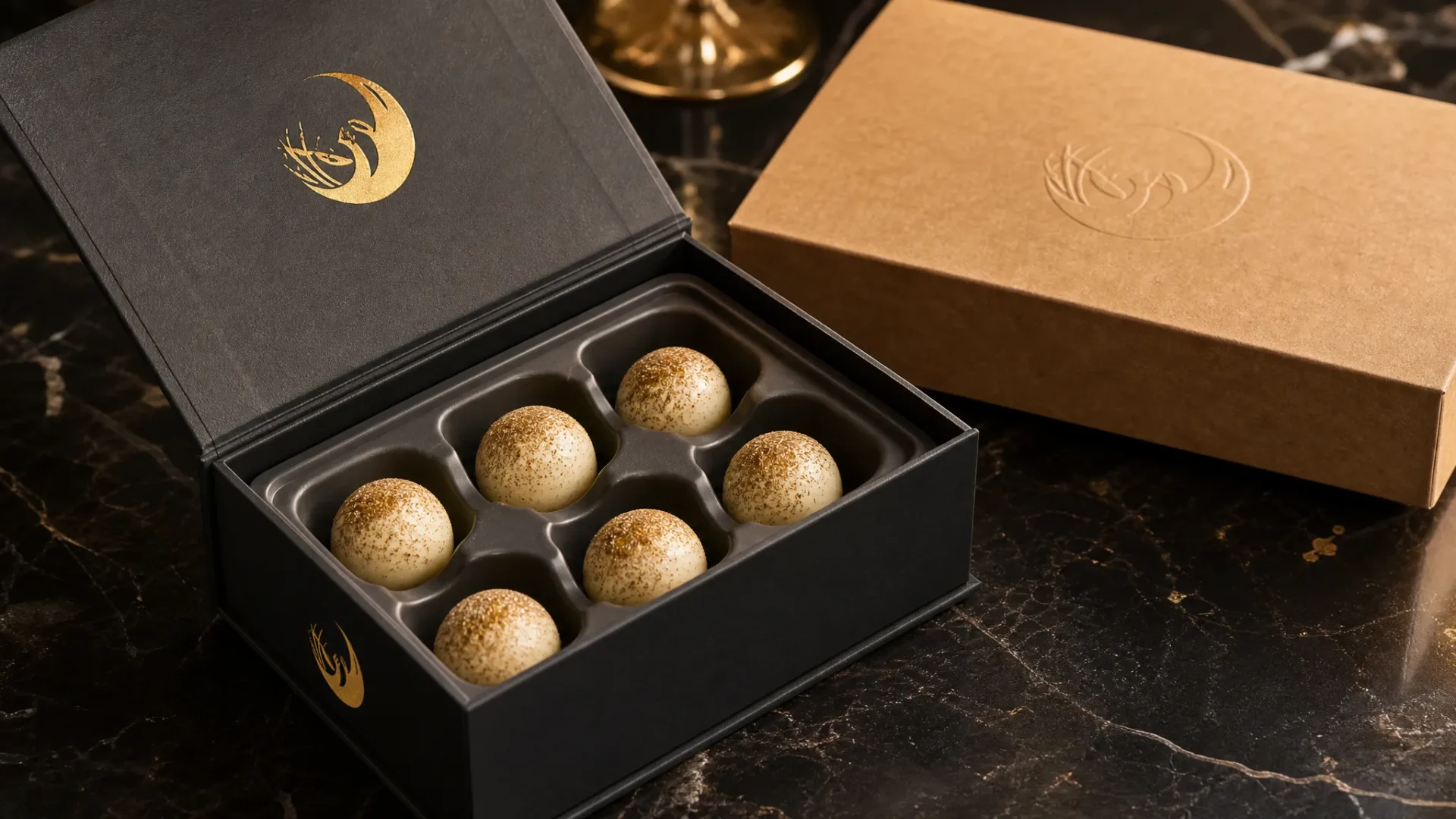
Chocolate box packaging UK is custom-printed food-contact packaging designed to protect, present, and sell chocolate confectionery at retail, gifting, or D2C channels. It covers everything from a simple folding carton for a 150g chocolate bar to a 2mm rigid greyboard luxury gift box for a 24-piece truffle collection, and the specification decisions between those two ends of the range are more consequential than most buyers realise when they start shopping for a box.
Chocolate is one of the most packaging-sensitive food products sold in the UK. It absorbs ambient odours through uncoated board surfaces, blooms when moisture reaches the cocoa fat through condensation cycles, and melts under sustained temperature exposure. The board, inks, inner liner, and any insert tray used in a chocolate box must all comply with retained EU Regulation 1935/2004 on food contact materials, and we supply full certification with every order. Anti-migration inks are used as standard across all chocolate box print runs, since standard solvent-based inks used in some general commercial printing can transfer aroma compounds to chocolate in direct-contact configurations and affect the flavour of the product.
The Six Chocolate Box Types and What Each One Is For
| Type | Board | Weight Capacity | Price From | Best For |
|---|---|---|---|---|
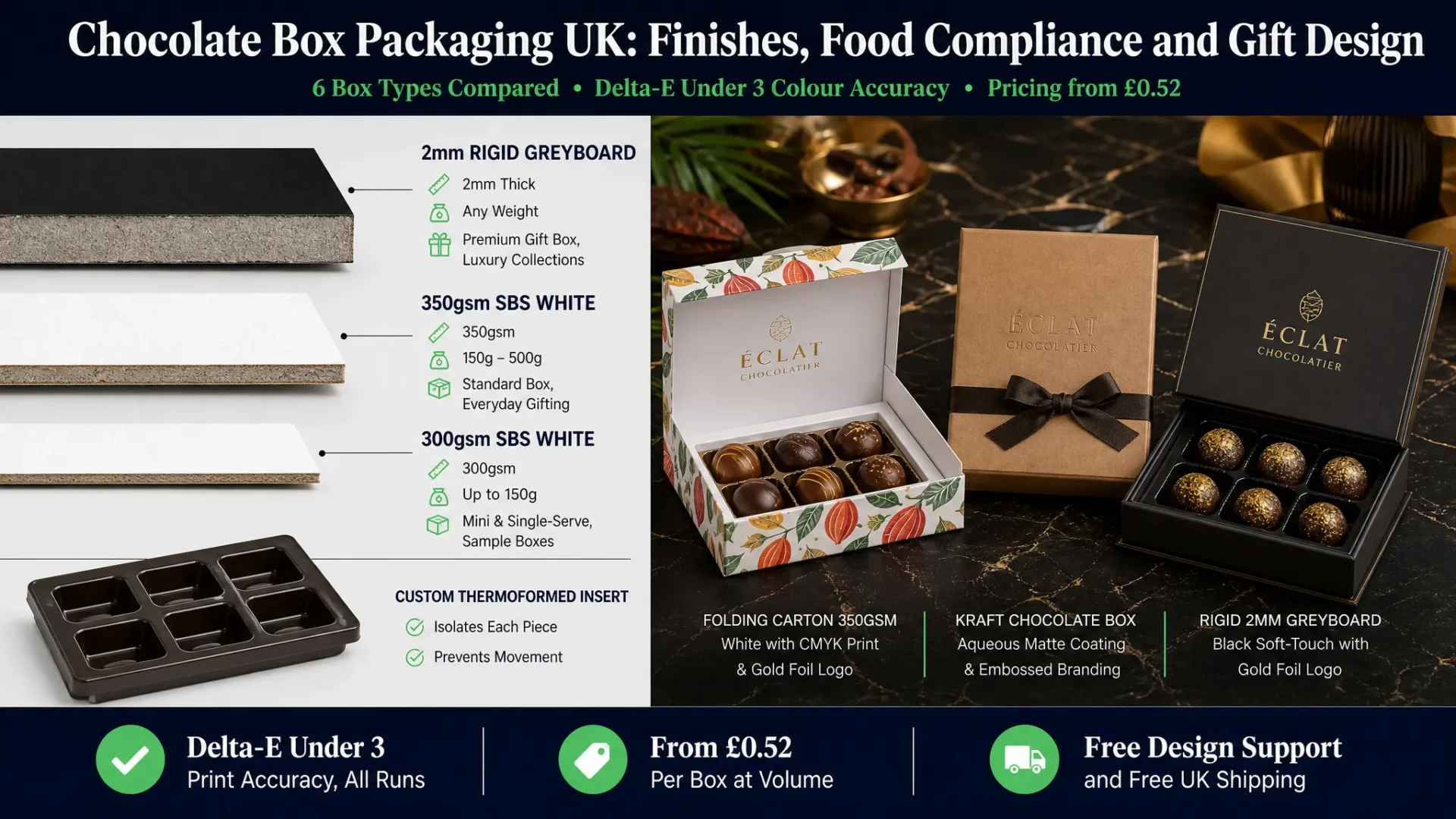
| Folding carton, white SBS | 350gsm SBS white coated | 150 to 500g product | £0.52 at 10,000 units | Retail, farm shop, deli, D2C subscription, most volume applications |
| Kraft folding carton | 350gsm FSC certified kraft | 150 to 500g product | £0.61 at 10,000 units | Artisan, farm shop, eco-positioned brands, organic chocolate |
| Rigid gift box | 2mm greyboard with printed outer wrap | Any weight, premium presentation | £3.20 at 5,000 units | Luxury gifting, hotel amenity, corporate gifting, wedding favours |
| Ballotin and traditional | White board with angled lid | Any weight, classic format | £1.10 at 1,000 units | Truffle and praline presentation, traditional confectionery gifting |
| Windowed carton | 350gsm SBS with food-safe PET window | 150 to 500g product | £0.74 at 10,000 units | Counter retail, impulse purchase, where product visibility drives conversion |
| Bar sleeve and seasonal | Slim sleeve, 360-degree print canvas | Bar format, seasonal gift set | £0.38 at 10,000 units | Artisan chocolate bars, seasonal campaign, Christmas and Valentine’s |
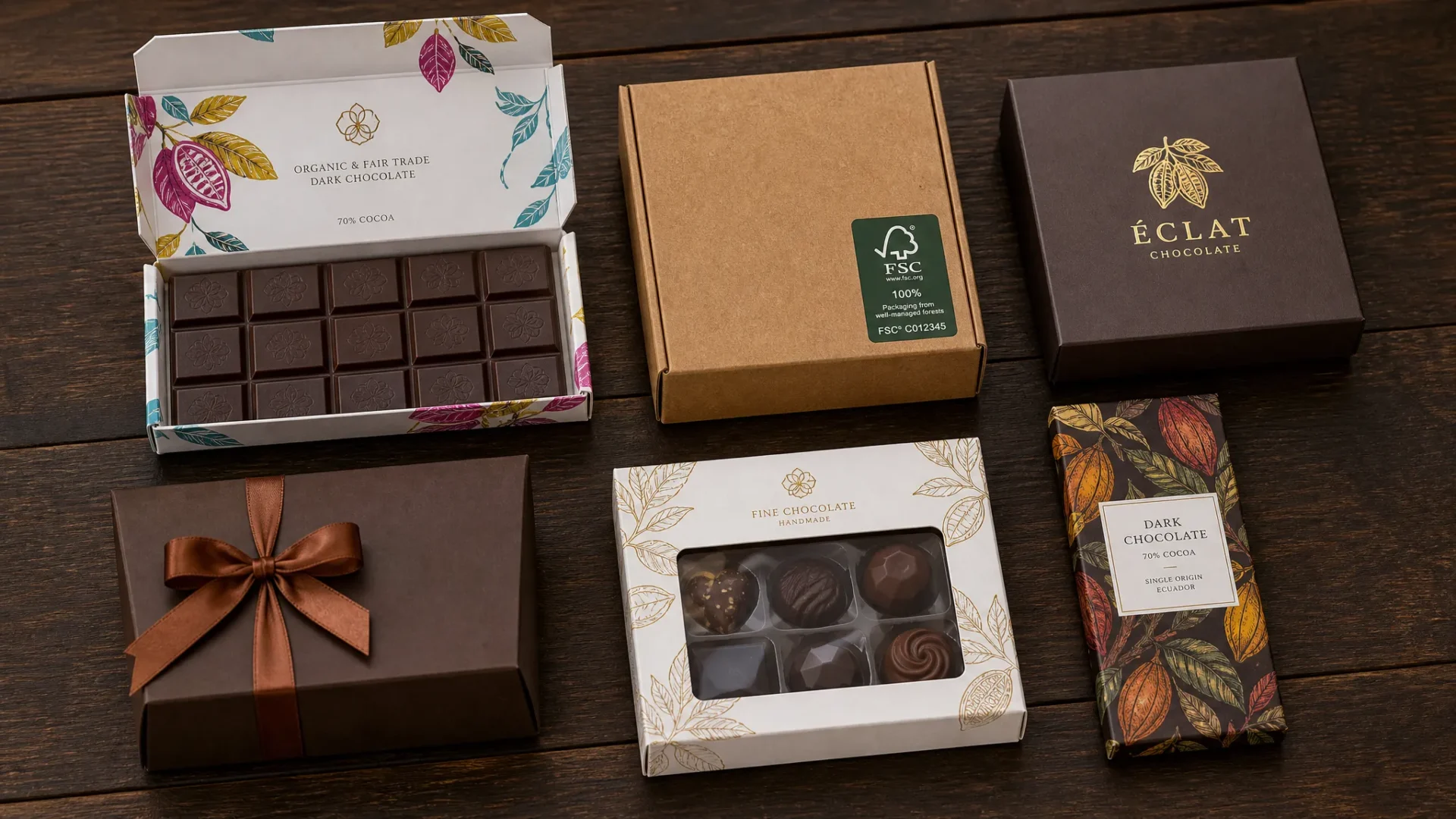
The folding carton in 350gsm white SBS is the standard for around 80 percent of UK chocolate retail applications, since it handles the full range of typical confectionery weights, takes CMYK printing accurately to a Delta-E variance of under 3 across every print run, and costs less than a third of the rigid gift box at volume. The rigid gift box earns its cost premium at the higher end of the gifting market, where the weight and the slow, satisfying lid reveal of a quality rigid box signal a price point before any text is read.
The ballotin is worth mentioning specifically because it is genuinely an under-specified choice in UK chocolate packaging. The angled-lid format, with its ribbon closure, is the format associated globally with premium truffle and praline presentation, and for small artisan chocolatiers selling at farm shops or independent delis, a well-printed ballotin often supports a higher RRP than an equivalent folding carton at the same print quality.
Board Grades and Product Weight: The Specification Most People Get Wrong
The board grade decision is set by the weight of the filled chocolate configuration, not by the size of the box. A large box with a light product does not need heavy board. A compact box with a dense chocolate configuration does.
The practical guide: 300gsm SBS for mini and single-serve products up to 150g. 350gsm SBS for standard retail boxes up to 500g product weight. 400gsm SBS for larger family boxes between 500g and 1kg. 2mm rigid greyboard for premium gifting at any weight, where the presentation quality of the board itself is part of the product’s perceived value.
The most common specification error is using 350gsm for a 600g or 700g box of assorted chocolates. At that weight, 350gsm begins to flex at the base panel under sustained handling in a retail or gifting environment, which is visible before the product is even opened and reads as poor quality regardless of how good the print is. We flag right-sizing issues on every quote, including cases where a box is over-specified or over-sized for the product it carries, which adds unnecessary cost without adding value.
Aldercroft Chocolate, an artisan chocolatier based in Reading, came to us after their previous supplier had been producing their signature 400g truffle box in 350gsm board for two years. The base panel flex was showing up at their farmers’ market stall after the boxes had been handled a few times during the morning, and two stockists had commented that the boxes felt lightweight for a product at their price point. We moved them to 400gsm for their 400g and above range and retained 350gsm for their lighter single-bar products. The flex issue stopped immediately, and both stockists noted the improvement without being prompted.
Delta-E Colour Accuracy: Why This Matters for Chocolate Branding
Delta-E is the measurement unit for colour difference between a target colour and the printed output. A Delta-E variance of zero is a perfect match. A variance of under 3 is considered imperceptible to the human eye under retail lighting. A variance above 5 begins to look noticeably different, and above 10 it is a clear mismatch between what was designed and what was printed.
This matters for chocolate packaging specifically because confectionery brands at the premium end of the UK market often build their identity around very specific colours: a deep burgundy, a precise shade of gold, a particular teal that is associated with one brand globally. On our print runs, we achieve a Delta-E variance of under 3 across every batch. On standard commercial printing without active colour management, variance between print runs can reach 8 to 12 even within the same job, which creates inconsistency across seasonal reprints that is visible when boxes from different print runs sit side by side on a shelf.
For brands specifying Pantone colours, our spot Pantone matching adds £0.04 per box at all volumes and locks the colour to the Pantone standard rather than approximating it in CMYK. For brands in premium retail channels including Selfridges, Fortnum and Mason, and Waitrose, consistent colour across every print run is a practical requirement, not just an aesthetic preference.
The Finish Upgrades That Pay Back on Chocolate Packaging
The commercial case for finish upgrades on chocolate packaging is among the strongest of any food packaging category in the UK, because the price elasticity of premium-positioned chocolate is high. The box changes what the product is worth to the customer before a single chocolate is tasted.
An Edinburgh artisan chocolatier added soft-touch laminate and gold foil stamping to their kraft boxes. Their RRP increased from £18 to £22 per box, a £4 increase on a product retailing on a margins basis that supports it. The finish upgrade cost £0.31 more per box. That is the mechanism in practice. Our luxury packaging finishes guide covers the full range of finish options and their cost-to-perceived-value relationship across all premium packaging categories.
| Finish | Cost Per Box | Effect on Perceived Value | Best Used On |
|---|---|---|---|
| Soft-touch laminate | £0.09 | Very high: velvet surface feel that signals luxury immediately | Rigid boxes, premium folding cartons, kraft gifting range |
| Gold or silver foil stamp | £0.18 | Very high: metallic brand impression visible in any lighting | Logo panel, brand name, decorative accent line |
| Embossing | £0.12 | High: tactile raised brand impression, strongest on matte surfaces | Logo, monogram, or decorative frame |
| Spot UV coating | £0.11 | High: selective gloss on matte background creates visual contrast | Product imagery, logo on matte base |
| Interior print | £0.06 | Moderate to high: brand story or pattern inside lid, drives unboxing moment | Rigid boxes, premium folding cartons for D2C |
| Spot Pantone matching | £0.04 | Indirect: consistent colour across all print runs protects brand recognition | Any box where colour accuracy is part of the brand identity |
The single most cost-effective upgrade for most UK chocolatiers is the combination of soft-touch laminate and a gold foil stamp on the logo panel. At a combined cost of £0.27 per box, it is the minimum investment that moves a chocolate box from functional to genuinely luxury in hand. Our wine box guide from this series covers a similar ROI calculation for wine gifting, and the e-commerce unboxing guide covers how finish decisions affect customer behaviour in D2C chocolate subscription operations specifically.
Cost and Pricing Guide
All prices below are confirmed from our live chocolate boxes page and include full CMYK print on all panels and free UK-wide shipping.
Chocolate Box Pricing by Type and Volume
| Volume | White 350gsm | Kraft 350gsm | Windowed | Ballotin | Rigid 2mm |
|---|---|---|---|---|---|
| 100 to 249 units | £2.65 | £3.00 | £3.20 | £2.10 | £9.50 |
| 250 to 499 units | £1.95 | £2.30 | £2.55 | £1.70 | £8.20 |
| 500 to 999 units | £1.45 | £1.72 | £1.88 | £1.45 | £6.80 |
| 1,000 to 2,499 units | £1.05 | £1.24 | £1.38 | £1.10 | £5.40 |
| 2,500 to 4,999 units | £0.82 | £0.98 | £1.10 | £1.00 | £4.10 |
| 5,000 to 9,999 units | £0.64 | £0.75 | £0.88 | £0.90 | £3.20 |
| 10,000 plus units | £0.52 | £0.61 | £0.74 | n/a | n/a |
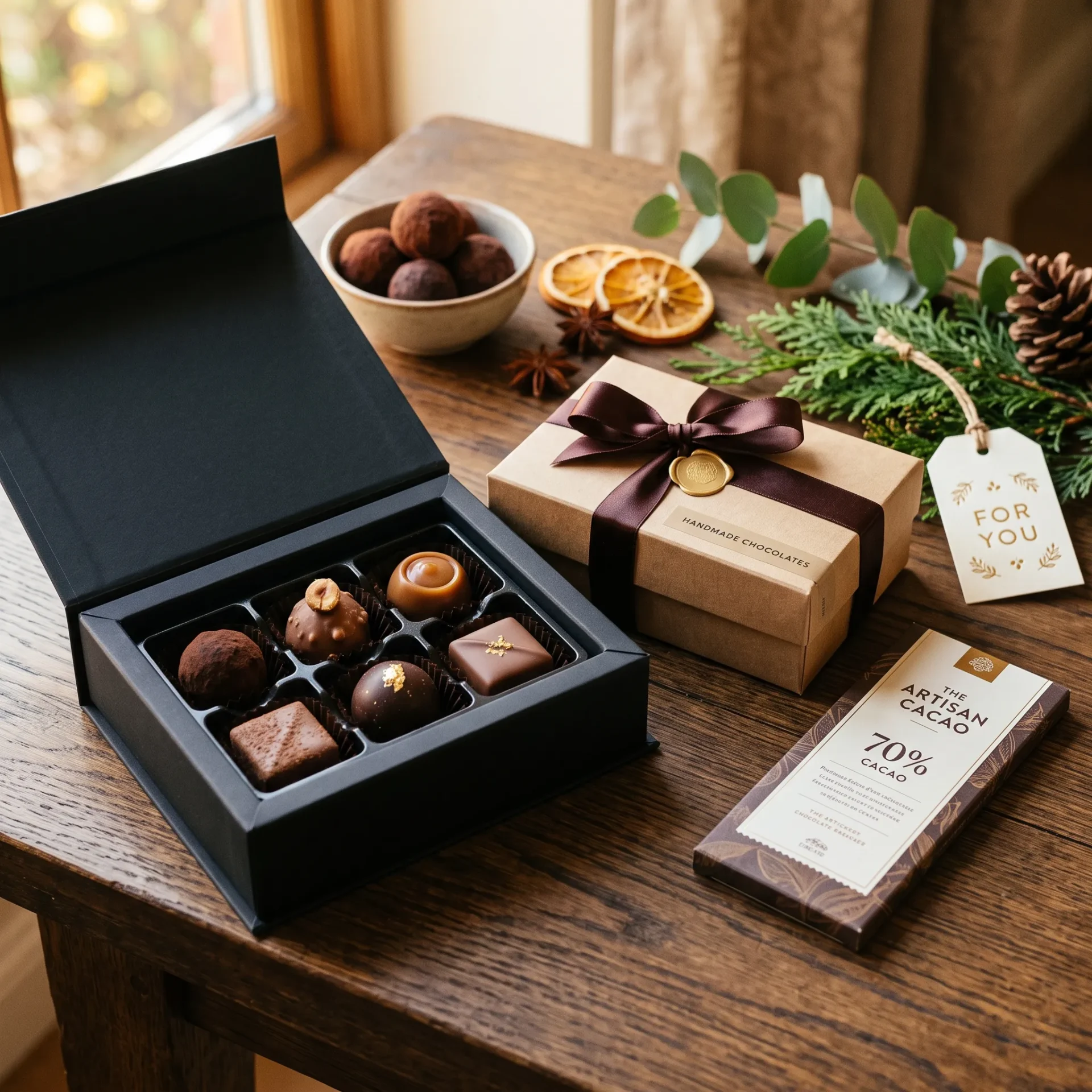
Bar sleeves start from £0.38 at 10,000 units. Seasonal box formats start from £0.58. Custom insert trays with no tooling cost, which is stored permanently and applied to all subsequent reorders at no additional charge.
There is no minimum order on any chocolate box format, including rigid gift boxes. In practice, below 200 units the per-box cost is high enough relative to the print setup that a branded sticker on a plain white box may serve a test run better than a full custom print run, and we will tell a customer that rather than simply take the order. Most UK chocolatiers start their first branded run at 250 to 500 units, where the per-box pricing becomes commercially sensible. If your artwork is not yet print-ready, our design team will check your file, set it up correctly, or build the design from scratch, at no extra cost. Delivery is free to any UK address on every order.
How to Choose: A Decision Framework for Your Chocolate Business
Work through these four questions before requesting a quote.
- What is the weight of your largest chocolate configuration? Under 150g: 300gsm. 150 to 500g: 350gsm standard. 500g to 1kg: 400gsm essential. Above 1kg or gifting regardless of weight: 2mm rigid greyboard.
- What is your retail channel? Farm shop or deli counter: folding carton with windowed option for impulse purchase. Premium retail or gifting platform: rigid box minimum, with soft-touch and foil to support the price point. D2C subscription: rigid or 400gsm folding carton with thermoformed insert to prevent chocolate movement in postal transit.
- What finish supports your retail price? Below £10 retail: standard CMYK on 350gsm with no finish upgrade. £10 to £20 retail: soft-touch laminate alone justifies the £0.09 investment. Above £20 retail: soft-touch plus gold foil is the minimum finish standard for the price point to be believable in hand.
- Are you making a sustainability claim? Uncoated white SBS or kraft with aqueous coating is kerbside recyclable and supports FSC and OPRL “Recycle” claims. Soft-touch laminate is not kerbside recyclable and OPRL “Not currently recyclable” is the correct label. Under CMA enforcement guidance from April 2025, claiming “eco-friendly packaging” on a soft-touch laminated chocolate box is a legally exposed statement. Our sustainable food packaging guide covers exactly which claims are defensible for premium food packaging in 2026, and our OPRL labels guide covers how to apply the correct label to each finish combination. For seasonal programmes, see our gift boxes UK guide for how chocolate box decisions connect to wider gifting packaging strategies.
Chocolate Box Delivery Across the UK
Wherever your chocolate business is based, lead time and pricing stay identical. An artisan chocolatier in Chester works to the same 7 to 10 working day production turnaround as a confectionery manufacturer in Derby, and delivery is free to any UK address regardless of format or volume.
We receive a regular flow of enquiries from independent chocolatiers in Plymouth asking specifically about seasonal planning for Christmas, Valentine’s Day, and Easter, since those three peaks drive the majority of annual volume for most UK chocolate businesses. Our standard advice: Christmas orders by mid-October. Valentine’s by late December. Easter by mid-February. These lead times account for the 7 to 10 working day production window plus typical December courier delays. Whether you are running a boutique chocolate shop in Coventry or supplying a retail chain from Reading, turnaround and pricing are identical, and our design team is available throughout at no extra charge.
Food Safety and Compliance for Chocolate Boxes
All chocolate boxes we supply comply with retained EU Regulation 1935/2004 on materials and articles intended to come into contact with food. Anti-migration inks are used as standard. Food contact compliance certificates are available with every order on request and are the documentation that Trading Standards officers and retail buyers ask for during audits.
The OPRL label depends entirely on the finish specification. Uncoated white SBS or kraft: OPRL “Recycle,” kerbside recyclable. Matte or gloss laminate: OPRL “Check local recycling.” Soft-touch laminate: OPRL “Not currently recyclable.” PET windows: not kerbside recyclable. We apply the OPRL-correct label to every box based on its actual finish combination, at no extra cost, and we will not print an inaccurate recycling claim on a chocolate box regardless of what the customer’s brief requests.
Under UK EPR regulations, the packaging you place on the market as a chocolate business contributes to your annual EPR reporting obligation if you exceed the relevant threshold. We supply full EPR material data with every order above 1,000 units at no charge. Our EPR Packaging UK guide covers how confectionery packaging feeds into the reporting framework. This reflects packaging compliance guidance as of June 2026. Always verify current requirements at gov.uk before making compliance decisions for your business.
FAQ
What board weight do I need for my chocolate box?
Match the board to your product weight. Under 150g product: 300gsm. 150 to 500g: 350gsm, the standard for most UK chocolate retail. 500g to 1kg: 400gsm essential, since 350gsm begins to flex at base panels under this weight. Premium gifting at any weight: 2mm rigid greyboard communicates luxury regardless of product weight.
Are custom chocolate boxes food-safe?
Yes. All boards, inks, inner liners, and insert trays comply with retained EU Regulation 1935/2004 on food contact materials. Anti-migration inks are used as standard across every chocolate box print run. Food contact compliance certificates are available with every order on request.
Can I get custom printed chocolate boxes with no minimum order?
Yes. There is no minimum order on any format including rigid gift boxes. Below 200 units the per-box cost is high relative to print setup, and we will tell you if a simpler format serves a test run better. Most UK chocolatiers start their first branded run at 250 to 500 units.
Do you deliver custom chocolate boxes to Chester and Derby?
Yes. Wabs Print delivers custom chocolate boxes to businesses across the UK, including Chester, Derby, Reading, Exeter, Plymouth, Coventry, London, and every other UK postcode, with free UK-wide shipping on every order. Standard production is 7 to 10 working days from artwork approval.
What is the cheapest custom chocolate box per unit?
White 350gsm folding carton with full CMYK print starts at £0.52 per box at 10,000 units. Kraft at £0.61. Windowed at £0.74. Bar sleeves at £0.38. Rigid 2mm gift boxes at £3.20 at 5,000 units. All prices include full print and free UK shipping.
What finish do I need to support a retail price above £20?
Soft-touch laminate (£0.09 per box) and gold foil stamping (£0.18 per box), used together at a combined cost of £0.27, is the minimum finish investment that makes a chocolate box feel genuinely premium in hand at a £20 plus price point. An Edinburgh artisan chocolatier added this combination and increased their RRP from £18 to £22 per box. The per-box upgrade paid for itself within the first batch.
When should I order seasonal chocolate boxes?
Christmas: mid-October. Valentine’s Day: late December. Easter: mid-February. Mother’s Day: early March. We hold standing seasonal programmes for 340 plus UK confectionery brands and can set up a rolling order schedule that ensures you are never without stock at peak.
Making the Call
Chocolate box packaging UK decisions start with the product weight, then the channel, then the finish that supports the retail price. Match the board to the weight to prevent flex. Choose the finish that makes the price believable in hand. Apply OPRL-correct labelling based on the actual finish rather than an aspirational sustainability claim. And plan your seasonal runs with enough lead time to avoid the avoidable stress of a peak-period rush.
Whether you are an artisan chocolatier in Chester, a corporate gifting agency in Derby, or a D2C subscription brand in Reading, Wabs Print delivers custom chocolate boxes across the UK with no minimum order, free UK-wide shipping, free design support on every order, and the same 7 to 10 working day turnaround regardless of volume. If you are ready to get a price, custom chocolate boxes UK and you will have a quote within 24 hours.