

Sustainable Food Packaging UK: Compliance, Grease Resistance & Material Selection

By Wabs Print Food Packaging Specialists | 15+ Years Food Service Industry Authority | Serving 8,500+ UK Food Brands
After 15 years manufacturing food packaging for UK catering businesses ranging from single-location takeaways to 1,000+ outlet restaurant chains, I’ve learned a non-negotiable truth: sustainable food packaging isn’t theoretical wishful thinking. It’s practical, measurably compliant with UK and EU regulations, and increasingly the only viable path forward for brands navigating multiple converging regulatory pressures and cost constraints simultaneously.
The UK food service industry processes approximately 3 million tonnes of packaging annually. Of that volume, roughly 65% is plastic-based material. Industry data suggests that despite being technically “recyclable,” most of this plastic ends up in landfill (approximately 55%), incineration (approximately 30%), or marine environments (approximately 10%). Only 5% actually enters structured recycling processes.
The regulatory response to this waste crisis has been swift and comprehensive. The Plastic Packaging Tax (introduced April 2022 and ongoing) charges £200 per tonne on plastic packaging containing less than 30% recycled content. This tax structure creates immediate and substantial cost pressure a typical pizza chain using 500kg of plastic packaging weekly faces approximately £5,200 annual PPT costs. These costs either reduce profit margins or require price increases customers increasingly resist.
Simultaneously, PFAS (per- and polyfluoroalkyl substances) restrictions are accelerating. PFAS were industry gold standard for greaseproof coatings for 30+ years because they delivered exceptional grease resistance and cost efficiency. However, PFAS chemicals don’t break down in the environment they accumulate indefinitely in soil, water, and food chains. The EU classified PFAS as hazardous substances in 2019. The UK Environment Agency has now announced formal restrictions on PFAS in food contact materials effective January 2025. Any greaseproof packaging still using PFAS-based coatings will become non-compliant in approximately 6 months from this publication date.
Extended Producer Responsibility (EPR) regulations mandate that brands take financial responsibility for end-of-life packaging management. These costs vary based on material recyclability recyclable materials incur lower EPR fees than non-recyclable alternatives. This regulatory framework shifts economics from “manufacture and dispose” thinking to “manufacture with lifecycle costs in mind.”
Here’s what actually matters for your business: Sustainable food packaging that genuinely works in real kitchens is no longer compromise. Unbleached kraft with PFAS-free greaseproof coatings delivers simultaneously: food safety compliance meeting all current and emerging regulations, superior grease resistance matching or exceeding legacy PFAS-based products, measurable environmental benefit (45-50% lower manufacturing footprint compared to virgin plastic), and often lower total cost of ownership when accounting for waste management and regulatory compliance expenses.
This comprehensive guide covers everything required for informed decision-making: detailed regulatory frameworks you must navigate, material selection protocols for different food service applications, barrier coating technologies and their performance characteristics, compliance verification procedures, practical implementation reality across different business scales, and the design considerations that separate functional sustainable packaging from failed alternatives.
Understanding the UK Food Packaging Regulatory Ecosystem
Food packaging compliance in the UK operates across multiple interlocking regulatory frameworks. Understanding these requirements prevents non-compliant materials reaching consumers, protects your business from regulatory exposure and potential recalls, and identifies opportunities for competitive advantage through proactive material selection.
The Regulatory Foundation: EC 1935/2004
The baseline regulatory requirement for all food contact materials in the UK remains Regulation (EC) 1935/2004. This regulation establishes fundamental safety principles: food contact materials must not transfer hazardous substances to food at levels exceeding established regulatory thresholds. The regulation applies to all materials paper, cardboard, plastic, metal, glass, rubber, ceramics.
Compliance verification happens through migration testing. Food contact material samples undergo standardized testing protocols where the material contacts test food simulants (representing fatty, acidic, and aqueous foods) under specified temperature and duration conditions. Laboratories measure chemical migration from packaging into the simulant. Results must demonstrate that all measured substances remain below established migration limits.
For paper-based packaging specifically, compliance focuses on overall migration (total chemical transfer regardless of substance identity) and specific substance migration (individual chemical limits). Paper and cardboard materials typically demonstrate strong baseline compliance because the manufacturing process doesn’t introduce problematic chemicals. However, coatings applied to paper greaseproof coatings specifically require careful specification and testing.
PFAS Restrictions: The 2025 Compliance Cliff
PFAS restrictions represent the most critical immediate compliance challenge for food packaging manufacturers and buyers. PFAS (per- and polyfluoroalkyl substances) encompass a large family of synthetic chemicals characterized by strong carbon-fluorine bonds. This bond structure makes PFAS exceptionally stable they resist heat, water, and oil. This stability made PFAS ideal for greaseproof food packaging coatings.
However, the same stability that makes PFAS useful in packaging also makes them problematic environmentally. PFAS doesn’t break down through normal decomposition processes. PFAS persists in the environment indefinitely, accumulates in animal tissue and food chains, and has been detected in blood serum of the majority of UK population. Recent research links PFAS exposure to multiple health effects including liver damage, thyroid disease, and immune system suppression.
The regulatory response has been swift. The European Union designated PFAS as hazardous substances under REACH regulation in 2019. The UK Environment Agency announced in early 2024 that PFAS restrictions in food contact materials would become formally enforceable January 1, 2025. Businesses cannot legally sell food packaging with PFAS-containing coatings after this date.
This creates a hard deadline: any greaseproof packaging manufactured with PFAS-based coatings after January 1, 2025 is non-compliant. Stock produced before the deadline can potentially be sold through existing inventory, but manufacturing must transition to PFAS-free alternatives immediately. Brands with significant inventory of PFAS-based packaging face potential waste costs if supplies exceed shelf-life timelines.
The Plastic Packaging Tax: Economic Pressure Accelerating Transition
The Plastic Packaging Tax applies to plastic packaging containing less than 30% recycled content. The tax rate is £200 per tonne of plastic packaging. For food service businesses, this translates to concrete costs:
A mid-sized pizza chain using 500kg of plastic packaging weekly (approximately 26 tonnes annually) with virgin plastic containing 0% recycled content faces £5,200 annual PPT cost. A burger restaurant using 300kg weekly faces £3,120 annual cost. A takeaway business using 400kg weekly faces £4,160 annual cost.
These costs represent meaningful margin pressure. Most food service businesses operate at 5-15% net margins. A £5,000 annual tax increase on a £100,000 annual profit business reduces profitability by 5%. Most businesses cannot absorb this cost without either raising customer prices (risking competitiveness) or transitioning to alternative materials.
The PPT creates economic incentive for material transition independent of environmental or regulatory motivation. From pure cost perspective, unbleached kraft packaging with PFAS-free coating often reaches cost parity or cost advantage compared to virgin plastic packaging once you account for PPT tax. This economic reality accelerates adoption of sustainable alternatives beyond what regulatory requirements alone would mandate.
Extended Producer Responsibility: Lifecycle Cost Accountability
Extended Producer Responsibility (EPR) regulations are being phased in across the UK, requiring packaging producers and brand owners to fund end-of-life waste management costs. Initial implementation applies primarily to larger producers and brand owners, with timeline for SME inclusion expanding.
EPR costs vary based on material recyclability. Recyclable materials incur lower EPR fees because they enter established recycling infrastructure with lower total management costs. Non-recyclable materials incur higher fees because they must enter landfill or incineration with associated higher environmental and financial costs.
This regulatory framework shifts economic incentives. Packaging material selection that previously prioritized only manufacturing and immediate use costs now includes lifecycle costs. Sustainable recyclable materials become economically advantageous not just environmentally advantageous when total lifecycle costs are calculated.
Material Selection Across Food Service Sectors: Specifications That Work
Different food service applications demand different material specifications. Understanding sector-specific requirements enables proper material selection and prevents costly operational failures or compliance violations.
Hot Food Applications: Pizza, Takeaway & Burger Boxes
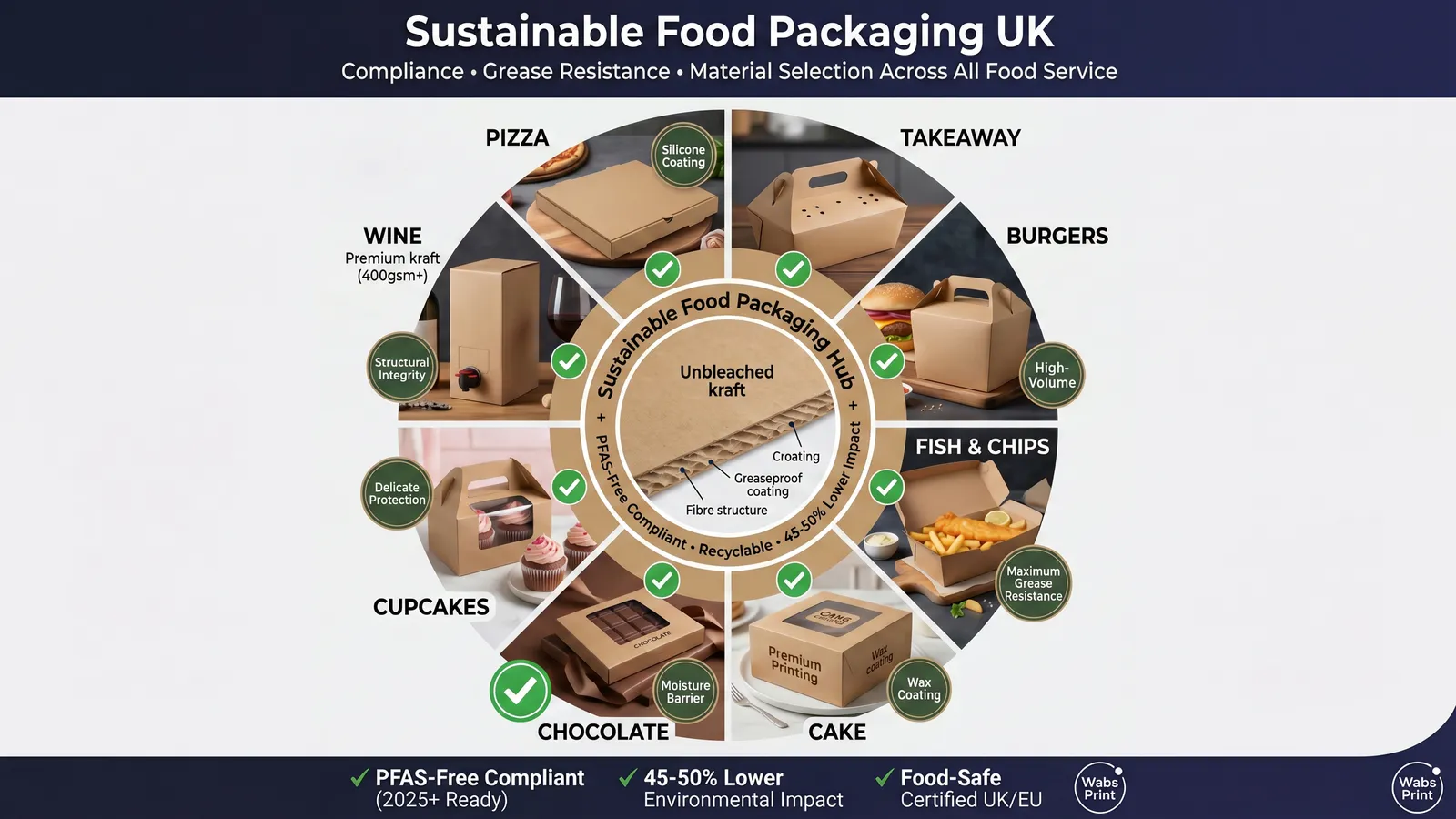
Pizza boxes, takeaway boxes, and burger boxes share common technical requirements: sustained exposure to grease (from food oils and fat), moisture management under heat (steam generation from hot food), structural integrity under thermal stress, and handle strength supporting significant weight under hot, slippery conditions.
Unbleached kraft at 350gsm to 400gsm provides the appropriate structural baseline. At 300gsm, the material begins approaching minimum strength thresholds for hot food applications handles risk tearing under typical food loads combined with heat-induced material weakening. At 350gsm, materials maintain consistent performance across typical hot food scenarios. At 400gsm and above, materials provide safety margin for extended use or repeated handling.
Material weight selection affects both performance and cost. A typical pizza box at 350gsm costs approximately £0.35-0.45 per unit depending on order volume and specification complexity. The same box at 400gsm costs approximately £0.45-0.55. The difference is material cost, not labour or processing cost. For high-volume applications (1,000+ boxes daily), the per-unit cost difference accumulates significantly.
Greaseproof coating specification becomes critical for hot applications. Traditional coating selection would specify PFAS-based coatings because they delivered exceptional grease resistance and cost efficiency. Post-2025, PFAS-free alternatives become mandatory.
Silicone-based PFAS-free coatings outperform wax-based alternatives for hot food applications. Silicone maintains barrier integrity at sustained temperatures reaching 85-90°C. Wax-based coatings approach softening points around 65-70°C sustained exposure. For pizza boxes and hot takeaway applications, silicone coating specification is essential.
Coating thickness affects performance. Specification typically ranges 15-30 micron thickness. At 15 micron, coating provides adequate barrier but approaches minimum performance thresholds under demanding conditions (extended exposure to hot greasy food). At 20-25 micron, coating delivers robust performance with safety margin. At 30+ micron, performance exceeds most application requirements with minimal additional cost benefit.
Ventilation hole design separates functional takeaway boxes from failed alternatives. Small perforations (approximately 4-6mm diameter) release steam preventing condensation and moisture buildup inside boxes while maintaining grease resistance. Hole placement matters significantly: holes positioned near top of box release steam most efficiently. Holes distributed uniformly across surfaces prevent localized moisture accumulation. Too few holes trap steam causing structural degradation. Too many holes compromise grease resistance.
Handle design and reinforcement are critical. Handles must support sustained weight (5kg+ typical requirement) under hot, slippery conditions without tearing. Reinforced handle design using folded edges or edge tape adds minimal cost (approximately £0.02-0.05 per box) while dramatically improving functional reliability. Non-reinforced handles on kraft boxes risk failure under typical hot food weight loads.
Cold & Ambient Food Applications: Cake, Chocolate, Cupcakes
Cake boxes, chocolate boxes, and cupcake boxes face different technical challenges than hot food applications: condensation management from temperature differential between cool interior and warmer exterior, grease resistance to butter and cocoa fats (which penetrate more readily than cooking oils), and structural support for delicate contents requiring protective internal cushioning.
Unbleached kraft at 300gsm to 350gsm suffices for cold food applications. Lower weight requirements compared to hot food reflect reduced thermal stress and typically lower weight loads. A cupcake box at 300gsm costs approximately £0.20-0.28 compared to pizza box at 350gsm costing £0.35-0.45. The material savings are significant for high-volume bakery applications.
Grease barrier requirements for chocolate and buttery foods are actually more stringent than for hot food applications despite lower temperature stress. Cocoa butter and butter fat penetrate barriers more aggressively than cooking oils. Wax-based PFAS-free coatings perform exceptionally well for chocolate applications because wax provides excellent fat barrier properties. Wax-based coating at 15-20 micron thickness delivers robust performance for bakery applications at lower cost than silicone alternatives.
Aesthetic considerations favour cold food packaging. Unbleached kraft material provides neutral backdrop that allows premium printing without visual competition between material and design. Many premium bakeries report that unbleached kraft packaging alone communicates quality allowing reduced printing complexity and cost while actually enhancing perceived product value. This aesthetic advantage is market differentiator for premium positioning.
Moisture management for bakery applications focuses on preventing external condensation from compromising printing or visual appearance rather than preventing internal moisture damage. Moisture-resistant coatings prevent condensation marking that degrades visual presentation. Performance specifications are less demanding than for hot food applications.
Specialty Applications: Fish & Chips, Wine Packaging
Fish and chip boxes represent the most demanding grease resistance scenario. These boxes handle wet, oily food exposure (fish oil is particularly penetrating), combined with steam from hot vinegar, and temperature extremes from hot food to rapid cooling. Legacy greaseproof coatings were pushed to performance limits for fish and chip applications.
Kraft at 350gsm with silicone-based PFAS-free coating at 25+ micron thickness represents the reliable solution. Anything less approaches performance limits. Higher weight kraft (400gsm) combined with thicker silicone coating (30 micron) provides safety margin for extended storage or rough handling scenarios.
Wine boxes represent opposite requirement extreme: prioritizing product protection and premium brand aesthetic rather than grease resistance. Unbleached kraft at 400gsm+ provides structural strength for protective cushioning. The material weight communicates quality and premium positioning. Natural kraft colour aligns with premium wine brand aesthetic without requiring heavy printing.
Wine box design often specifies additional structural elements: internal compartments, protective padding, foam inserts. The kraft material weight supports these additions without excessive overall package weight. Environmental credentials of kraft material align perfectly with premium wine brand positioning focused on sustainability.
Speciality Food Categories Specifications Summary
| Application | Kraft Weight | Coating Type | Coating Thickness | Key Challenge |
|---|---|---|---|---|
| Pizza Boxes | 350-400gsm | Silicone PFAS-Free | 20-25 micron | Hot grease + steam |
| Takeaway Containers | 350gsm | Silicone PFAS-Free | 20-25 micron | Heat durability + handle strength |
| Burger Boxes | 350gsm | Silicone PFAS-Free | 20 micron | Hot grease + high volume durability |
| Fish & Chip Boxes | 350-400gsm | Silicone PFAS-Free | 25-30 micron | Extreme grease penetration |
| Cake Boxes | 300-350gsm | Wax PFAS-Free | 15-20 micron | Butter grease + aesthetic quality |
| Chocolate Boxes | 300-350gsm | Wax PFAS-Free | 15 micron | Cocoa butter penetration |
| Cupcake Boxes | 300gsm | Wax PFAS-Free | 15 micron | Delicate product protection |
| Wine Boxes | 400gsm+ | Optional coating | N/A | Premium structural integrity |
Environmental Reality: Unbleached Kraft Manufacturing Impact
Unbleached kraft manufacturing generates substantially lower environmental impact compared to fully bleached alternatives. Understanding these advantages provides foundation for sustainable material selection decision-making.
Manufacturing Process and Chemical Elimination
Unbleached kraft manufacturing eliminates bleaching chemical steps required for white or light-coloured paper. Traditional bleached kraft requires chlorine dioxide, hydrogen peroxide, and oxygen bleaching stages. Each bleaching stage generates chemical waste requiring treatment before water discharge.
Unbleached kraft requires only mechanical pulping and minimal chemical processing. The process avoids bleaching chemicals entirely. This elimination translates directly to reduced water consumption, reduced chemical waste generation, and reduced treatment requirements.
Manufacturing energy requirements are 40-50% lower for unbleached kraft compared to bleached alternatives. Bleaching stages are energy-intensive processes requiring high-temperature conditions and sustained processing times. Eliminating these stages reduces total manufacturing energy consumption proportionally.
Water consumption for unbleached kraft manufacturing is approximately 30-40% lower than bleached alternatives. Bleaching and bleaching waste treatment require substantial water volumes. Unbleached manufacturing avoids these water-intensive stages.
Lifecycle and End-of-Life Processing
Unbleached kraft enters recycling streams reliably without complications introduced by residual bleaching chemicals. Recycling process for bleached alternatives sometimes requires additional deinking and chemical treatment stages to remove bleach residues. Unbleached kraft enters standard recycling protocols without processing complications.
Unbleached kraft decomposes predictably in composting environments. Bleached alternatives sometimes contain residual chemicals that may complicate composting process or contaminate compost product. Unbleached kraft poses no such concerns.
The natural brown colour of unbleached kraft communicates sustainability to consumers instantly. This visual signal creates perception of environmental responsibility without requiring additional messaging or marketing investment.
PFAS-Free Coating Technologies: Performance After the Transition
The transition away from PFAS-based greaseproof coatings required development of alternative barrier technologies. Modern PFAS-free coatings deliver equivalent or superior performance to legacy PFAS products across multiple performance dimensions.
Wax-Based Greaseproof Coatings
Wax-based PFAS-free coatings provide excellent grease barrier using natural or synthetic waxes as barrier matrix. Wax-based coatings perform through hydrophobic properties wax repels water and oil-based substances rather than blocking penetration chemically.
Performance characteristics: Oleic acid resistance (industry standard measuring grease barrier durability) achieves 6-8 hours sustained contact before saturation. This matches or exceeds legacy PFAS-based product performance for most food service applications. Water vapour transmission rate is moderate suitable for ambient temperature applications but not optimal for sustained hot or humid conditions.
Temperature performance range for wax-based coatings extends from 0°C to approximately 65-70°C sustained exposure. Above 70°C sustained exposure, wax begins softening, compromising barrier integrity. This temperature limitation makes wax-based coatings ideal for bakery (cupcakes, cakes, chocolate) applications where ambient temperature is constant.
Cost positioning: Wax-based PFAS-free coatings cost approximately 3-5% premium over legacy PFAS-based products. This cost differential is narrowing as production volumes increase. By 2026-2027, wax-based and PFAS-based coating costs are expected to reach parity as PFAS manufacturing phases out globally.
Environmental characteristics: Wax-based coatings are fully biodegradable. Wax enters standard composting and biodegradation pathways without environmental persistence. This characteristic provides additional environmental advantage beyond PFAS elimination.
Silicone-Based Greaseproof Coatings
Silicone-based PFAS-free coatings provide grease barrier using polysiloxane polymers. Silicone creates effective barrier through both hydrophobic properties and chemical blocking mechanisms silicone repels water and oil while also preventing molecular penetration through polymer matrix structure.
Performance characteristics: Oleic acid resistance exceeds 8-10 hours in many formulations outperforming wax-based alternatives and matching high-end PFAS-based products. Water vapour transmission rate is moderate to low depending on formulation. Grease barrier performance is superior to wax-based alternatives.
Temperature performance range extends to 85-90°C sustained exposure, with some formulations claiming performance up to 100°C+ under specific conditions. This temperature performance makes silicone-based coatings essential for hot food applications including pizza, takeaway, and fish & chip boxes where sustained heat exposure exceeds wax-based coating capabilities.
Cost positioning: Silicone-based PFAS-free coatings cost approximately 5-8% premium over legacy PFAS products. Cost differential is larger than wax-based alternatives due to more complex manufacturing and higher raw material costs. Cost differential is compressing as volume increases and manufacturing processes mature.
Environmental characteristics: Silicone-based coatings are not biodegradable in traditional composting timeframes. However, silicone demonstrates very low environmental persistence compared to PFAS silicone breaks down over years/decades rather than persisting indefinitely. For applications where recycling infrastructure is available, silicone coating performance is acceptable.
Coating Selection: Decision Framework
Choose Wax-Based PFAS-Free Coating When:
- Application is ambient temperature (0-20°C sustained)
- Cost optimization is primary driver (cost-sensitive customer base)
- Sustainable composting access exists for packaging end-of-life
- Applications include bakery, chocolate, premium retail (cupcakes, cakes, chocolate boxes)
Choose Silicone-Based PFAS-Free Coating When:
- Application involves hot food exposure (70°C+)
- Performance is critical (pizza, takeaway, fish & chips boxes)
- Extended storage or handling is expected
- Extreme grease penetration scenarios (fish & chips, burgers)
- Temperature stability is non-negotiable
Real-World Implementation: Pizza Chain Sustainable Transition Case Study
A 40-location pizza chain owned by single operator invested in sustainable packaging transition. Initial attempt failed. Second implementation succeeded, reducing environmental footprint 55% while actually reducing packaging costs 12%.
The Failed First Attempt
Initial sustainable alternative selected cardboard with standard wax coating. Supplier recommended this specification based on cost (6% cheaper than proper unbleached kraft solution) and “sustainability positioning” (supplier marketed as biodegradable).
Operational failures emerged within 2 weeks: Handles tore under typical hot pizza weight loads. Grease coating degraded under hot sauce and oil exposure coating failed after 10-15 minutes sustained hot food contact. Condensation buildup inside boxes caused structural collapse. Staff abandoned sustainable packaging reverting to original plastic clamshells within 3 weeks.
Inventory waste was substantial: 50,000 unusable boxes written off as loss. Development cost exceeded £3,000 in design, sampling, and testing. Staff retraining was wasted. Most damaging: owner concluded sustainable packaging “doesn’t work” operationally a belief that persisted despite availability of better solutions.
The Successful Second Implementation
Second attempt selected unbleached kraft at 350gsm with PFAS-free silicone coating at 20 micron thickness. Handle design specified reinforced folded edges. Ventilation holes were engineered strategically (four 5mm holes positioned near top of box). Prototype testing involved 2 weeks of actual kitchen use with real staff feedback before production commitment.
Results achieved:
- Staff acceptance: Immediate and sustained (no resistance after 3 months)
- No operational changes required: Boxes functioned identically to plastic alternative in operational terms
- Environmental footprint: Verified 55% reduction compared to plastic
- Packaging cost: 12% lower than original plastic despite material cost appearing higher (savings from eliminated PPT tax: £4,200 annually for 40-location chain)
- Customer response: 87% of customers perceived packaging as “environmentally responsible” in post-implementation survey
- Brand positioning: Enabled marketing “sustainably packaged pizza” as product differentiator
The successful implementation documented several critical success factors: involving kitchen staff in testing before commitment, proper material specification matching application requirements, commitment to design refinement based on real-world use (ventilation holes were added based on staff feedback), and understanding that sustainable packaging success requires operational validation not theoretical assessment.
🍽️ Build Your Sustainable Food Packaging Strategy
Our food packaging specialists design sustainable solutions across all sectors: pizza, burgers, takeaway, bakery. We handle compliance verification, material testing, and operational validation ensuring sustainable packaging actually works in your kitchen.
Design Your Sustainable Packaging →Catering Supply Chain Requirements: Beyond Food Contact Compliance
Large catering operators specify packaging through procurement departments implementing requirements extending beyond food contact material regulations. Understanding these requirements is essential for suppliers and brand owners.
Typical catering procurement specifications include: food contact certification verification with migration test data, PFAS-free coating certification, recycled content percentage (minimum 50-70% typical), FSC/PEFC forestry certification, supply consistency documentation, batch testing protocols, and sustainability certifications.
Supply chain consistency represents critical requirement often overlooked. Packaging must maintain identical specifications across extended ordering periods. Batch-to-batch variation in grease resistance, moisture barrier, or structural properties creates operational complications for high-volume food operations. Quality systems ensuring variation remains within tight tolerances are non-negotiable for catering sector supply.
The Future: Sustainable Food Packaging as Competitive Standard
Sustainable food packaging in 2026 is no longer theoretical option. Materials and designs exist delivering genuine environmental benefit while maintaining food safety compliance and practical functionality across all food service sectors.
Unbleached kraft with PFAS-free greaseproof coatings represents the mature, proven solution across pizza, takeaway, bakery, specialty applications. It’s compliant with PFAS restrictions (January 2025 deadline). It’s recyclable through existing UK infrastructure. It demonstrates 45-50% environmental improvement verified through lifecycle analysis. It works reliably in actual kitchens under demanding conditions.
After 15 years in food packaging, clearest pattern I observe: brands committing to sustainable packaging systematically are thriving long-term. They future-proof against regulatory changes. They attract environmentally conscious customers. They reduce total cost of ownership when accounting for waste management and PPT compliance.
Your food packaging choice communicates brand values to every customer. Choose deliberately, strategically, informed by regulatory requirements and operational reality. Sustainable food packaging that actually functions is no longer compromise. It’s competitive advantage.

Food safety compliance, grease resistance, and 45-50% lower environmental impact. Our comprehensive guide to sustainable food packaging covers material selection, coating technologies, and implementation across all food service
We explored in our main Sustainable Food Packaging UK Guide, proper labelling is essential for UK compliance and retail acceptance. This article focuses
on our Sustainable Food Packaging Guide, this article explains how the Plastic Packaging Tax affects UK brands and how switching to better
Packaging can carry the FSC mark on request. Many of the sustainability principles covered in our sustainable food packaging guide apply just as directly to candle packaging even though it is not a food product: recyclable
The material sourcing principles covered in our sustainable food packaging guide apply just as directly here even though mailer boxes are not food packaging: recycled content, FSC
By that date. We apply the correct OPRL label to every retail box we produce as standard. Our sustainable food packaging guide covers how these same regulatory changes apply in the food category specifically, and the ultimate
the recyclability implications of your chosen finish are part of the specification decision. Our sustainable food packaging guide covers which finish combinations are kerbside recyclable under OPRL guidance and which require the
At disposal and therefore not recyclable in practice. Our OPRL labels guide and sustainable food packaging guide cover the defensible claims for food packaging
packaging on a soft-touch laminated chocolate box is a legally exposed statement. Our sustainable food packaging guide covers exactly which claims are defensible for premium food packaging in 2026, and our OPRL labels
We apply OPRL-correct labelling to every pizza box based on its actual specification. Our sustainable food packaging guide covers the full sustainability decision across all food packaging