

Understanding OPRL Labels: How to Correctly Mark Your Retail Packaging

By Wabs Print Packaging Compliance Specialists | 15+ Years Retail Packaging Authority
After 15 years manufacturing retail packaging for UK brands, I’ve watched thousands of products get rejected at retail because OPRL labels were wrong. Not just slightly wrong. Dangerously wrong in ways that prevent customers from understanding recycling instructions, cause retailer refusal, and expose brands to compliance violations.
As we explored in our main Sustainable Food Packaging UK Guide, proper labelling is essential for UK compliance and retail acceptance. This article focuses specifically on OPRL kerbside recyclable label standards, correct placement rules, and how to avoid retail rejection.
Most designers treat OPRL labels as afterthoughts. They slap the Recycle Kerbside graphic somewhere on packaging without understanding the technical requirements that make labels legally compliant and practically functional. Minimum sizes, clearance zones, placement rules, barcode symbol integration these details separate compliant packaging from rejected stock gathering dust in warehouses.
This guide exists because I’ve seen too many brands waste money on packaging that retailers refuse stocking. I’ve seen campaigns delayed because OPRL compliance requirements weren’t built into design timelines. I’ve seen brands exposed to regulatory fines for inadequate or missing recycling label information.
Over the next 2,800 words, you’ll understand exactly how to apply OPRL labels correctly, the specific measurements and placement rules that matter, how to integrate labels into packaging design systems, and the common mistakes that trigger retail rejection. This is technical knowledge compiled from thousands of successful deployments and dozens of failure case studies.
What OPRL Labels Actually Are: The Legal Foundation
OPRL stands for On-Pack Recycling Label. These labels communicate recycling instructions directly on packaging using standardised graphics and text. The Recycle Kerbside graphic represents materials collectible through household waste collection systems. This distinction matters legally because it separates materials customers can access easily from materials requiring specialist drop-off facilities.
The On-Pack Recycling Label guidelines originated from UK environment regulations requiring brands to provide recycling information transparently. These aren’t suggestions. They’re legal requirements. Retailers use OPRL compliance as a gate criterion. Non-compliant packaging won’t reach shelves regardless of product quality or brand reputation.
For food packaging manufacturers, OPRL compliance represents regulatory obligation. Pizza boxes, takeaway boxes, and cake boxes require OPRL labels communicating material composition and kerbside recyclability. Non-compliance means retailers refuse stock. It’s that simple.
For retail packaging brands using custom labels and custom stickers, OPRL requirements integrate into label design specifications. The label cannot be afterthought. It must be designed simultaneously with primary branding because space allocation affects both.
The Recycle Kerbside Graphic: Specifications That Matter
The Recycle Kerbside graphic consists of a green circular arrow (representing the recycling loop) surrounding a kerbside bin silhouette. This standardised image communicates instantly that materials are collectible through household waste systems. Retailers recognise this graphic. Consumers understand it. Regulators verify its presence.
However, the graphic isn’t interchangeable. Specific proportions, colours, and protective space exist. The arrow width must maintain consistent ratio relative to outer circle diameter. The bin silhouette must remain proportionally accurate. Stretch or compress the graphic, and compliance fails because the visual no longer matches standardised specifications.
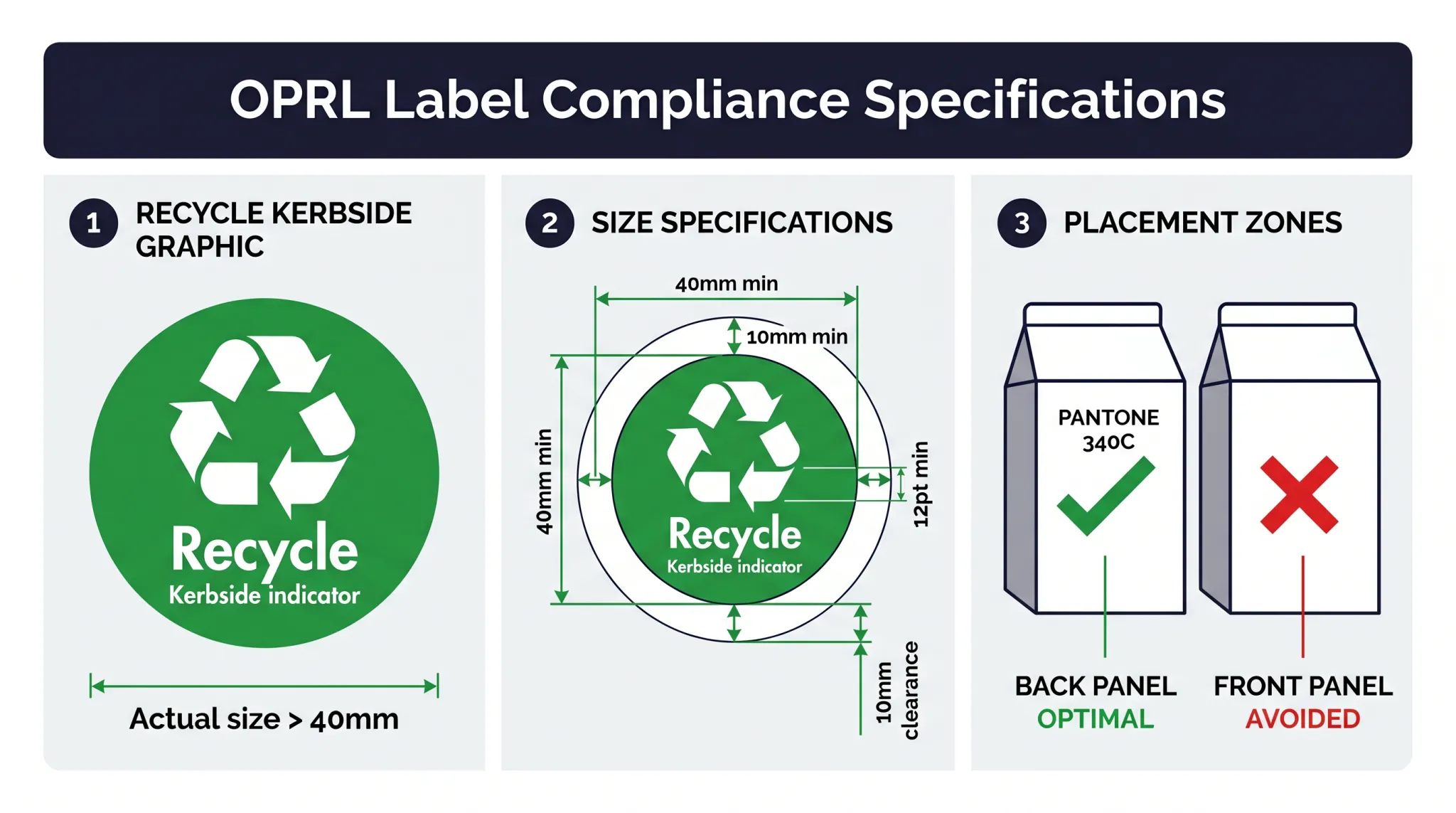
The graphic colour is green (Pantone 340C or equivalent). This specific green distinguishes the Recycle Kerbside label from other packaging graphics. Brands cannot substitute alternative greens without compromising visual recognition and regulatory compliance.
🏷️ Get Official OPRL Graphics for Your Labels
Our design team integrates compliant OPRL graphics into your custom labels and custom stickers. We verify compliance before production to prevent retail rejection.
Get OPRL Compliant Labels →Minimum Label Size Clearance (mm): The Measurement Standards
OPRL labels require minimum visible area. This seems straightforward until you realise how small some custom stickers attempt to make labels to minimise visual brand impact. Too small, and retailers reject packaging. Too small, and consumers cannot read recycling instructions. The measurements matter for both compliance and practical function.
Primary Label Dimensions
The Recycle Kerbside graphic minimum recommended size is 40mm diameter. This represents the smallest size where the graphic remains visually distinct and recognisable. Smaller graphics still technically comply but approach visual degradation where retailers might challenge compliance.
The minimum text accompanying the graphic (communicating what material is recyclable, recycling instructions, or both) requires 12-point font minimum size for readability. This measurement assumes standard sans-serif font and adequate contrast against background colours. Smaller text creates accessibility issues and regulatory challenges.
Total OPRL label area including graphic plus text typically occupies 50mm × 80mm minimum on standard retail packaging. Premium retail categories often allocate 60mm × 100mm or larger to ensure the label communicates clearly without appearing cramped.
Clearance Zones and Protective Space
The Recycle Kerbside graphic requires protective space around it. Minimum clearance of 8mm to 10mm on all sides prevents the graphic appearing crowded or compromised by adjacent design elements. This clearance zone cannot contain other graphics, text, or design elements without compromising compliance.
For custom labels, clearance zone specification becomes critical because labels themselves are dense information carriers. The OPRL label might occupy one section of a larger label containing barcode, brand information, weight declarations, and ingredient listings. Proper clearance prevents visual confusion where one element interferes with another.
Placement on box panels affects clearance requirements. If the OPRL label sits near box edges, additional edge clearance (minimum 10mm from box edge) ensures labels won’t appear cut off during die-cutting. Labels sitting in panel centres require minimal edge concern but must maintain internal clearance from other graphics.
Placement Rules: Where Labels Belong on Retail Packaging
Label placement affects both compliance and practical visibility. Regulators require labels in locations consumers can see without excessive effort. Retailers expect labels in expected locations where consumers automatically look for recycling information.
Front vs Back Panel Considerations
Front panels (primary display faces) represent premium real estate. Brands naturally want minimal visual impact from compliance labels on premium front panels. However, placing OPRL labels on back panels only creates compliance risk because consumers primarily see front panels before purchasing.
Optimal placement strategy: OPRL labels appear on back panels with secondary placement on information panels (sides). This provides visibility when consumers examine full packaging while respecting premium front panel branding.
For food packaging with limited panel area, OPRL requirements integrate onto the cardboard backing rather than primary display surfaces. The placement must balance consumer visibility with brand aesthetic priority.
Interaction with Barcode and Other Symbols
Barcodes, weight declarations, allergen information, and other mandatory symbols compete for space on packaging. OPRL labels must integrate without compromising readability of other critical information.
Minimum 15mm clearance between OPRL labels and barcodes prevents visual confusion where one element interferes with optical recognition of another. Barcode scanners require clean separation from competing graphics.
Allergen symbols and warnings take priority in packaging hierarchy. OPRL labels should never interfere with prominent allergen warning placement. For food packaging, allergen declarations legally supersede OPRL label placement. Designers must accommodate allergen priority first, then integrate OPRL labels.
| Packaging Type | Optimal OPRL Placement | Minimum Size | Clearance Zone |
|---|---|---|---|
| Food Packaging | Back panel, clearly visible | 40mm graphic, 12pt text | 10mm minimum all sides |
| Retail Boxes | Back panel or information side | 40mm graphic, 12pt text | 10mm minimum |
| Custom Labels | Dedicated label section | 40mm graphic, 10pt text (acceptable) | 8mm minimum |
📐 Strategic Label Placement for Your Packaging
Our design team reviews your packaging layout, identifies optimal OPRL label placement, and integrates compliance into custom labels without compromising brand aesthetics. We guarantee retail acceptance through proper compliance design.
Review Your Label Placement →Artwork Design Guidelines and Barcode Symbol Integration
Creating production-ready OPRL labels requires understanding artwork specifications and file format requirements that prevent manufacturing failures.
File Format and Colour Specifications
Artwork files must be supplied in vector format (Adobe Illustrator, EPS, or PDF) ensuring graphic clarity regardless of output size. Raster images (JPG, PNG) create pixelation and quality loss unacceptable for compliance graphics.
Colour specification requires Pantone references or CMYK colour codes. Design software converts Pantone to CMYK for printing, but professional designers specify both ensuring colour accuracy. The green Recycle Kerbside graphic requires Pantone 340C (or equivalent) to match standardised specifications.
Text specifications demand sans-serif fonts (Helvetica, Arial, or similar) for maximum readability. Serif fonts create visual noise reducing clarity at small sizes. Font weight should be regular or semi-bold, avoiding extremely thin weights that disappear at small point sizes.
Barcode Symbol Proximity and Integration
Barcodes scanned at retail require specific clearance preventing misreads. Placement of OPRL labels near barcodes demands careful spacing. The barcode itself requires quiet zone (empty space) of 4mm minimum on all sides. OPRL labels must respect this quiet zone.
If OPRL label and barcode appear on same panel, maintain minimum 20mm separation. This prevents optical scanner confusion where label graphics interfere with barcode recognition.
For custom labels combining barcode, OPRL information, and branding, professional layout becomes essential. The label designer must understand barcode placement requirements, OPRL specifications, and brand aesthetic requirements simultaneously. This integrated approach prevents design conflicts.
Material-Specific OPRL Requirements and Recycling Claim Integration
Different packaging materials require specific recycling messaging. This specification prevents misleading consumers about material recyclability and ensures legal compliance with recycling claims regulations.
Material Claim Messaging
The Recycle Kerbside label must communicate clearly what material is recyclable. For cardboard boxes, messaging reads “Cardboard – Recycle” or “Cardboard – Please Recycle”. This explicit claim prevents consumer confusion about material type.
For packaging with multiple materials, the label must communicate what’s recyclable and what isn’t. If plastic elements are not recyclable, messaging must clarify “Cardboard Only – Remove Plastic Elements Before Recycling”. This prevents consumer errors recycling non-recyclable components.
For food packaging with complex material combinations (cardboard, plastic windows, paper fill), the OPRL label must address each component. Complex material compositions require clearer messaging preventing consumer confusion.
Sustainable Print Identification and Environmental Claims
Many UK brands now add additional sustainability messaging beyond minimum OPRL requirements. Claims like “Made from 100% Recycled Cardboard” or “FSC Certified Packaging” integrate into label design alongside OPRL graphics.
Environmental claims require substantiation and must avoid misleading consumers. A brand claiming “Recyclable” must confirm the material actually enters recycling streams in most UK councils. Claiming “Made from Recycled Materials” requires defining percentage accuracy.
Professional OPRL labels integrate these environmental claims without creating visual clutter. The solution: prioritise OPRL compliance graphics, then layer environmental claims as secondary information. This visual hierarchy ensures compliance graphics remain primary.
Related Topic: For complete understanding of tax implications on food packaging, read our detailed guide on the UK Plastic Packaging Tax (PPT).
Common OPRL Mistakes That Trigger Retail Rejection
After 15 years manufacturing retail packaging, I’ve identified the most common OPRL errors causing warehouse rejection or expensive reprinting:
Mistake #1: Incorrect Graphic Sourcing
Designers source OPRL graphics from unofficial websites, creating variations missing official specifications. Retailers compare packaging against official OPRL guidelines. Non-standard graphics fail inspection.
Solution: Always source official OPRL graphics from OPRL management authority or certified suppliers. Verify graphic proportions and colour specifications against governance standards.
Mistake #2: Undersized Text and Graphics
Brands attempt to minimise OPRL label visibility by reducing sizes below specifications. Text becomes unreadable. Graphics appear unclear. Retailers reject the packaging as non-compliant.
Solution: Allocate adequate space for OPRL labels in design phase. Minimum 40mm graphic diameter and 12-point font are non-negotiable. Design around these constraints rather than fighting them.
Mistake #3: Poor Colour Contrast
OPRL labels printed on dark backgrounds without adequate contrast become illegible. Retailers reject packaging where consumers cannot read recycling instructions clearly.
Solution: Place OPRL labels on light backgrounds ensuring contrast. If background must be dark, use white text on dark or add white background box behind label text ensuring readability.
Mistake #4: Label Placement Too Near Box Edges
Labels positioned near box edges get cut off during die-cutting, appearing incomplete. Retailers refuse stock where labels appear damaged.
Solution: Position all labels minimum 10mm from box edges. Maintain clearance accounting for die-cutting tolerances. Allow safety margin beyond minimum specifications.
Mistake #5: Missing or Incorrect Recycling Claims
Packaging claims material is recyclable when local councils don’t actually accept it. This creates consumer confusion and regulatory exposure. Retailers increasingly scrutinise recycling claims before accepting stock.
Solution: Verify material recyclability against your actual distribution area council guidance. Claim only materials accepted in majority of UK councils. Avoid claims like “Recyclable” without specifying material type or conditions.
Real-World OPRL Implementation: Case Study
This actual implementation demonstrates OPRL label application in food packaging context:
Food Brand Compliance Success: Pizza Packaging
A regional pizza brand wanted OPRL labels on pizza boxes but allocated minimal space respecting premium branded design. Initial design placed 25mm OPRL graphic in corner, meeting technical minimum but appearing undersized.
Challenge: Balance OPRL visibility with premium brand aesthetics on limited box surface area.
Solution: Repositioned graphic to 40mm and integrated with existing box design element. The OPRL label became visual design feature rather than regulatory afterthought. The larger graphic enhanced perceived brand quality while achieving full compliance. Result: Retailers approved packaging immediately with no rejection delays.
Key Takeaway: OPRL compliance doesn’t require compromise. Strategic design integration makes compliance elements reinforce rather than detract from brand positioning.
✅ Get Your OPRL Labels Compliance Verified
Our design and compliance teams review your packaging artwork, verify OPRL label specifications, confirm retail acceptance requirements, and integrate compliance into your custom labels or custom stickers. Zero risk of retail rejection through proper compliance design.
Get OPRL Compliance Review →The Bottom Line: OPRL Labels Aren’t Optional
OPRL labels represent legal compliance requirements, retailer gate criteria, and consumer communication tools simultaneously. Getting them right prevents warehouse rejection, supports sustainable consumer behaviour, and communicates brand commitment to environmental responsibility.
After 15 years manufacturing retail packaging, the clearest pattern I observe: brands investing time in proper OPRL label integration launch without delays or complications. Brands treating labels as afterthoughts waste money on reprinting and face retail acceptance delays.
Your packaging communicates material composition and recycling instructions to every customer. Make that communication compliant, clear, and professionally executed. The difference between proper OPRL labels and inadequate compliance can determine whether your product reaches shelves or sits rejected in warehouses.
The investment in proper OPRL label design and integration is minimal relative to the cost of non-compliance. Make this investment deliberately, strategically, and informed by actual regulatory requirements and retailer expectations. Your launch timeline and budget will thank you.
See Also: Learn how to correctly label your packaging for kerbside recycling in our detailed OPRL Labels Guide.
The customer at the point of disposal rather than after they have already unboxed the product. Our OPRL labels guide covers exactly how to apply this to your specific packaging mix if your fragrance box includes
that label change alone has opened listings that were previously unavailable. Our OPRL labels guide covers how to apply the correct label for your specific finish combination accurately, including
PE-coated corrugated is not kerbside recyclable regardless of the board grade. Under our OPRL labels guide requirements and CMA enforcement guidance, printing “recyclable” on a PE-coated pizza
will be oil and vinegar-contaminated at disposal and therefore not recyclable in practice. Our OPRL labels guide and sustainable food packaging guide cover the defensible claims for food packaging
panel, tear-strip, and tray depth specifications before briefing the display, not after. Our OPRL labels guide covers the recycling label requirements that also apply to retail display packaging, including
OPRL labelling on cupcake boxes see our OPRL labels guide, correct dimensions guidance see our custom box dimensions guide, and sustainability claims see our
At no extra cost, and will not print an inaccurate claim regardless of what a brief requests. Our OPRL labels guide covers the full positioning and label selection requirements in more
local recycling; label instead. And for brands growing toward retail listings, the OPRL labels guide explains exactly where the recycling label must appear on the box panel for OPRL