
Blister Packaging UK: When to Use It vs Boxes, Cost and Retail Compliance

Your product keeps disappearing from the shelf. Or your retailer is telling you the box takes up too much pegboard space. Or you’re losing stock to shoplifting and a cardboard box is doing nothing to slow that down. These are the three most common reasons UK brands end up looking seriously at blister packaging, and whether it actually solves your problem depends on which of those three is actually your problem.
This guide comes from the team at Wabs Print, a UK-wide packaging supplier that has produced custom blister packs and retail packaging for UK businesses since 2008. We supply 8,500 plus brands and have seen blister packaging save businesses significant money in theft prevention, and we have also seen brands choose it when a well-designed box would have done the same job for less. The honest answer on when to use blister packaging UK versus a box is more nuanced than most suppliers will tell you, because blister packaging has real costs and compliance considerations that only matter if you know about them before you order. Wabs Print supplies custom blister packaging to retail businesses across the UK, from independent hardware retailers in Newcastle upon Tyne and Cardiff to FMCG brands in Nottingham and Glasgow. If you want a price now, custom blister packaging UK will get you a quote within 24 hours. Free design support is included on every order, and delivery is free to any UK address.
What Is Blister Packaging UK?
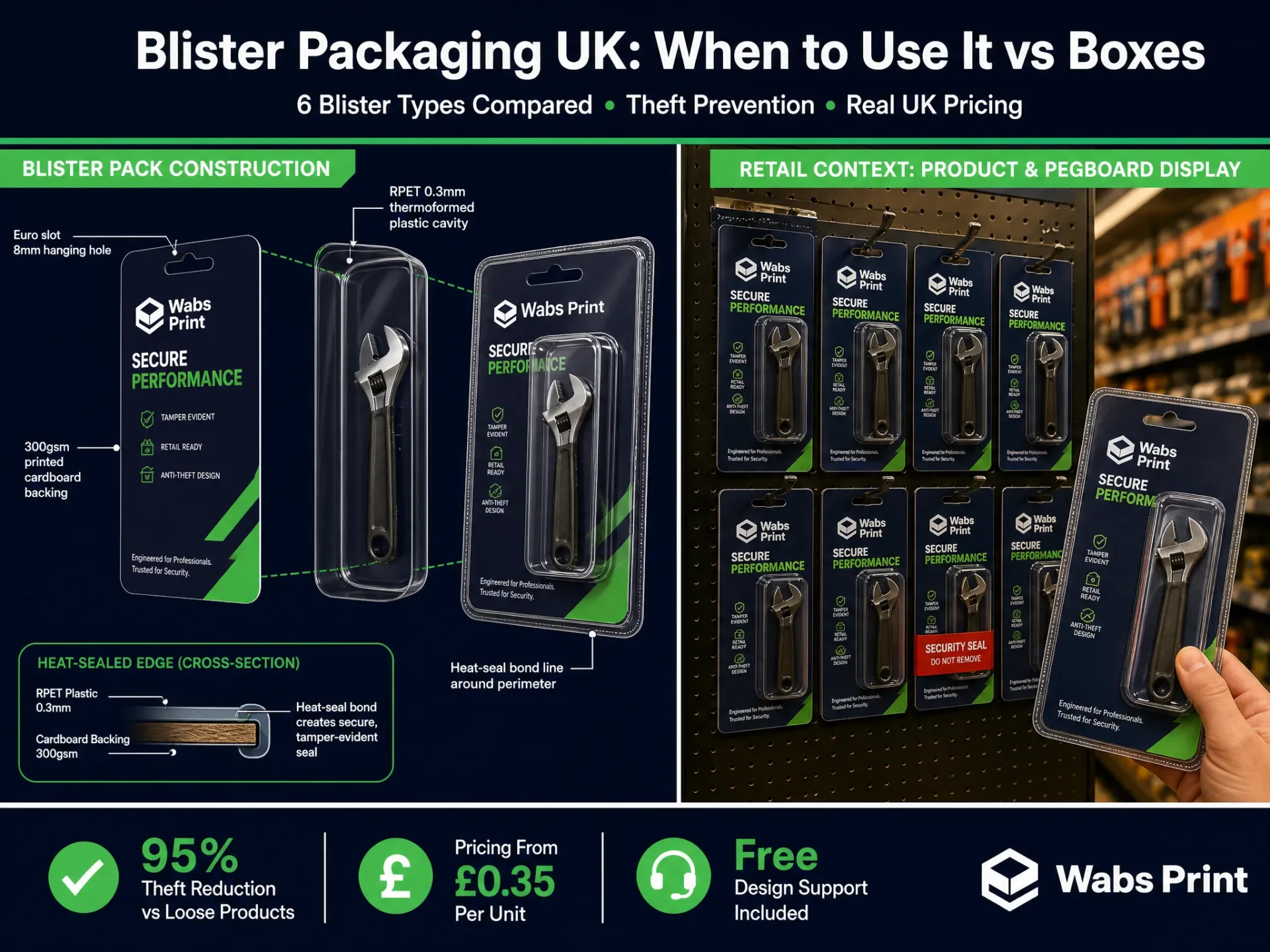
Blister packaging is retail display packaging combining a pre-formed plastic cavity with a printed cardboard backing card. The transparent plastic dome, called the blister, protects products while allowing complete product visibility, and is heat-sealed or RF-welded to the card to create a tamper-evident, theft-resistant unit ready to hang on a pegboard or stand on a counter.
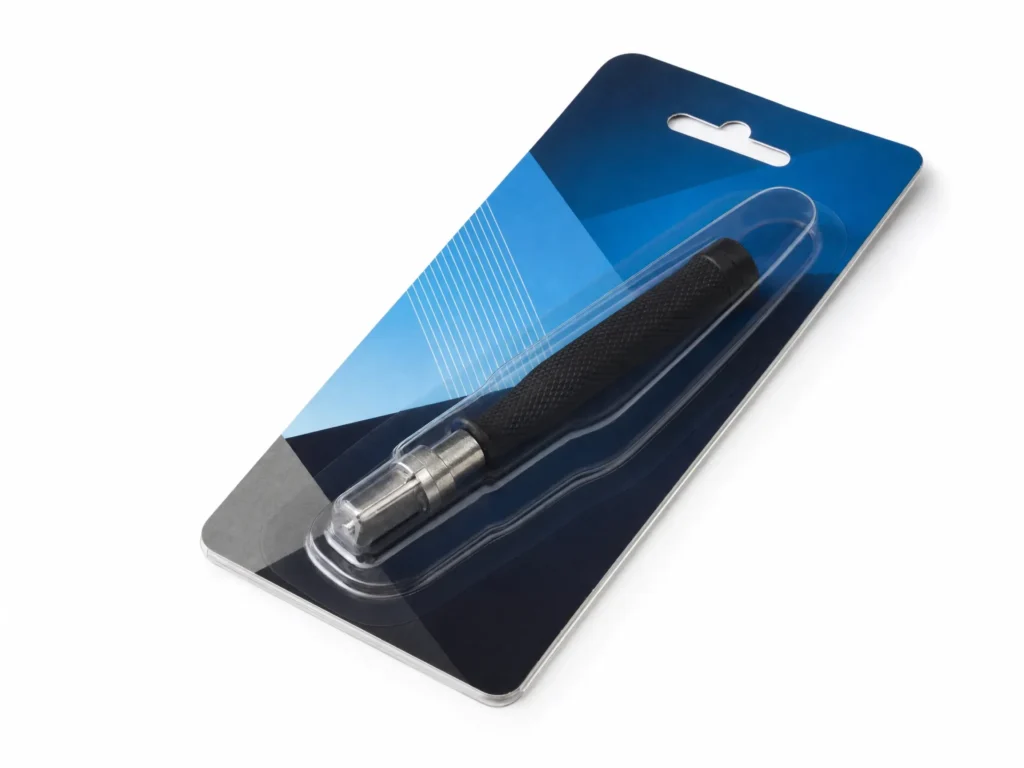
The plastic component is thermoformed RPET (recycled polyethylene terephthalate), the same material as most plastic drinks bottles, heated to around 160 to 180 degrees Celsius and vacuum-pulled over a custom aluminium mould to create a cavity matching the product’s shape. The card backing is typically 300 to 600gsm SBS board, printed in full colour with the brand, product information, barcode, and any required compliance labelling. The two components are joined by a heat-seal bond running around the blister perimeter, creating a package that is extremely difficult to open without visibly destroying it.
One thing that catches a lot of first-time blister pack buyers off guard: the plastic and the card are two separate materials with two separate compliance implications, which matters both for EPR reporting and for any sustainability claim on the outer packaging. We cover that in the compliance section below. It is worth knowing before you brief the spec rather than after.
Blister Pack vs Box: When Each One Wins
The choice between blister packaging and a printed box is rarely about which looks better. It is about which solves the actual retail problem your product has.
| Factor | Blister Pack Wins | Printed Box Wins |
|---|---|---|
| Theft risk | High: small, high-value, easily pocketed items (hardware, batteries, cosmetics) | Low: bulkier products that are harder to conceal |
| Product visibility | Essential: customers need to see colour, size, or condition before buying | Not critical: product described well on box, or condition is consistent |
| Retail space | Limited pegboard space, vertical display needed | Adequate shelf space, brand storytelling on the box earns its keep |
| Unboxing experience | Not a consideration: checkout counter, pharmacy, hardware store | Significant: gifting, D2C, subscription, premium positioning |
| Sustainability messaging | Harder: plastic component requires care with OPRL and PPT | Easier: single-material card boxes recycle without qualification |
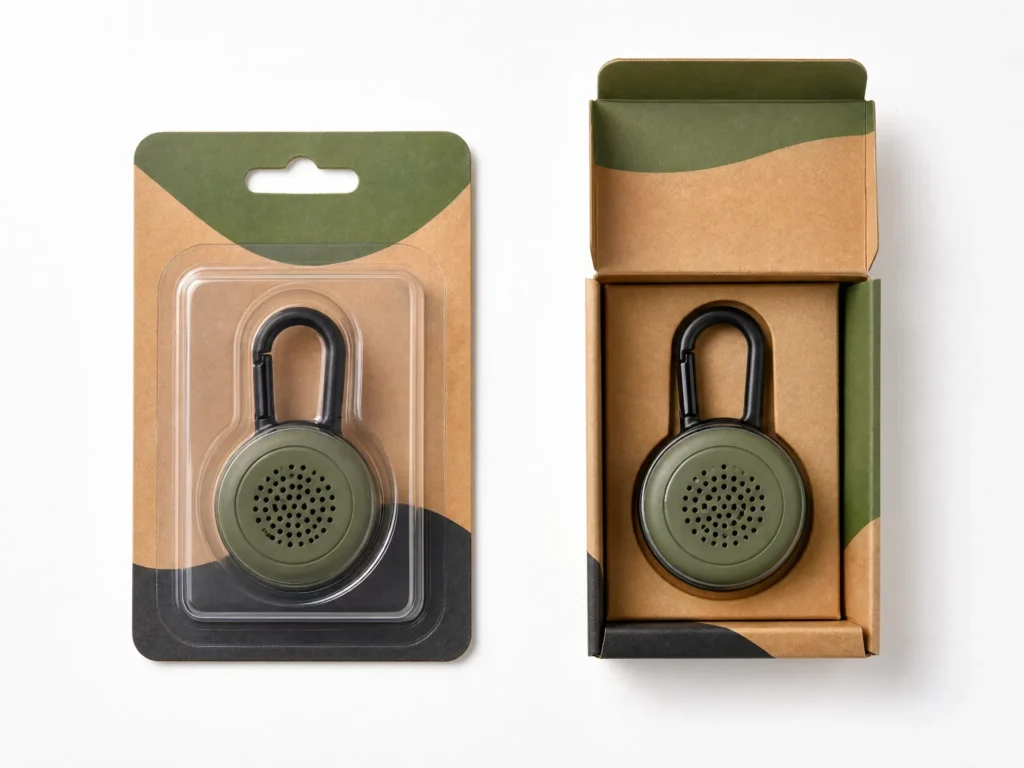
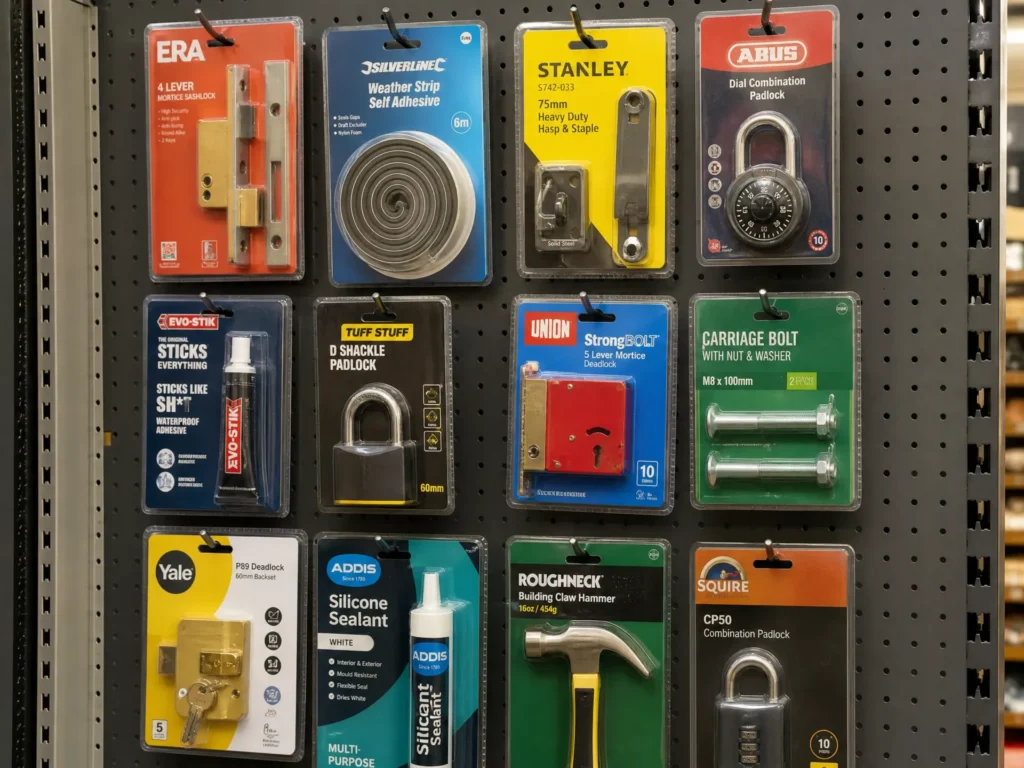
The clearest case for blister packaging is when your product is small, high-value, easily concealed, and sold in an environment where shoplifting is a real cost. Hardware accessories, batteries, fishing tackle, cosmetics sold in Boots or independent pharmacies, electronics accessories. In those environments, blister packs reduce theft by up to 95 percent compared with loose or boxed products, which for a retailer stocking multiple high-value SKUs can represent substantial annual savings.
The clearest case against blister packaging is when your product’s value is tied to the unboxing moment, when you are selling direct-to-consumer, or when your brand is built on sustainability credentials that a plastic blister undermines. Our no minimum order packaging guide covers the wider decision framework for early-stage brands choosing packaging formats, where blister packs’ tooling cost and minimum volume make them a poor choice for test batches and early-stage validation.
The Six Types of Blister Pack and When Each Fits
Choosing the right blister type is a structural decision before it is a design decision.
| Type | Construction | Starting Price | Best For |
|---|---|---|---|
| Face seal | Plastic blister heat-sealed to front of printed card | £0.35 per unit at 10,000+, £0.55 at 500-1,000 | Lightweight products under 200g, most economical option, batteries, stationery, fishing tackle |
| Trapped blister | Plastic cavity sandwiched between two cardboard layers | £0.85 per unit at 10,000+, £1.15 at 500-1,000 | Heavier products up to 2kg, maximum strength, both sides printable |
| Clamshell | Two hinged plastic halves that snap shut, no card needed | £0.65 per unit at 10,000+, £0.95 at 500-1,000 | 360-degree product visibility, fishing lures, craft supplies, reusable by customer |
| Slide blister | Plastic blister slides into printed cardboard sleeve | £1.20 per unit at 10,000+, £1.45 at 500-1,000 | Premium unboxing feel, luxury cosmetics, high-end accessories, gift items |
| Mock blister | Printed card only, product fixed with tabs, no plastic | £0.25 per unit at 1,000+, starting price | Low-theft environment, fully recyclable, fastest production |
| Full face blister | Plastic extends across entire card surface | £1.45 per unit at 10,000+, £1.85 at 500-1,000 | Multi-piece kits, delicate items, maximum encapsulation |
Face seal is the most commonly requested type across our customer base and is the right starting point for most products. Trapped blister earns its place when the product is heavy enough that a face-sealed construction risks the blister pulling away from the card under the product’s weight. Clamshell suits any situation where 360-degree product visibility matters more than having a printable card surface. Slide blister is the premium option for brands where the unboxing experience is part of the perceived value, not just the product protection. Mock blister is the overlooked option for products in low-theft environments, since it is the only fully recyclable single-material option in the range and has the fastest production lead time.
Cost and Pricing Guide
All prices below are confirmed from our live blister packaging page and include the printed cardboard backing in one to two colours. Full-colour CMYK printing adds £0.08 to £0.15 per unit. Free UK-wide shipping is included on every order.
Face Seal and Clamshell Pricing by Volume
| Volume | Face Seal, Small 80x120mm | Face Seal, Medium 150x200mm | Clamshell, Medium |
|---|---|---|---|
| 500 to 1,000 units | £0.55 | £0.85 | £0.95 |
| 2,500 plus units | £0.42 | £0.72 | £0.78 |
| 10,000 plus units | £0.35 | £0.60 | £0.65 |
Trapped, Slide, and Full Face Pricing by Volume
| Volume | Trapped Blister, Medium | Slide Blister, Medium | Full Face, Large |
|---|---|---|---|
| 500 to 1,000 units | £1.15 | £1.45 | £1.85 |
| 2,500 plus units | £0.95 | £1.28 | £1.58 |
| 10,000 plus units | £0.85 | £1.20 | £1.45 |
There is no minimum order at Wabs Print. If your artwork is not yet print-ready, our design team can check your file, set up the backing card artwork, or build the full design from scratch including all compliance labelling, at no extra cost.
How to Choose: Decision Framework for Your Retail Situation
Work through these before briefing a blister pack spec, in this order.
- Is theft actually your problem, or are you solving for something else? Blister packaging is unrivalled at theft prevention but less cost-effective than a box if theft is not your primary concern. If your issue is shelf presence, brand storytelling, or small batch flexibility, a well-designed box from our retail boxes hub will usually serve you better at lower cost.
- Does your product need to be seen before purchase? If customers need to verify colour, condition, or size before buying, the crystal-clear RPET cavity gives them that without you having to rely on product photography on a box. Cosmetics, fishing tackle, and craft supplies are classic examples.
- What is the retail environment? Pegboard hanging in a hardware store, pharmacy, or convenience store strongly favours blister packs. Shelf display in a gift shop, boutique, or D2C box strongly favours a printed carton. Our display box packaging guide and our corrugated box grades guide cover the structural options in non-blister retail formats in more depth if the retail environment is shared between blister and corrugated display.
Blister Pack Delivery Across the UK
Wherever your retail business is based, lead time and pricing stay identical. A craft supply brand in Newcastle upon Tyne works to the same 7 to 10 working day turnaround from artwork approval as a hardware retailer in Belfast, and delivery is free to any UK address regardless of order size or blister type.
Compliance and Sustainability for Blister Packaging
Blister packaging has more compliance complexity than most packaging formats because it combines two materials with different regulatory treatment. The cardboard backing card is straightforward: recyclable SBS board, OPRL “Recycle” label applies, no Plastic Packaging Tax implications. The RPET plastic blister is where it gets more complicated.
Under UK Extended Producer Responsibility rules, the plastic component of a blister pack counts toward your plastic packaging EPR obligation. The Plastic Packaging Tax (PPT), confirmed at £228.82 per tonne from 1 April 2026 under HMRC regulations, applies to plastic packaging containing less than 30 percent recycled content. RPET blister packaging is made from recycled PET and typically exceeds the 30 percent recycled content threshold by a significant margin, which means RPET blister packs generally fall outside the PPT scope. However, if you are using standard virgin PET rather than RPET, the PPT applies. Always confirm the exact recycled content percentage with us at quote stage if you are reporting PPT liability. Our OPRL labels guide covers how the two-material structure of blister packs affects the recycling labelling on the backing card. The OPRL guidance for blister packs requires two separate labels, one for the card (Recycle) and one for the plastic component (Check Local Recycling or Recycle, depending on whether your local council accepts PET plastic at kerbside, which most now do). This reflects packaging compliance guidance as of June 2026. Always verify current requirements at gov.uk before making compliance decisions for your business.
FAQ
What is the difference between blister packaging and clamshell packaging?
Blister packaging combines a plastic cavity heat-sealed to a printed cardboard backing. Clamshell packaging consists of two plastic halves connected by a living hinge that snap shut, with no card required. Blister packs offer more surface for brand messaging on the card. Clamshells give full 360-degree product visibility. Both are used widely in UK retail, often in the same store on the same pegboard depending on the product.
How much does custom blister packaging cost in the UK?
Face seal blister packs start from £0.35 per unit at 10,000 plus units, or £0.55 at 500 to 1,000 units, for a small 80mm x 120mm size with one to two colour card printing. Full-colour CMYK printing adds £0.08 to £0.15 per unit. . Free UK-wide shipping is included on every order.
Does blister packaging attract Plastic Packaging Tax?
RPET blister packaging is typically made from more than 30 percent recycled content, which means it falls outside the Plastic Packaging Tax scope. If you use virgin PET rather than RPET, the tax applies at £228.82 per tonne from 1 April 2026. Confirm the recycled content percentage with us at quote stage if PPT reporting matters for your business.
Do you deliver blister packaging to Cardiff and Newcastle upon Tyne?
Yes. Wabs Print delivers custom blister packaging to businesses across the UK, including Cardiff, Newcastle upon Tyne, Glasgow, Nottingham, Belfast, Edinburgh, and London, with free UK-wide shipping on every order. Standard production is 7 to 10 working days from artwork approval.
What is the minimum order for blister packs?
We will always give you an honest assessment of whether the investment is justified at your volume before you commit. There is no minimum order on the packaging itself.
Why is RPET better than PVC for blister packaging?
PVC (polyvinyl chloride) is not recyclable in UK waste streams, releases toxic chlorine gas when incinerated, and is increasingly banned or rejected by major UK retailers including Tesco, Sainsbury’s, and B&Q. RPET is 100 percent recyclable under UK kerbside collection, produces 79 percent lower carbon emissions than virgin PET production, and meets all major retailer sustainability requirements. We only supply PET and RPET blister materials.
Making the Call
Blister packaging UK wins when theft prevention, product visibility, and pegboard merchandising are the primary retail requirements. A well-designed box wins when unboxing experience, sustainability credentials, brand storytelling, or small-batch flexibility matter more. The honest decision is not which format looks more impressive, it is which one solves the real problem your product has in its specific retail environment.
Whether you are a retailer in Cardiff, a brand in Newcastle upon Tyne, or an FMCG business running a campaign from Glasgow, Wabs Print delivers custom blister packaging across the UK with free UK-wide shipping, free design support on every order, and the same 7 to 10 working day turnaround. If you are ready to get a price, custom blister packaging UK and you will have a quote within 24 hours.