
Cake Box Packaging UK: Durability, Food Compliance and Design Trends 2026

Your cake arrives looking exactly as it left your kitchen. Then the box fails. The base bows, the icing shifts, or a winter delivery leaves moisture staining on an unlaminated kraft surface. The cake was fine. The box was not, and the refund or the review that follows costs more than the difference between a correct and incorrect specification would have.
This guide comes from the team at Wabs Print, a UK-wide packaging supplier that has produced custom cake boxes for UK food businesses since 2008. We have supplied cake packaging to 8,500 plus UK bakeries, patisseries, wedding cake studios, and online cake businesses, and the specification questions we field most often are about board weight matching cake weight, what food-safe certification actually covers, and how to make the economics of custom print work at low volumes. Wabs Print supplies custom cake boxes to food businesses across the UK, from independent bakeries in Oxford and Cambridge to celebration cake studios in York and Leicester. By the end of this guide you will know which board grade suits your heaviest cake, what the food contact regulations require, and what it costs per box at your volume. If you want a price now, custom cake boxes UK will get you a quote within 24 hours. Free design support is included on every order, and delivery is free to any UK address.
What Is Cake Box Packaging UK?
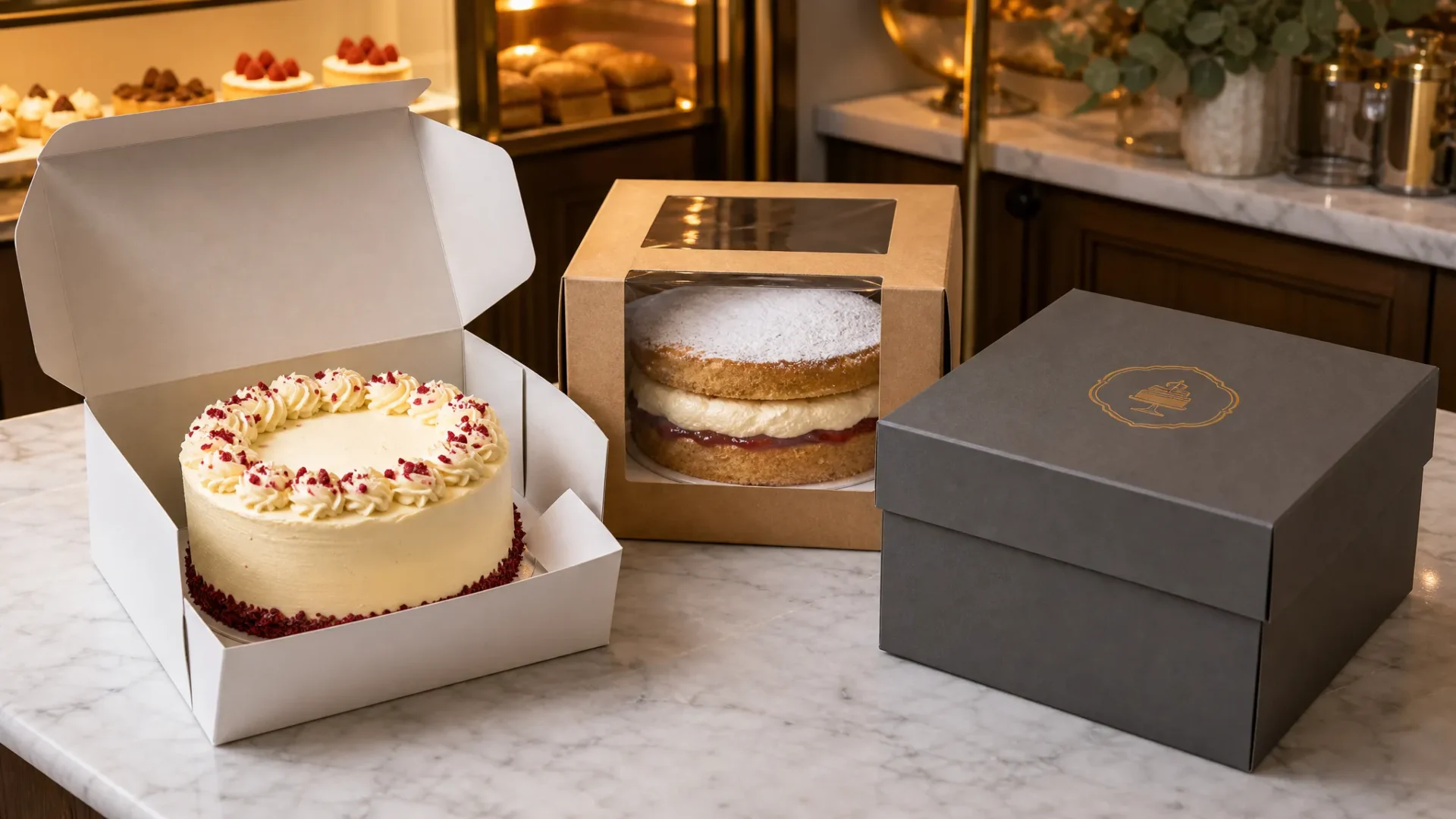
A cake box is a rigid or semi-rigid food packaging container engineered to hold, protect, and present baked goods through the journey from your kitchen to your customer’s table. Unlike a generic cardboard box, a correctly specified cake box has board weight matched to the cake’s mass, a base construction that locks and does not bow under load, and food-safe certified materials throughout.
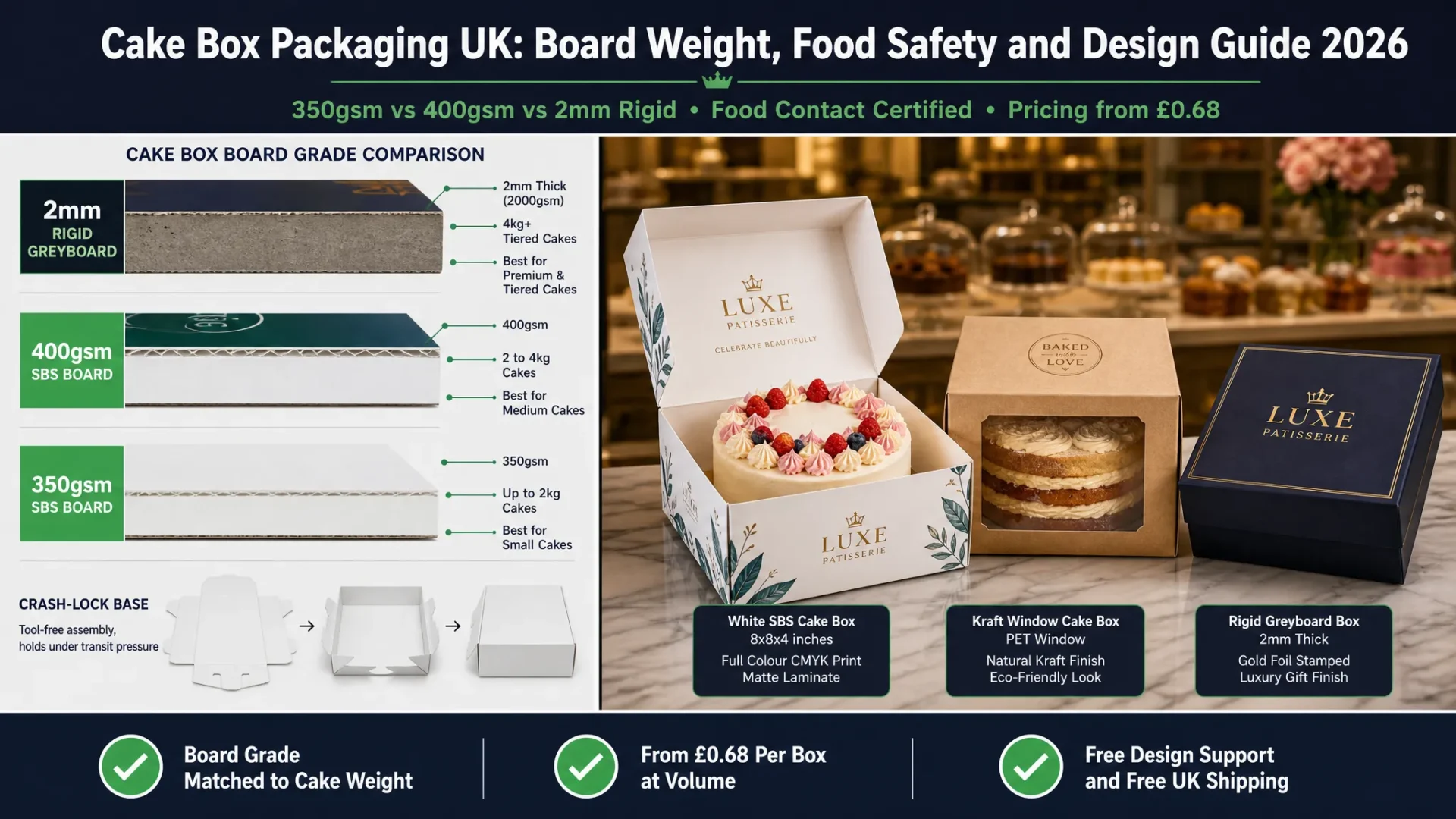
UK cake boxes are made primarily from SBS (solid bleached sulphate) board at 350 to 400gsm, or from 2mm rigid greyboard for premium and high-weight applications. SBS board has a smooth white printing surface on both sides, takes full-colour CMYK printing accurately, and is the standard for the majority of UK bakery and patisserie cake boxes. Kraft board, an unbleached natural brown alternative, uses the same structural specifications but presents with a warm, artisan aesthetic and is available in both unlaminated and laminated versions.
One thing most first-time cake box buyers underestimate: the difference between the three board grades is set by the cake’s weight, not by the box’s size. A large square white box in 350gsm is the correct choice for a 1.5kg layered sponge. The same box in 350gsm is the wrong choice for a 3.5kg heavily decorated wedding tier. The board bows under the weight during transit, and what arrives at the venue is a deformed box and a conversation you do not want to be having an hour before a ceremony.
The Four Cake Box Types and What Each One Does
| Type | Board | Weight Capacity | Price From at 10,000 units | Best For |
|---|---|---|---|---|
| White coated SBS | 350gsm SBS | Up to 2kg | £0.68 per box | Standard celebration cakes, bakery counter, local delivery |
| White coated SBS heavy | 400gsm SBS | 2 to 4kg | £0.84 per box | Heavier decorated cakes, online delivery, wedding tiers |
| Windowed box | 350gsm SBS or kraft with PET window | Up to 2kg | £0.92 per box | Farmers’ market, deli counter, impulse purchase display |
| Rigid gift box | 2mm rigid greyboard with printed wrap | 4kg plus and tiered | £2.45 per box | Premium patisserie, wedding cakes, gifting occasions |
The standard 350gsm white SBS box is the correct starting point for around 90 percent of UK bakery cake packaging. It takes full-colour CMYK printing accurately, is available with gloss, matte, or soft-touch laminate, and handles the weight range that covers most celebration, birthday, and retail bakery cakes. The 400gsm heavy grade earns its place specifically when the cake’s mass is above 2kg and the delivery distance is long enough that sustained base load becomes a real risk. The rigid greyboard box is not a finish upgrade on a standard box, it is a structurally different product built for the weight of tiered cakes, heavy decorated creations, and premium gifting occasions.
The windowed box is the choice that drives the most measurable immediate impact at point of sale. A PET window cut into the lid lets customers see the actual product before purchase, which at a farmers’ market or deli counter consistently outperforms a fully printed box where the customer has to imagine what is inside.
Choosing the Right Board Weight for Your Cakes
The board weight decision is the one that protects your cakes and your reputation in transit, and it is also the one most commonly underspecified because suppliers rarely ask about cake weight at the quote stage.
The practical guide is straightforward. Standard sponge cakes, layer cakes, and most retail bakery products under 2kg sit comfortably in a 350gsm crash-lock base box. A 400gsm crash-lock base box handles cakes from 2 to 4kg, which includes most heavily decorated two-tier cakes, large fruit cakes, and standard wedding tiers. Above 4kg, including multi-tiered wedding cakes and large celebration cakes with extensive sugar decoration, the correct specification is a 2mm rigid greyboard box with a reinforced crash-lock base, since standard folding carton construction cannot maintain its shape under sustained heavy weight during transit.
There is a moist-versus-cold transit consideration that is equally important for UK bakeries: unlaminated kraft board, however beautiful it looks on a bakery counter, absorbs moisture from the ambient environment in transit between October and March. If your cakes travel any distance between autumn and spring, a matte laminate at £0.09 per box prevents a preventable failure. A Bristol online patisserie we supply shifted to matte laminate after transit damage from moisture absorption dropped their complaint rate from 6.4 percent to 0.8 percent in the following month. The laminate cost £0.09 per box. The complaints it prevented cost considerably more.
Collingwood Cakes, a celebration cake studio based in Cambridge, came to us after a run of base failures on their larger two-tier wedding cakes during summer months. They had been specifying 350gsm boxes, which was adequate for their single-tier range but not for their heavier builds. A two-tier cake with full fondant decoration sits at approximately 3 to 4kg depending on the sponge and filling combination, exactly the range where 350gsm shows its limits under transit loading. We switched their wedding tier range to 400gsm crash-lock boxes with matte laminate and retained 350gsm for their single-tier counter range. The base failures stopped immediately. They now run two separate specifications and have extended their delivery radius as a result.
Custom Design: When the Investment Pays Back
A Manchester celebration cake studio added soft-touch laminate and gold foil stamping to their boxes in early 2026. Their average order value increased by £14 per cake. The finish upgrade cost £0.27 more per box. The return was immediate.
That example, confirmed on our live page, illustrates the mechanism by which custom print earns its cost in the cake market specifically: the box is not just packaging, it is part of what the customer is paying for. When someone orders a celebration cake at £60 to £100, the box they carry it in communicates the quality of what is inside before the recipient ever opens it. A plain white box with a sticker is a very different proposition to a soft-touch matte box with a gold foil logo, and the retail price that customers will pay reflects that difference.
The economics of the switch depend on your volume. At 50 units a month, the per-box cost of custom print at that volume (starting from £2.85 per box for 50 units) is high relative to what the print adds. At 500 units a month, the per-box cost drops to £1.43, and the custom print investment becomes straightforward to justify against the price premium it supports.
| Volume | Price Per Box, White SBS 350gsm | Custom Print and Matte Laminate Included |
|---|---|---|
| 50 units | £2.85 | Yes |
| 100 to 499 units | £2.10 to £2.85 | Yes |
| 500 to 999 units | £1.43 | Yes |
| 1,000 to 2,499 units | £1.12 | Yes |
| 5,000 plus units | £0.82 | Yes |
| 10,000 plus units | £0.68 | Yes |
Adding soft-touch laminate costs £0.09 per box. Gold or silver foil stamping adds £0.18 per box. Embossing adds £0.12 per box. Interior print adds £0.06 per box. There is no minimum order, no setup fee, and if your artwork is not yet print-ready, our design team will check your file, set it up correctly, or build the design from scratch, at no extra cost. Our luxury packaging finishes guide covers the full range of finish options and what each one does to the perceived value of premium food and gifting packaging in more depth than fits here.
How to Choose: A Decision Framework for Your Bakery
Work through these before specifying a cake box.
- What is the weight of your heaviest cake? Under 2kg: 350gsm crash-lock. 2 to 4kg: 400gsm crash-lock. Above 4kg or tiered: 2mm rigid greyboard. If you are unsure, weigh a representative cake including its board or separator and use that number rather than estimating.
- How does the cake travel? Counter to customer in person: unlaminated board is fine. Local delivery within 20 minutes: laminate is strongly recommended. Postal or courier delivery of any distance: 400gsm minimum with matte laminate as a non-negotiable specification.
- Does the customer need to see the product before buying? Farmers’ market, deli counter, or pop-up sale: a PET windowed box consistently outperforms a fully printed box for impulse purchase decisions, since the product is its own most powerful advertisement at those distances and price points. Our custom box dimensions guide covers how to measure your specific cake dimensions correctly for a precise fit, which matters more in a windowed box where the fit is visible to the customer through the panel.
- What does your retail price support? Under £15 per cake: plain or minimally printed box, the economics of custom print are harder to justify. £15 to £40: a single finish upgrade, soft-touch or matte laminate plus a single-colour print, typically earns back its cost within the first month. Above £40: full custom print with finish upgrades is appropriate and expected by the customer at that price point.
For brands where the box also needs to meet sustainability standards for retailer listings, the recyclability implications of your chosen finish are part of the specification decision. Our sustainable food packaging guide covers which finish combinations are kerbside recyclable under OPRL guidance and which require the “Check local recycling” label instead. And for brands growing toward retail listings, the OPRL labels guide explains exactly where the recycling label must appear on the box panel for OPRL compliance.
Cake Box Food Safety Compliance
All cake boxes we supply comply with retained EU Regulation 1935/2004 on materials and articles intended to come into contact with food. This covers the board, the ink system, any laminate applied to the surface, and the glue used in construction. A Declaration of Compliance is available with every order on request and is the standard document that trading standards inspectors and retail buyers ask for.
The OPRL recycling label for cake boxes depends on the finish specification. Unlaminated white or kraft board: OPRL “Recycle” designation, kerbside recyclable. Matte or gloss laminate: technically recyclable but requires specialist facilities not available through most kerbside collections, so OPRL “Check local recycling” is the correct label. Soft-touch laminate: currently not recyclable, OPRL “Not currently recyclable.” PET window patches: not kerbside recyclable as a combined unit, though the card and window separate for different recycling streams in some facilities. We apply the OPRL-correct label to every cake box based on its specific finish combination, at no extra cost.
The Plastic Packaging Tax at £228.82 per tonne from 1 April 2026 applies to plastic packaging containing less than 30 percent recycled content. A PET window patch on a cake box is a plastic component and may bring the box within PPT scope depending on its weight relative to the total box weight. We provide PPT material data with orders where this is relevant, and our Plastic Packaging Tax UK guide covers the calculation method for mixed-material food packaging. This reflects packaging compliance guidance as of June 2026. Always verify current requirements at gov.uk before making compliance decisions for your business.
Cake Box Delivery Across the UK
Wherever your bakery or cake business is based, lead time and pricing stay identical. An independent cake studio in York works to the same 7 to 10 working day production turnaround as a multi-site bakery chain in Leicester, and delivery is free to any UK address regardless of order size or board grade.
We receive a regular flow of enquiries from online cake businesses in Oxford asking specifically how to specify a box for postal delivery rather than local collection, since the two use cases have meaningfully different structural requirements. For Royal Mail or courier transit, 400gsm board with matte laminate is our standard starting point for any cake above 1kg sent through the post, since the box will experience sustained load, ambient humidity changes, and handling roughness that a counter-to-customer journey does not. Whether you are baking from a home kitchen in Cambridge or running a cake operation from a commercial unit in Southampton, turnaround and pricing are identical, and our design team is available throughout at no extra charge.
FAQ
What board weight do I need for my wedding cake box?
Match the board to the assembled cake’s weight. For single-tier wedding cakes under 2kg: 350gsm crash-lock. For two-tier or heavily decorated cakes between 2 and 4kg: 400gsm crash-lock. For multi-tiered cakes above 4kg: 2mm rigid greyboard with a reinforced crash-lock base. The most common mistake is specifying 350gsm for a heavy two-tier build, which causes base deformation under transit loading.
Do I need food-safe certified cake boxes in the UK?
Yes. Any packaging in direct contact with food in the UK must comply with retained EU Regulation 1935/2004, which covers board materials, inks, coatings, and adhesives. All cake boxes we supply carry full food contact compliance certification. A Declaration of Compliance is available with every order on request, which is what trading standards inspectors and retail buyers ask for during audits.
Can I get custom printed cake boxes with no minimum order?
Yes. There is no minimum order. You can order 50 boxes with full custom CMYK print, matte laminate, and a specific finish, and receive the same quality as a 10,000-unit production run. The per-box price is higher at low volumes since setup cost is spread across fewer units, but the print and board specification are identical. Most UK bakeries start between 100 and 500 units for their first branded run.
Do you deliver custom cake boxes to Oxford and Cambridge?
Yes. Wabs Print delivers custom cake boxes to businesses across the UK, including Oxford, Cambridge, Leicester, Southampton, Brighton, York, and London, with free UK-wide shipping on every order. Standard production is 7 to 10 working days from artwork approval.
How do I choose between laminated and unlaminated cake boxes?
Unlaminated board is kerbside recyclable and looks cleaner in an eco-sustainability context, but absorbs moisture in transit between October and March, which can deform the box or transfer moisture to the cake. Laminated board resists moisture, protects the print surface against handling wear, and is the correct specification for any postal or courier delivery. The matte laminate adds £0.09 per box and prevents a much more expensive transit failure. For counter display only, unlaminated is a reasonable choice.
What is the difference between a windowed cake box and a standard cake box?
A windowed cake box has a food-safe PET film panel cut into the lid or front, letting customers see the product before purchase. Standard cake boxes are fully printed on all external panels with no visible product. Windowed boxes outperform standard boxes for impulse purchase decisions at market stalls, deli counters, and bakery displays. They carry an OPRL “Check local recycling” label due to the PET window component, rather than the standard “Recycle” label on all-board boxes.
How much do custom cake boxes cost?
White SBS 350gsm starts from £2.85 per box at 50 units, dropping to £0.68 at 10,000 plus units. Kraft starts from £3.10 to £0.79. Windowed boxes from £3.45 to £0.92. Rigid greyboard from £9.00 to £2.45. All prices include full CMYK print and free UK shipping. Finish upgrades add £0.06 to £0.22 per box depending on type.
Making the Call
Cake box packaging UK decisions start with the cake’s weight and the distance it travels. Match the board grade to the weight. Add matte laminate for anything being posted or delivered in autumn and winter. Add custom print and a finish upgrade once your monthly volume makes the economics work. And specify the OPRL-correct label from the start rather than reprinting to add compliance labelling later.
Whether you are a celebration cake studio in York, an online bakery in Oxford, or an artisan patisserie in Cambridge, Wabs Print delivers custom cake boxes across the UK with no minimum order, free UK-wide shipping, free design support on every order, and the same 7 to 10 working day turnaround regardless of volume. If you are ready to get a price, custom cake boxes UK and you will have a quote within 24 hours.