
Takeaway Box Packaging UK: Materials, Compliance and Sustainability Guide 2026

You are choosing a box for food that goes through delivery platform logistics, gets handled by a driver, arrives at a door, and is opened by a customer who judges your brand on the whole experience, not just the food inside. Most UK takeaway operators pick a box based on price per unit and move on. The ones who get complaints about soggy food, greasy exteriors, or collapsed boxes usually discover afterwards that the specification gap was a few pence per box.
This guide comes from the team at Wabs Print, a UK-wide packaging supplier that has produced custom takeaway boxes for UK food businesses since 2008. We supply 5,000 plus UK food businesses across fast food, delivery-only kitchens, street food, and catering operations. The questions we get asked most often are about material choice, specifically kraft versus white versus bagasse, the grease resistance claims that differ between box types, and how food contact compliance works across a mixed takeaway menu that might include burgers, noodle boxes, and chip containers in the same order. Wabs Print supplies custom takeaway boxes to food businesses across the UK, from independent takeaways in Cambridge and Oxford to ghost kitchen operations in Brighton and York. By the end of this guide you will know which box type suits each menu item, what the materials actually differ on, and what the compliance requirements genuinely ask of you. If you want a price now, custom takeaway boxes UK will get you a quote within 24 hours. Free design support is included on every order, and delivery is free to any UK address.
What Are Takeaway Boxes UK?
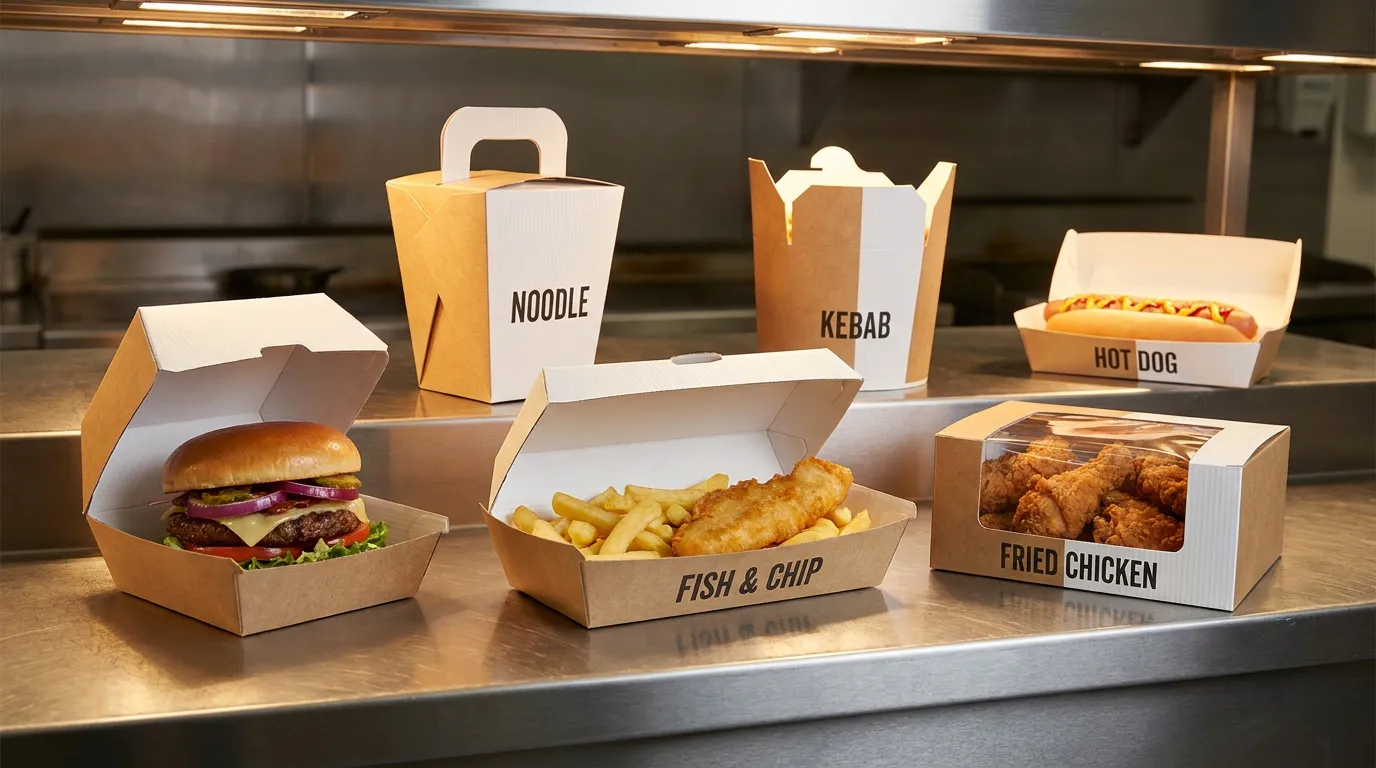
Takeaway boxes UK are corrugated cardboard containers made from grease-resistant board, designed to pack and deliver hot and cold food from kitchen to customer without structural failure, grease bleed-through, or food quality loss in transit. They are the most diverse packaging category in UK food service, since a single ghost kitchen operation might use six different box formats within one order, and each of those formats has its own structural and grease-resistance requirements.
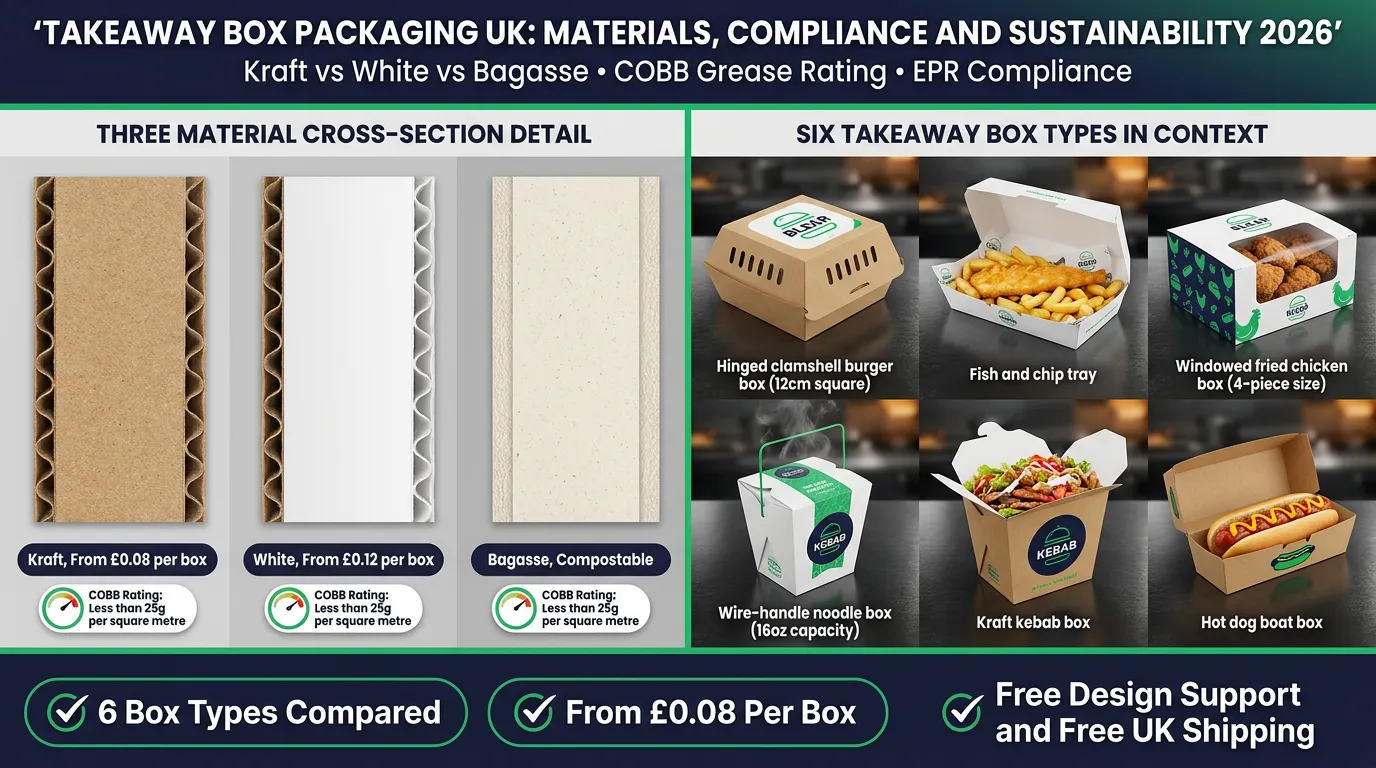
The category covers everything from the hinged clamshell burger box with its lock-tab and ventilation slots, covered in detail in our burger box packaging guide, to open fish and chip trays, windowed fried chicken boxes, wire-handle noodle containers, deep kebab boxes, and hot dog boats. What all of these share is a food-grade grease-resistant inner coating, corrugated E-flute or B-flute construction, and EN 1935:2004 food contact certification. What they differ on is the construction that suits each specific food format and the material the outer box is made from.
The Six Takeaway Box Types and What Each One Is For
The box type is set by the food format before the material is chosen. Specifying the wrong box type for the food it carries causes practical problems at the packing bench and in transit, not just aesthetic ones.
| Box Type | Construction | Food Application | Price From at Volume |
|---|---|---|---|
| Burger box, clamshell | Hinged one-piece, lock-tab, ventilation slots | Burgers, chicken sandwiches, breakfast items | £0.12 per box |
| Fish and chip tray | Open-top tray, heavy grease resistance, stackable | Fish and chips, battered sides, open sharing portions | £0.08 per box |
| Fried chicken box | Windowed lid for product display, multi-piece capacity | Fried chicken portions, 2, 4, 8, 12-piece | £0.15 per box |
| Noodle box | Wire handle, PE-lined base, leak-resistant | Noodles, rice, curry, saucy Asian dishes | £0.18 per box |
| Kebab box | Deep tray with lid, high sauce volume capacity | Doner kebabs, wraps, high-sauce dishes | £0.14 per box |
| Hot dog boat | Long format, open or half-covered | Hot dogs, sausages, street food formats | £0.08 per box |
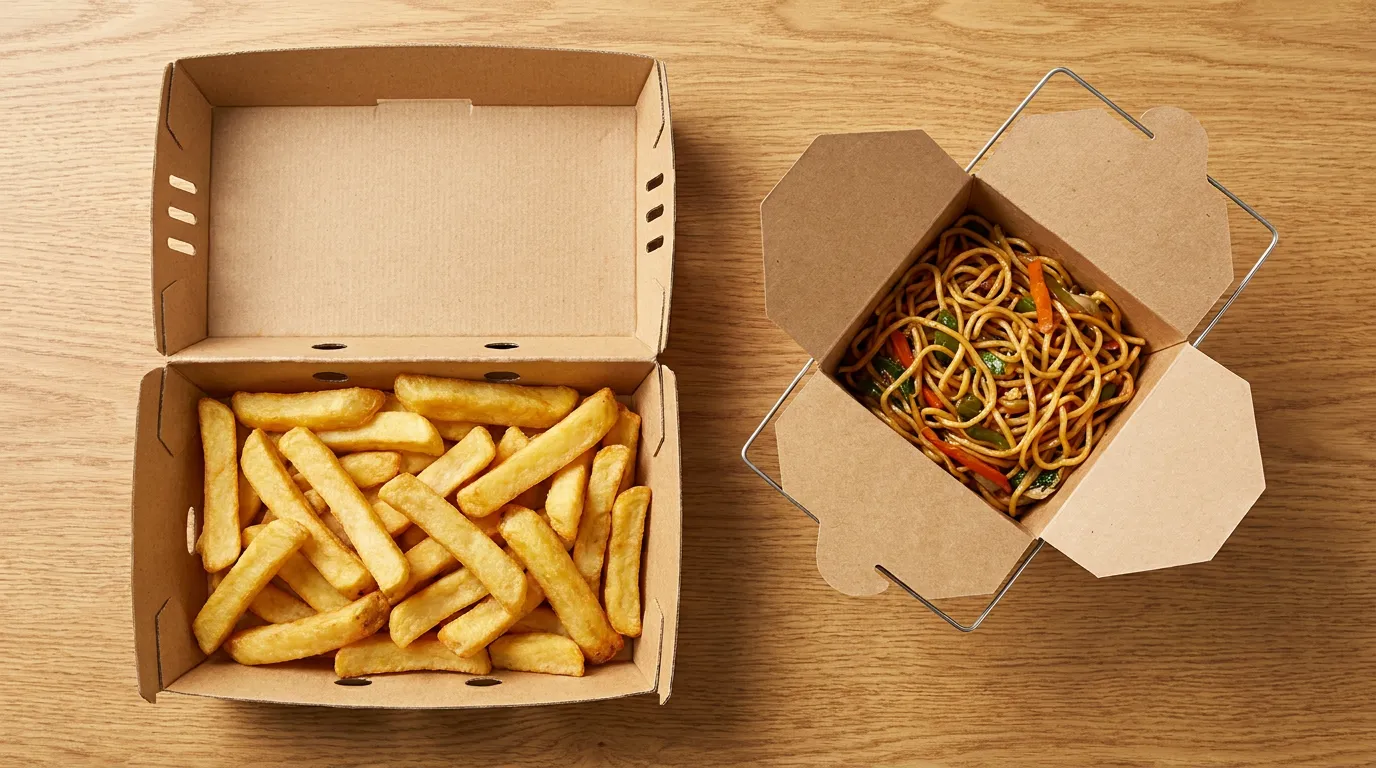
The fish and chip tray is the format that most clearly demonstrates why box type is set by the food first: its open-top design is deliberate, not a cost saving, since chips and battered fish need to vent steam continuously rather than being enclosed. Enclosing them creates exactly the condensation problem that makes a chip soggy before it reaches the customer. An open tray allows steam to escape while the grease-resistant inner surface keeps the tray intact under the oil load.
The noodle box is the format that catches most first-time operators out, because the wire handle and PE-lined base are not a decorative feature, they are structural necessities for a format that holds 16oz of hot saucy food being carried by a single point of contact. The PE lining makes the base genuinely leak-resistant rather than merely grease-resistant, which matters specifically for dishes with a significant liquid component.
Kraft vs White vs Bagasse: The Material Decision
The material decision is separate from the box type decision, since all six box types above are available in all three materials. The choice between kraft, white, and bagasse is primarily about brand positioning and sustainability claims, since all three materials share the same grease-resistance coating standard and the same EN 1935:2004 food contact certification.
Kraft (natural brown unbleached board) is the most economical option, typically 10 to 15 percent cheaper than white at the same specification. It communicates a natural, artisan, or eco-conscious brand identity and is the most widely used material across UK independent takeaways for that reason. It is FSC certifiable, contains 70 percent or more recycled content in our standard range, and is kerbside recyclable when clean. One honest limitation: uncoated kraft is more susceptible to moisture absorption in transit than white or laminated board, which matters for delivery operations in autumn and winter or for long delivery windows.
White (clay-coated bleached board) gives the clearest printing surface of the three materials and is the right choice for operations where brand-colour accuracy and a premium presentation matters. It costs more than kraft, typically 10 to 15 percent above, and prints full-colour CMYK more accurately. It is equally recyclable to kraft when clean.
Bagasse (sugarcane fibre board, produced from agricultural waste) is the genuinely compostable option. It breaks down in industrial composting environments in approximately 90 days and in home composting environments in somewhat longer. It costs 20 to 40 percent more than kraft for the same specification. The compliance point worth knowing: bagasse compostability claims are verifiable and defensible under CMA enforcement guidance from April 2025, since bagasse certification to EN 13432 (the industrial compostability standard) exists and is testable. A “100% compostable” claim on an EN 13432 certified bagasse box is a legitimate claim. The same claim on standard kraft or white corrugated is not.
| Material | Cost Relative to Kraft | Print Quality | Recyclability | Sustainability Claim |
|---|---|---|---|---|
| Kraft | Base price | Good, warm earthy tones | Kerbside recyclable when clean | Recycled content, FSC certified |
| White | Plus 10 to 15 percent | Excellent, accurate CMYK colour | Kerbside recyclable when clean | FSC certified |
| Bagasse | Plus 20 to 40 percent | Good, natural texture | Compostable, EN 13432 certified | Compostable, biodegradable |
The COBB Rating and Grease Resistance in Practice
All takeaway boxes we supply carry a COBB rating of less than 25g per square metre, meaning the inner liner absorbs less than 25 grams of oil per square metre in a 60-second test. This is the food service standard for grease-resistant corrugated takeaway containers and is adequate for the grease load of most standard takeaway menus under a 30-minute delivery window.
For operations with very high-fat menu items, particularly fish and chips with high oil content or heavily sauced kebabs, pairing a standard grease-resistant box with a greaseproof sheet liner gives complete oil protection at a lower total cost than upgrading the entire box specification. A greaseproof sheet costs approximately £0.04 to £0.08 per sheet at volume, which for a fish and chip operation placing a 300g portion in an open tray is the most practical and cost-effective complete solution.
Stoneridge Kitchen, a multi-cuisine ghost kitchen operation based in Brighton serving Deliveroo and Just Eat, came to us reviewing their entire packaging range after complaints about grease seeping through their kebab box bases on long delivery routes. They were using a standard kraft tray and running delivery windows of up to 40 minutes. We moved them to a B-flute heavy-duty tray specification, at 3mm versus the standard E-flute at 1.5mm, combined with a greaseproof sheet liner inside each kebab tray. The B-flute specification handles the extended delivery window and stacking weight from a full bag, and the liner completes the grease barrier for a format with high sauce volume. Their kebab complaint rate dropped to near-zero within two weeks and they have since standardised B-flute across all their hot, saucy menu items while keeping E-flute for their lighter formats like chicken sandwiches and noodle boxes.
Cost and Pricing Guide
All prices below are confirmed from our live takeaway boxes page and include free UK-wide shipping. Custom CMYK print is available on all box types and sizes from the same pricing base.
Takeaway Box Pricing by Type and Volume
| Box Type | Small or Minimum Size | 250 to 499 units | 500 to 999 units | 1,000 plus units |
|---|---|---|---|---|
| Burger box, regular 12cm | £0.22 | £0.18 | £0.15 | £0.12 |
| Fish and chip tray, medium | £0.18 | £0.13 | £0.10 | £0.08 |
| Fried chicken box, 4-piece | £0.32 | £0.25 | £0.20 | £0.15 |
| Noodle box, 16oz | £0.32 | £0.26 | £0.22 | £0.18 |
| Kebab box, large | £0.24 | £0.20 | £0.17 | £0.14 |
| Hot dog boat, standard | £0.14 | £0.11 | £0.09 | £0.08 |
Volume discounts are available at 500 and 1,000 units across all box types. There is no minimum order. Most UK independent takeaway operators start at 250 to 500 units for their first branded run, then move to a rolling monthly order once they know their weekly throughput. If your artwork is not yet print-ready, our design team will check your file, set it up correctly, or build the design from scratch, at no extra cost. Delivery is free to any UK address on every order.
How to Choose: A Decision Framework for Your Takeaway Operation
Work through these before specifying your takeaway box range.
- Map each menu item to its correct box type. Do not use a generic container for every item. A noodle box for noodles, an open tray for chips, a clamshell for burgers. Each box type is designed around the physical requirements of that food format, and using the wrong one causes avoidable quality failures regardless of how good the food itself is.
- Choose your material based on brand positioning, not just cost. Kraft for eco-conscious and artisan positioning. White for premium brand-colour accuracy. Bagasse for a verifiable compostable claim with EN 13432 certification. Do not put “eco-friendly” on a standard kraft box without specifying what that means precisely, since the CMA’s enforcement powers active from April 2025 make vague environmental claims a liability.
- Decide whether any items need B-flute rather than E-flute. Standard E-flute at 1.5mm handles most UK takeaway items in a 20 to 30 minute delivery window. High-fat, high-sauce items on delivery windows above 30 minutes benefit from B-flute at 3mm, which holds its structure better under sustained load and moisture. Our corrugated box grades guide covers the full flute grade decision in more depth for operations specifying across a range of formats.
- Consider a greaseproof sheet liner for your highest-fat items. For fish and chips, kebabs, and heavily sauced dishes, a greaseproof sheet liner inside a standard grease-resistant box is a more economical complete solution than upgrading the entire box specification.
For the broader compliance context, our EPR Packaging UK guide covers how takeaway box volume contributes to your Extended Producer Responsibility obligation if your food business exceeds the annual threshold, and our sustainable food packaging guide covers the sustainability decision across all food packaging materials in more depth than fits here.
Takeaway Box Food Safety and Compliance
All takeaway boxes we supply are certified to EN 1935:2004 for direct food contact, covering board, print inks, and grease-resistant coating. A Declaration of Compliance is available with every order on request, which is what Environmental Health officers ask for during routine inspections.
The recyclability of a takeaway box depends on whether it is food-contaminated or clean. A clean takeaway box, one with no grease, sauce, or food residue, is recyclable in UK kerbside paper collections. A food-contaminated box is not recyclable and should go in general waste. The OPRL guidance published for food service packaging is therefore that “Check local recycling” is the more accurate label for most takeaway box formats, since the majority of boxes in service will be food-contaminated at disposal. The live page’s “100% recyclable” claim refers to the material being recyclable in principle, which is true for clean board, but the OPRL-correct label for contaminated food packaging is not a straight “Recycle.” We print the OPRL-correct label on every box based on its actual specification.
Under OPRL guidance, the OPRL labels guide covers how to apply the correct label to each component of a mixed-format order accurately. Our OPRL labels guide goes into the specific requirements. This reflects packaging compliance guidance as of June 2026. Always verify current requirements at gov.uk before making compliance decisions for your business.
Takeaway Box Delivery Across the UK
Wherever your takeaway operation is based, lead time and pricing stay identical. A ghost kitchen in York works to the same 7 to 10 working day production turnaround as a multi-site fast food chain in Leicester, and delivery is free to any UK address regardless of box type or volume.
We receive a regular flow of enquiries from independent takeaway operators in Cambridge asking specifically about standing orders that match their weekly throughput, since running out of branded boxes mid-week is a real operational problem. We set up standing monthly orders for any customer on a rolling call-off basis, where the same specification and artwork is held permanently and reordered at the agreed interval. Whether you are running a single-site takeaway in Oxford or a multi-brand ghost kitchen in Brighton, turnaround and pricing are identical, and our design team is available throughout at no extra charge.
FAQ
What is the best material for takeaway boxes UK?
It depends on your brand positioning and sustainability priorities. Kraft is most economical, with an eco-conscious natural aesthetic, and is kerbside recyclable when clean. White gives the most accurate CMYK print surface for premium brand work. Bagasse is the only genuinely compostable option with verifiable EN 13432 certification. All three share the same grease-resistance standard and EN 1935:2004 food contact certification.
Are takeaway boxes food-safe in the UK?
Yes. All takeaway boxes we supply are certified to EN 1935:2004 for direct food contact, covering board, inks, and grease coating. A Declaration of Compliance is available with every order on request. This is the standard document Environmental Health officers request during inspections.
Can takeaway boxes be recycled?
A clean, food-free takeaway box is kerbside recyclable in UK paper collections. A box with grease, sauce, or food residue is not recyclable and should go in general waste. This is why the OPRL guidance for most food service packaging is “Check local recycling” rather than a straight “Recycle,” since most boxes in use will be food-contaminated at disposal.
Do you deliver custom takeaway boxes to Oxford and York?
Yes. Wabs Print delivers custom takeaway boxes to businesses across the UK, including Oxford, York, Cambridge, Leicester, Southampton, Brighton, and London, with free UK-wide shipping on every order. Standard production is 7 to 10 working days from artwork approval.
What is the minimum order for takeaway boxes?
No minimum order. You can order any quantity. Most UK independent takeaway operators start at 250 to 500 units for their first branded run where the unit pricing becomes commercially sensible. Standing monthly orders on a call-off basis are available for established throughput volumes.
What is the difference between E-flute and B-flute takeaway boxes?
E-flute at 1.5mm is the standard specification for most UK takeaway box formats, adequate for menu items up to 3kg in a 20 to 30 minute delivery window. B-flute at 3mm is the heavy-duty specification for high-fat, high-sauce, or heavy items on delivery windows above 30 minutes, or where delivery bag stacking loads are consistently high. B-flute costs roughly 15 to 25 percent more per box than E-flute at the same specification.
Are bagasse takeaway boxes really compostable?
Yes, specifically EN 13432 certified bagasse is genuinely compostable in industrial composting conditions and breaks down in home composting environments over a longer period. The certification is independently verifiable, which makes “compostable” a defensible claim under CMA enforcement guidance from April 2025 for EN 13432 certified bagasse. The same claim applied to standard kraft or white corrugated board is not defensible.
Making the Call
Takeaway box packaging UK decisions start with matching each menu item to the correct box type, then choosing the material that fits your brand positioning and sustainability claims, and then deciding where B-flute and greaseproof sheet liners are needed for your highest-demand formats. Get those three decisions right across your menu and the cost, compliance, and delivery quality issues that most UK takeaway operators attribute to their food or their couriers turn out to have been packaging decisions they had not yet made.
Whether you are a ghost kitchen in Brighton, an independent takeaway in Oxford, or a multi-cuisine operation in Cambridge, Wabs Print delivers custom takeaway boxes across the UK with no minimum order, free UK-wide shipping, free design support on every order, and the same 7 to 10 working day turnaround regardless of volume. If you are ready to get a price, custom takeaway boxes UK and you will have a quote within 24 hours.