

The Independent Maker’s Guide to Premium Custom Boxes for Cosmetic & Skincare Packaging

By Wabs Print Cosmetic Packaging Specialists | 15+ Years Beauty Brand Partnership
After 15 years manufacturing cosmetic packaging for indie beauty brands, small-batch skincare makers, and emerging luxury labels, I’ve learned that premium packaging isn’t about aesthetics alone. It’s about protecting products during transit, communicating brand values through material choice, and creating unboxing moments that justify premium pricing.
Independent cosmetic brands face unique packaging challenges that mass-market manufacturers don’t. You’re working with small order quantities (100-500 units typically), irregular demand patterns, and limited budgets for tooling. You need protection comparable to luxury brands but with realistic MOQs. You need designs that communicate premium positioning without mass-production appearance.
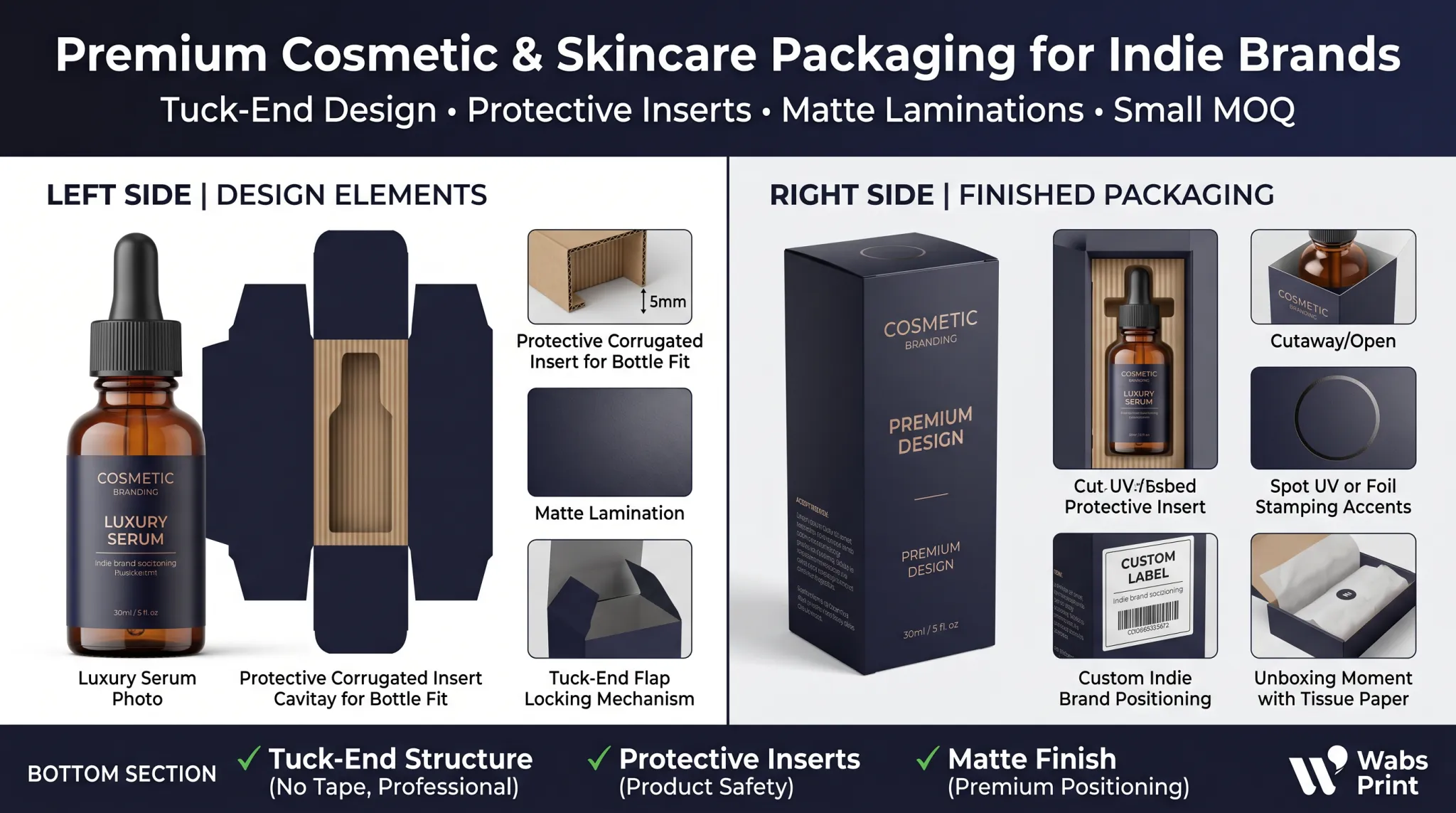
This sector guide covers everything indie beauty makers need: premium packaging finishes like foil stamping, spot UV, and soft-touch coatings that elevate perception, tuck-end box design that provides structural elegance, protective corrugated inserts that keep bottles safe, matte laminations that communicate sophistication, and the practical dimensions and safety specifications that prevent product damage during shipping.
Whether you’re launching a serum line, creating candle-cosmetic hybrids, or scaling a skincare subscription, this guide provides the technical knowledge and design strategies that separate professional indie brands from amateur packaging.
Understanding Tuck-End Box Design for Cosmetics
Tuck-end boxes represent the architectural foundation of premium cosmetic packaging. Unlike mailer boxes that rely on tape closure, tuck-end designs use folded flaps that lock automatically when the box is assembled creating clean aesthetics without visible fasteners.
Structural Advantages for Beauty Products
Tuck-end construction provides superior structural integrity compared to simple folding carton designs. The locking mechanism distributes compression forces evenly across the box, preventing edge collapse under stacking weight. For cosmetic products with fragile glass bottles or delicate serums, this structural reliability matters critically.
The design allows cosmetic boxes to maintain professional appearance throughout the customer journey from warehouse to unboxing. Tape-sealed boxes develop visible creasing and deterioration. Tuck-end designs remain pristine because the locking mechanism eliminates tape altogether.
Interior space in tuck-end designs can be optimized for custom box configurations specific to bottle dimensions. Luxury serum bottle packaging dimensions typically range 30mm diameter × 50-60mm height for 30ml bottles. Tuck-end designs allow precise interior space calibration (±2mm) without additional construction cost.
Design Specifications for Small-Batch Brands
Tuck-end carton design requires careful dimensional specification. The most common indie beauty application uses 180gsm-220gsm board (providing structure without excessive weight), with external dimensions typically 90mm × 90mm × 110mm for serum bottles or 100mm × 60mm × 140mm for elongated skincare tubes.
Tuck flap length must be precisely engineered typically 20-25mm depending on board thickness and crush strength. Too short and flaps don’t lock securely. Too long and flaps create wrinkles or protrude visibly. Professional specification requires structural analysis, not guesswork.
Minimum order quantities for tuck-end cosmetic boxes typically start at 100-200 units depending on customization complexity. This MOQ threshold aligns perfectly with indie beauty launch requirements small enough to test market, large enough to achieve economies of scale that reduce per-unit costs to £0.40-0.85 depending on specifications.
Protective Corrugated Box Inserts: Product Safety Engineering
Protective corrugated box inserts represent the critical difference between packages that arrive pristine and packages that arrive damaged. For indie cosmetic brands, even single damaged bottle becomes brand-damaging negative review and refund cost.
Insert Material Selection and Specifications
Corrugated inserts come in two primary configurations: die-cut foam (EVA foam typically) and corrugated cardboard dividers. For cosmetic applications, corrugated cardboard inserts outperform foam because they compress minimally under shipping stress while providing adequate shock absorption.
Insert density matters critically. 120gsm corrugated provides adequate support for bottles up to 500ml. Lighter inserts (80gsm) risk compression under stacking weight in transit. Heavier inserts (150gsm+) add unnecessary bulk and shipping cost without proportional protection improvement.
Protective corrugated box inserts dimensioned specifically for bottle shape provide optimal protection. A serum bottle 30mm diameter × 55mm height requires an insert cavity with 35mm diameter (5mm clearance) and 60mm depth to prevent bottle movement. Generic inserts with oversized cavities allow bottles to shift during transport the primary cause of cosmetic packaging damage.
Insert configuration for multi-product shipments requires careful planning. A subscription box containing 3 serum bottles, 2 creams, and 1 lip balm requires custom insert layout with individual compartments preventing bottle-to-bottle contact. Standard configurations don’t accommodate mixed product sizes.
Integration with Tuck-End Design
Corrugated inserts integrate into tuck-end custom boxes through several configuration options:
Option 1: Loose Insert (Most Flexible) Insert sits freely inside box, held by friction. Cost lowest (£0.08-0.15 per unit), works for boxes containing single product. Risk: insert shifts if box orientation changes during shipping.
Option 2: Glued Insert (Most Common) Insert adhered to box base using PVA adhesive. Cost moderate (£0.12-0.25 per unit), prevents movement, holds reliably. Industry standard for cosmetic packaging.
Option 3: Integrated Design (Most Premium) Insert is die-cut as part of box structure itself, not separate component. Cost highest (£0.25-0.40 per unit), maximum elegance, zero movement risk. Luxury cosmetic brands prefer this approach.
Matte Lamination: The Premium Cosmetics Finish
Matte lamination represents the most effective visual communication of premium positioning in cosmetic packaging. Glossy finishes suggest mass-market products. Matte finishes communicate luxury, sustainability, and intentional brand positioning.
Matte Lamination Materials and Performance
Matte laminations for cosmetics use 80-120gsm film (typically polypropylene) applied to printed carton surface. The film reduces gloss level from typical 80-90 gloss units down to 10-15 gloss units, creating the characteristic matte appearance.
Performance characteristics: Matte lamination provides minor scuff resistance improvement (reducing visible fingerprints compared to unlaminated). Water resistance improves marginally but is not primary benefit. Durability through handling (retail, consumer) improves slightly. The primary benefit is aesthetic matte communicates premium positioning that justifies price premium.
Matte lamination thickness affects both appearance and cost. 80gsm matte creates very slight texture (subtle matte appearance). 120gsm creates obvious matte finish with slight tactile texture perceptible to touch. For luxury cosmetic brands, 100-120gsm is industry standard.
Cost impact: Matte lamination adds £0.04-0.08 per unit depending on specification and order volume. For 200-unit indie brand run, this represents £8-16 total cost (or £0.04-0.08 per unit). For premium positioning, this cost is negligible relative to perceived value increase.
Design Considerations with Matte Finish
Matte laminations affect color vibrancy. Bright CMYK colours appear slightly muted compared to unlaminated alternatives the lamination film acts as slight diffuser. This muting often improves premium perception (slightly softer colour palette reads as more sophisticated). However, some brand colours (bright metallics, neon) can appear diminished.
Spot UV and foil stamping integrate beautifully with matte laminations. Glossy spot UV applied over matte background creates striking visual contrast. Foil stamping on matte background delivers maximum elegance (matte foil appearance is luxury standard in cosmetics). This combination matte base + spot UV/foil accents is premium cosmetic standard.
Custom labels on matte-laminated boxes should specify matching matte lamination for consistency. Glossy labels on matte cartons create visual discontinuity signalling cost-cutting.
Luxury Serum Bottle Packaging Dimensions: Technical Specifications
Serum bottles represent the most challenging packaging scenario for indie brands because they’re typically fragile glass with precious contents (serums cost £80-150+ retail). Packaging must protect effectively while communicating premium positioning.
Standard Luxury Serum Bottle Dimensions
| Product Size | Typical Dimensions (Diameter × Height) | Box Interior Space Required | Insert Cavity Size | Recommended Board Weight |
|---|---|---|---|---|
| 15ml Serum (Concentrated) | 25mm × 45mm | 30mm × 50mm × 120mm | 32mm × 52mm × 58mm | 180-200gsm |
| 30ml Serum (Standard) | 30mm × 55mm | 35mm × 60mm × 130mm | 37mm × 62mm × 65mm | 200-220gsm |
| 50ml Luxury Serum | 35mm × 65mm | 42mm × 72mm × 145mm | 44mm × 74mm × 75mm | 220-250gsm |
| 100ml Premium Skincare | 45mm × 90mm | 55mm × 100mm × 170mm | 57mm × 102mm × 100mm | 250-280gsm |
These dimensions are industry standard for luxury cosmetic brands (Drunk Elephant, Augustinus Bader, Charlotte Tilbury serums). Deviations require justification undersized boxes compress inserts under stacking, oversized boxes waste material and shipping costs.
Secondary Packaging for Multi-Bottle Sets
Indie beauty brands often sell serum sets (core serum + supporting products, typically 3-4 items). Secondary box dimensions require careful calculation to accommodate protective inserts for each item while maintaining elegant proportions.
A 3-piece serum set (two 30ml serums + one 50ml cream) requires secondary box dimensions approximately 120mm × 80mm × 150mm to accommodate custom inserts holding each product securely without excessive void space. Excess void space requires filler material (tissue, paper fill) adding cost and sustainability concerns.
✨ Design Premium Cosmetic Packaging for Your Brand
Our cosmetic packaging specialists understand serum bottle requirements, protective insert engineering, and custom label integration. We design cosmetic boxes with protective inserts, matte finishes, and precise dimensions ensuring products arrive pristine.
Get Your Cosmetic Packaging Quote →Indie Beauty Brand Custom Print Specifications
Custom printing transforms generic tuck-end boxes into branded assets communicating brand story. Indie cosmetic brands typically invest heavily in design because packaging represents primary touchpoint with premium positioning.
Design Considerations for Small-Batch Printing
Indie beauty brands often use 2-4 colour CMYK printing (cost-optimized) rather than full-colour photography. This constraint actually benefits premium positioning simplified design language reads as more intentional and sophisticated than cluttered photography.
Design should emphasize product benefits succinctly. “Hyaluronic Serum | Lightweight Hydration | 30ml” communicates clearly without verbose marketing copy. Premium brands trust product quality to speak packaging communicates positioning, not promises.
Typography selection critically affects perception. Serif fonts (Garamond, Minion) read as luxury and heritage. Sans-serif fonts (Helvetica, Futura) read as modern and minimalist. Font choice shapes entire brand perception careless typography undermines premium positioning regardless of physical quality.
Custom print files require technical precision: 300 DPI minimum, CMYK colour mode (not RGB), proper bleeds (5mm minimum bleed on all edges), no text closer than 5mm from edges to prevent trimming issues. Specification mistakes create costly reprinting.
Sustainability Messaging in Design
Indie beauty brands typically emphasize sustainability natural ingredients, minimal packaging, eco-conscious sourcing. Packaging should communicate these values visually. Sustainable cosmetics presentation includes:
- Eco-Certification Badges: FSC certification (responsible forestry), recycling symbols, “100% Recyclable” claims (only if accurate)
- Sustainable Materials Callout: “Printed on recycled cardboard” or “FSC-certified kraft”
- Minimal Design Language: Simplicity reads as sustainability complex designs with excessive printing suggest over-production
- Ingredient Transparency: List key ingredients on custom labels or packaging (increasingly expected by conscious consumers)
These messaging elements must be accurate false sustainability claims expose brands to regulatory scrutiny and customer backlash. Verify all claims before printing.
Product Safety During Transit: Real-World Testing
Cosmetic packaging design must survive harsh realities of modern shipping rough handling, temperature extremes, stacking weight, vibration. Theoretical design doesn’t guarantee real-world performance.
Drop Testing and Compression Testing
Professional packaging design includes drop testing boxes dropped from various heights (36 inches minimum for cosmetics) to simulate worst-case handling scenarios. A serum bottle inside properly protected corrugated insert should survive drop testing without breaking.
Compression testing verifies box structural integrity under stacking weight. A 200-unit cosmetic shipment might stack to 12-15 boxes height. If each box weighs 200g, bottom boxes experience 2-3kg total weight. Corrugated insert compression under this weight can create micro-movements allowing bottles to shift testing reveals this.
Vibration testing during shipping environments simulates truck transport. Continuous vibration can loosen even well-secured bottles if protective design is inadequate. Professional testing includes 4-8 hour vibration simulation.
Sustainable Cosmetics Presentation: Building Brand Values
Modern indie beauty consumers expect brands to articulate sustainability values. Packaging communicates these values before customer opens the box.
Material Selection as Values Communication
Unbleached kraft cardboard signals sustainability instantly the natural brown colour communicates environmental consciousness without additional messaging. Premium indie brands increasingly select kraft tuck-end boxes specifically for this value communication.
Recycled content percentage matters to conscious consumers. 70% recycled content (industry standard for kraft) reads as genuinely sustainable. Claims of 100% recycled require verification some greenwashing brands make claims exceeding actual content.
Lamination material selection reflects sustainability values. Traditional plastic lamination conflicts with sustainability positioning. Water-based laminations or unlaminated finishes better align with eco-conscious brand positioning.
Unboxing Experience Design
Premium indie brands engineer unboxing experiences. Protective inserts should be visible when customer opens box showing visible protection communicates brand care for product and customer. Generic plain inserts disappoint customers expecting premium experience.
Tissue paper, branded stickers, or handwritten thank-you notes add minimal cost (£0.05-0.15 per unit) but create disproportionate emotional impact. These touches transform commodity packaging into brand experience.
Reusable packaging concept appeals to sustainable cosmetics brands. Some indie makers use custom boxes designed for post-purchase use (as storage containers, jewellery boxes) extending product lifecycle and brand visibility in customer homes.
🌿 Build Sustainable Cosmetic Packaging Your Brand Deserves
We design cosmetic boxes with protective engineering, sustainable materials, and premium finishes. From tuck-end design to custom inserts to matte laminations we handle every detail ensuring your brand values are visible in packaging.
Design Your Cosmetic Packaging →Premium Packaging as Indie Brand Advantage
Independent cosmetic brands compete against mass-market players with vastly larger marketing budgets. Packaging represents one asymmetric advantage available premium presentation that communicates brand values, protects products reliably, and creates unboxing experiences that generate word-of-mouth marketing.
Professional packaging design incorporating tuck-end structure, protective inserts, matte laminations, and precise product-specific dimensions costs marginally more than generic alternatives. The brand perception benefitand customer satisfaction benefit far exceeds investment.
After 15 years manufacturing cosmetic packaging, I consistently observe: indie beauty brands investing in proper protective design and premium finishes are the ones growing sustainably. Brands cutting packaging corners to save £0.10 per unit face damaged shipments, returns, and brand reputation damage costing 100x the savings.
Your packaging is brand. Design it professionally. Build it with quality. Test it under real shipping conditions. The result: products that arrive pristine, customers delighted by unboxing experience, and brand perception elevated to reflect your actual product quality.
Range, much of this same cost and structure logic applies across your packaging decisions, and our cosmetic boxes guide covers the broader category in more depth if you are packaging a full beauty line rather than