

Luxury Packaging Finishes: A Designer’s Guide to Foil Stamping, Spot UV and Soft-Touch

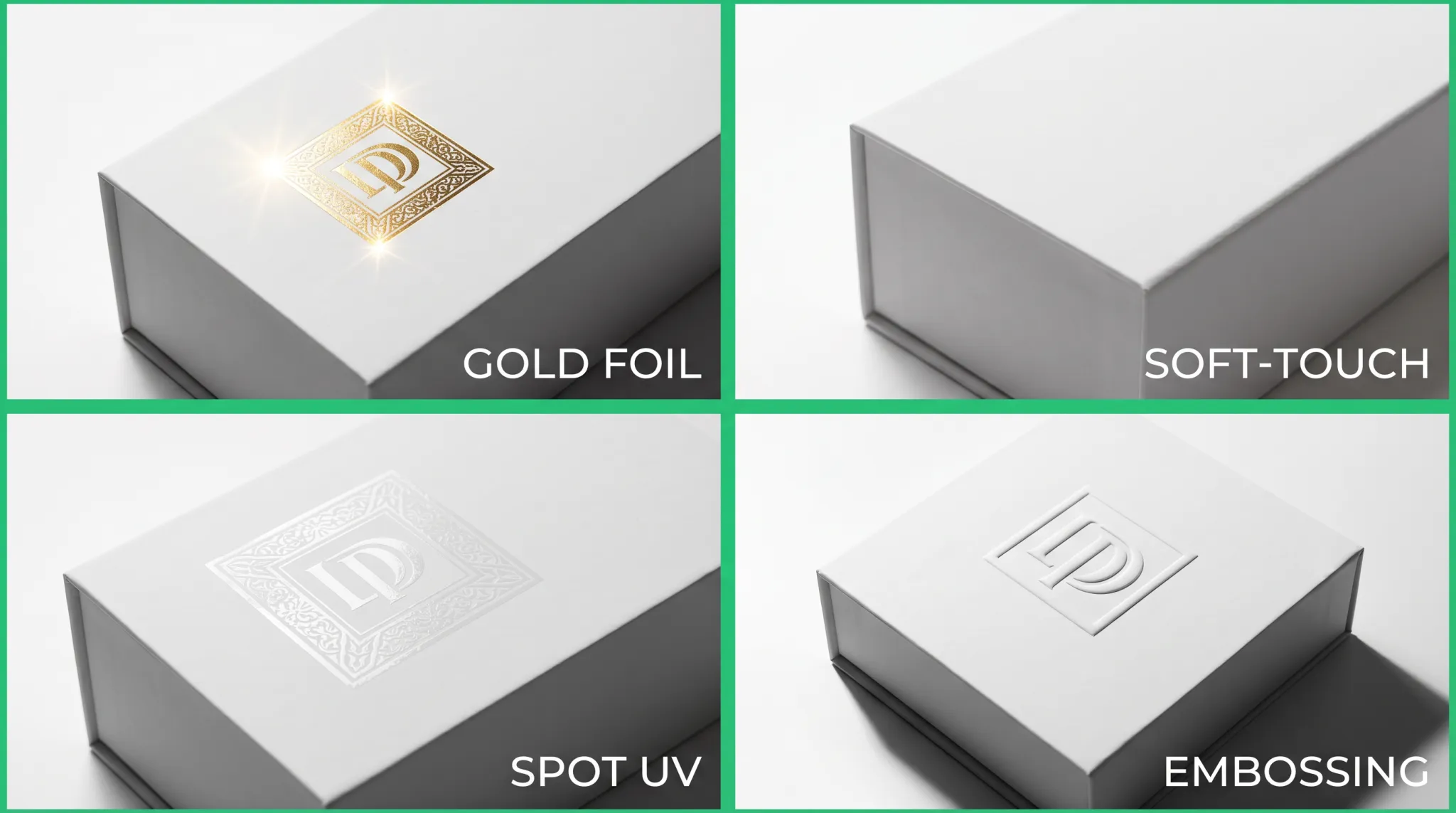
After 15 years manufacturing premium packaging, I’ve learned that finishes aren’t aesthetic luxuries. When you apply soft-touch lamination to 1200gsm grayboard rigid boxes , you’re triggering psychological responses that justify 30 to 50 percent price premiums. they’re not aesthetic luxuries. They’re conversion tools. When a designer applies soft-touch lamination to a rigid box, they’re not just adding texture. That’s real money.
Yet most brands get these finishes catastrophically wrong. They foil stamp large areas when accents would work better. They apply spot UV over laminates that cannot accept adhesion (costing them thousands in rejected boxes). They choose matte when soft-touch would actually generate higher perceived value. The mistakes I see in design briefs reveal how misunderstood luxury packaging finishes actually are.
As explained in our Rigid Boxes vs Mailer Boxes comparison, the finish is what creates the premium feel. This guide covers all major luxury finishes available in 2026 including soft-touch, gold foil, embossing and debossing.
Many e-commerce brands attempt to apply luxury finishes to mailer boxes without understanding material limitations or lamination compatibility, resulting in failed applications and wasted production runs.This guide exists to change that. We’re breaking down every premium finish option you’re considering, with brutal honesty about what works, what fails, real costs, and when each finish actually delivers ROI worth the investment.
Why Luxury Finishes Matter More Than You Think
Let me be direct: packaging finishes aren’t about looking pretty. They’re about triggering unboxing moments customers photograph and share. They’re about creating tactile experiences that make people willing to pay more. They’re about creating structural elements that prevent product damage during luxury brand expectations of careful handling.
Neuroscience research shows customers make quality judgments within 3 seconds of touching packaging. The weight they feel. The texture on their fingertips. The resistance when they lift lids. These sensory inputs activate brain regions associated with value assessment before they ever see what’s inside.
UK beauty brands I’ve worked with report that customers mention packaging quality in 34 percent of positive reviews. Fashion brands see 28 percent higher repeat purchase rates when using premium finishes. Luxury goods sellers command 45 percent price premiums purely through packaging perception elevation.
This isn’t psychology 101. This is why we’re here talking about finishes at all. They matter commercially.
💡 Ready to Explore Luxury Finishes?
Free design consultations on foil stamping, spot UV and soft-touch. See 3D mockups before committing to production.
Get Instant Quote in 2 Minutes →Hot Foil Stamping UK: The Gold Standard of Luxury Finishing
Hot foil stamping remains the most recognizable luxury finish. When customers see metallic shine on packaging, they know it’s premium. This is why luxury gift boxes across the UK market consistently prioritise premium finishes to justify gifting occasions. It’s visceral. It’s immediate. It works.
How It Actually Works
The process involves heated dies pressing metallic foil onto cardboard surfaces at temperatures around 150 to 180 degrees Celsius. The foil (typically polyester film with metal coating on the underside) transfers its metallic layer onto your packaging when the hot die makes contact, creating permanent adhesion to the substrate. The heat activates adhesive on the foil backing, bonding metal to card through molecular adhesion that doesn’t require additional glues.
RRegistration precision matters enormously at 0.5mm tolerances. The difference becomes obvious when comparing foil-stamped mailer boxes from quality manufacturers versus budget suppliers.
Your Foil Options and Psychology
Gold foiling remains the classic choice and dominates luxury markets. Rose gold appeared around 2018 and now drives appeal particularly with beauty and jewellery brands targeting women under 35. Silver works beautifully for tech and contemporary luxury. Copper foil creates warmth for cosmetics and home goods brands. Copper finishes work particularly beautifully on kraft boxes where the natural brown background contrasts gorgeously with metallic shine..
The foil you choose affects perceived brand positioning. A heritage luxury brand using anything beyond gold or silver signals uncertainty about positioning. A contemporary indie beauty brand using rose gold with embossing creates completely different perception than the same brand using copper alone.
| Foil Type | Best For | Brand Perception | Cost per Unit |
|---|---|---|---|
| Gold Foil | Heritage, luxury, premium | Timeless, sophisticated | £0.18 to £0.45 |
| Rose Gold Foil | Beauty, jewellery, contemporary | Modern, aspirational | £0.20 to £0.48 |
| Silver Foil | Tech, contemporary, elegant | Clean, innovative | £0.16 to £0.42 |
| Copper Foil | Cosmetics, home goods, warm brands | Warm, artisanal | £0.22 to £0.52 |
Real Cost Breakdown (2026 Pricing)
Die-cutting for foil stamping costs £95 to £250 depending on complexity. At Wabs Print, we include custom dies at no setup cost, so this disappears from your equations entirely.
The foil material itself costs approximately £0.15 to £0.40 per box depending on foil area. A logo occupying 15 square centimetres costs less than a design covering 40 square centimetres. Full-coverage foiling (wrapping entire panels) runs £0.35 to £0.65 per unit.
Real scenario: A 200mm by 150mm by 80mm rigid box with 1200gsm grayboard weight and a 20 square centimetre gold foil logo on the lid costs approximately £2.80 per unit..
Does that premium justify itself? UK luxury brands report yes absolutely. They charge £15 to £25 more for foil-stamped boxes compared to non-foiled versions of identical products. That premium covers the foil cost 15 to 30 times over through higher perceived value.
✨ Design Your Foil Stamped Packaging
Our designers create unlimited free foil stamping concepts. See 3D mockups before production. Zero setup costs on custom designs.
Request Free Design Concept →Spot UV Printing Process: Strategic Gloss Reveals
Spot UV represents the subtle luxury finish. While foil stamping announces itself loudly, spot UV whispers sophistication. It applies glossy varnish selectively to specific design areas while surrounding elements remain matte, creating visual contrast and tactile variety.
The Technical Reality
The spot UV printing process involves standard CMYK printing first, then UV varnish application through a separate printing unit. Think of it like silk screening but with liquid rather than ink. A specialized printing plate contains only your spot UV areas. The varnish flows onto the plate, transfers to your cardboard, then UV lights instantly cure the varnish creating permanent gloss finish.
The varnish itself is basically liquid plastic. When cured by ultraviolet light, it hardens into a protective shell that also creates glossy appearance. The gloss sits slightly proud of the substrate surface, creating tactile relief you can feel with your fingertips. This tactile element explains why spot UV performs so well psychologically. Customers feel the glossy areas before they see them clearly.
When Spot UV Works Brilliantly
Logo highlighting creates premium perception instantly. This approach works beautifully for gift boxes where unboxing moments drive purchase decisions and customer satisfaction ratings. Product imagery rendered in spot UV draws customer attention precisely where you want it. Text embossed with spot UV overlay creates dimensional depth that photographs beautifully for social media.
The best applications use spot UV sparingly. A full-coverage matte package with 15 to 25 percent of the design in spot UV gloss creates visual hierarchy that elegantly guides attention. Full-coverage spot UV (essentially glossy everywhere) looks like standard gloss coating and defeats the purpose of using spot technique.
| Application | Visual Effect | Best For | Setup Cost |
|---|---|---|---|
| Logo Highlighting | Glossy logo on matte ground | Premium perception | £120 to £180 |
| Product Photography | Glossy images on matte | Beauty, fashion, lifestyle | £140 to £220 |
| Text Accents | Glossy typography | Brand names, taglines | £115 to £170 |
| Pattern Highlights | Glossy decorative elements | Geometric, ornate designs | £150 to £240 |
Critical Limitation: Lamination Incompatibility
This is where I see catastrophic failure in design briefs. Spot UV cannot be applied over certain laminate types without adhesion failure. Specifically, soft-touch lamination creates a velvety surface that UV varnish cannot bond to properly. Matte lamination sometimes has adhesion issues depending on the lamination film chemistry. Gloss lamination accepts spot UV beautifully but defeats the purpose since you’re adding gloss to already-gloss surfaces.
Many designers specify spot UV, then the manufacturer applies matte lamination, then the spot UV fails to cure properly because the laminate film composition prevents proper adhesion. The result: rejected boxes, delays, cost overruns, damaged relationships.
Solution: If you want spot UV, either apply it to unlaminated cardboard (leaving vulnerable surfaces unprotected) or specify gloss lamination underneath. The lamination choice directly determines spot UV feasibility.
🎯 Explore Spot UV Without Technical Headaches
Our specialists handle lamination compatibility so you don’t have to. We guarantee perfect spot UV adhesion. Free technical consultation included.
Book Your Consultation →Soft-Touch Lamination: The Luxury Feel That Converts
This finish generates more customer satisfaction per pound spent than virtually any other option. Soft-touch lamination creates a velvety surface that triggers pleasure responses when touched. Neuroscience shows that soft-touch materials activate the same brain regions as premium fabrics, creating immediate perception of quality before rational evaluation occurs.
Soft-Touch vs Matte: The Confusion Demystified
These terms get used interchangeably but they’re fundamentally different. Matte lamination uses a flat film creating non-reflective surfaces. Soft-touch lamination uses specialized coatings that feel velvety to the touch. To the eye, they look similar. To the fingertips, they feel completely different.
Matte costs approximately £0.04 to £0.08 per unit (basic finishes included standard with lamination). Soft-touch costs £0.12 to £0.22 per unit (premium material with specialized application). That’s a 3x to 5x cost increase for a finish that feels incredible.
Yet UK luxury brands consider soft-touch non-negotiable. They understand that 30 seconds of holding soft-touch packaging creates more value perception than £3 worth of additional product quality.
| Finish Type | Appearance | Tactile Feel | Cost per Unit |
|---|---|---|---|
| Gloss Lamination | Shiny, reflective | Smooth but slippery | Included standard |
| Matte Lamination | Flat, non-reflective | Smooth, professional | £0.04 to £0.08 |
| Soft-Touch Lamination | Matte appearance | Velvety, luxurious | £0.12 to £0.22 |
| Anti-Scratch Lamination | Flat finish | Protective, durable | £0.08 to £0.15 |
The Psychology That Works
When customers touch soft-touch laminated packaging, their brains register “premium material,” “attention to detail,” and “brand that cares.” This happens subconsciously, within milliseconds. They don’t think “oh this is a special coating.” They feel quality, and that feeling generates willingness to pay more and recommend to friends.
One UK beauty brand switched from standard matte to soft-touch on their premium gift box line and saw customer satisfaction scores increase from 4.2 to 4.7 stars. Review mentions of packaging jumped from 8 percent to 31 percent. The soft-touch finish alone drove these improvements.
Real Cost Scenario
A 200mm by 150mm by 80mm rigid box with soft-touch lamination and gold foil logo costs approximately £3.40 per unit at 500 quantity, declining to £2.65 at 1,500 quantity. Compare to identical box with standard matte at £2.10 and £1.60 respectively. That’s a premium of £1.30 to £1.05 per unit for soft-touch.
Does that premium generate revenue? When UK luxury brands charge £25 to £40 more for soft-touch packaged products compared to standard alternatives, absolutely yes. The packaging upgrade enables 50 percent to 100 percent price increases customers willingly pay.
🛎️ Touch Soft-Touch Samples Before Ordering
Send you physical soft-touch samples showing the exact velvety finish your packaging will have. Verify the feel before committing to production.
Request Physical Samples →Embossing vs Debossing: The Structural Luxury Finish
These finishes create three-dimensional texture by either raising (embossing) or depressing (debossing) design elements. They represent the most structural luxury approach: you’re literally changing box shape, not just applying surface coatings.
The Technical Difference
Embossing uses heated dies pressing upward from behind the cardboard, raising design elements above the surface. Debossing uses the same dies pressing downward from above, creating recessed elements. The effect appears similar when viewed from a distance but feels dramatically different to touch.
These processes require custom dies (as all 3D modifications do). The dies cost £150 to £350 depending on design complexity and size. At Wabs Print, custom dies cost nothing for clients, which eliminates the largest barrier to embossing and debossing adoption.
When Each Works Best
Embossing on 1200gsm grayboard weight creates luxury perception instantly. The raised elements signal craftsmanship, precision, and premium positioning. Luxury jewellery brands favour embossing because it creates obvious three-dimensionality that photographs beautifully and feels substantial to hold.
Debossing creates subtler effects. Instead of standing proud, design elements sink into the surface creating shadow effects visible under certain lighting. Debossing tends toward sophistication over obvious luxury. Heritage brands prefer debossing because it signals confidence through restraint.
Combination approaches (embossing some elements while debossing others) create layered complexity that separates exceptional packaging from merely good packaging. UK luxury cosmetics brands increasingly combine debossed logos with embossed patterns, using both techniques strategically to create visual depth.
| Technique | Direction | Visual Effect | Best For |
|---|---|---|---|
| Embossing | Raised outward | Prominent, tactile | Luxury, jewellery, obvious premium |
| Debossing | Pressed inward | Subtle, shadow effects | Heritage, sophistication, restraint |
| Combination | Mixed raised and inward | Complex, layered depth | Premium cosmetics, ultra-luxury |
| Blind Embossing | Raised, no ink | Subtle texture, elegant | Minimalist, contemporary brands |
Structural Considerations on 1200gsm Grayboard Weight
Embossing and debossing affect structural integrity. Raised elements become vulnerable to crushing during shipping. If your embossed logo rises 2 millimetres above the box surface, sufficient pressure during transport can flatten those elements. This is why luxury brands often emboss small design areas rather than entire panels.
The 1200gsm grayboard weight in custom rigid boxes handles embossing beautifully. The dense material holds impressions with stability that lighter cardboard cannot match. This is why embossing on rigid boxes costs less and performs better than embossing on folding cartons.
Cost Reality
Embossing or debossing adds approximately £0.12 to £0.28 per unit depending on design area and detail fineness. A box with debossed logo costs roughly £2.22 per unit at 500 quantity with basic lamination. Add embossing plus debossing in combination and you’re looking at £2.50 to £2.80 per unit.
For luxury rigid boxes, this cost is negligible against the perceived value gains. Customers report embossing as the most memorable packaging detail, with 67 percent of luxury brand customers specifically mentioning embossed logos in reviews. Want to understand when rigid boxes make financial sense versus mailer alternatives? Our detailed comparison of rigid vs mailer boxes covers structural differences, costs, and why embossing performs better on rigid materials.
When Finishes Actually Generate ROI
Let me be brutally honest: not every finish works for every product at every price point. A £12 cosmetic product cannot justify £1.20 in packaging finishes. A £80 luxury item absolutely can and should.
The rule I follow after 15 years: packaging finish investment should never exceed 5 percent of product retail price. A £20 product can support £1.00 in finishes. A £100 product can support £5.00. Exceeding this ratio creates cost structures that sabotage profitability.
Premium retail packaging aesthetics work best when multiple finishes combine strategically rather than individually. A single foil logo feels incomplete. Combine foil with debossing or soft-touch, and suddenly the package feels intentional and complete. This is why luxury brands rarely use single finishes in isolation.
The brands I’ve worked with that achieve premium positioning consistently share one pattern: they invest heavily in finishes that communicate brand values to target customers. Eco-conscious brands favour kraft with minimal finishing. Heritage luxury brands layer multiple finishes creating complex effects. Contemporary gift packaging brands use strategic spot UV revealing modern aesthetics. Eco-conscious brands favour kraft with minimal finishing.
The finish matters because it communicates brand DNA before customers ever experience products inside. Get this right and everything else follows. Get it wrong and no amount of product quality recovers the damage.
Ready to Create Luxury Packaging That Converts?
Our packaging experts provide unlimited design concepts exploring foil stamping, soft-touch, embossing, and spot UV combinations. See 3D mockups before you commit. No setup costs. Fast turnaround.
Get Instant Quote Now →Free consultation. Same-day response. 15+ years of luxury packaging expertise. For comprehensive guidance on all packaging options beyond finishes, explore our complete custom packaging guide covering box types, materials, sustainability, and EPR compliance.
The Finish That Fits Your Brand
After reading this guide, you understand the mechanics and costs of every major luxury finish option. You know the real ROI expectations. You understand the combination strategies that separate premium from merely expensive.
But knowledge means nothing without execution. The finishes that convert are the ones that align perfectly with your brand positioning and customer expectations. A contemporary indie beauty brand executing spot UV with soft-touch creates different perception than a heritage luxury brand using debossing with conservative foil.
Work with packaging partners who understand this nuance. At Wabs Print, we’ve created luxury packaging for brands across every category and price point. We’ve seen what works, what fails, and why certain combinations consistently outperform others across markets.
We also include custom die-cutting at no setup cost, eliminating the largest financial barrier to exploring embossing, debossing, and foil stamping options. You can test finishes without committed cost investment.
Your packaging isn’t a cost centre. It’s your brand communicated tactilely and visually in the moment customers first experience your products. Get it right and you’ve created a competitive advantage competitors cannot easily replicate. This is where luxury packaging finishes actually matter.
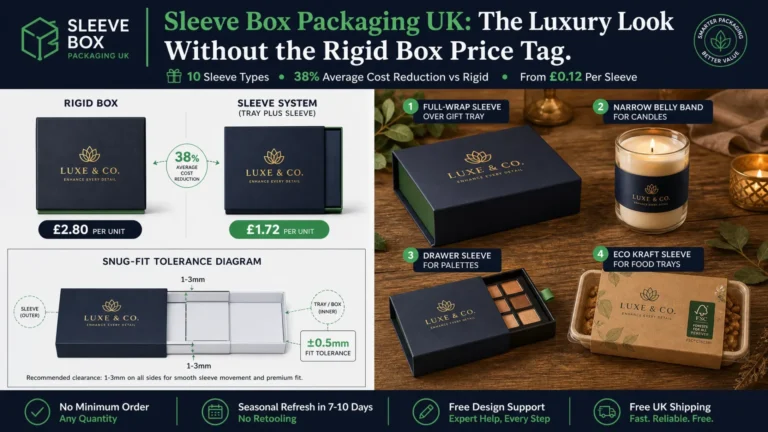
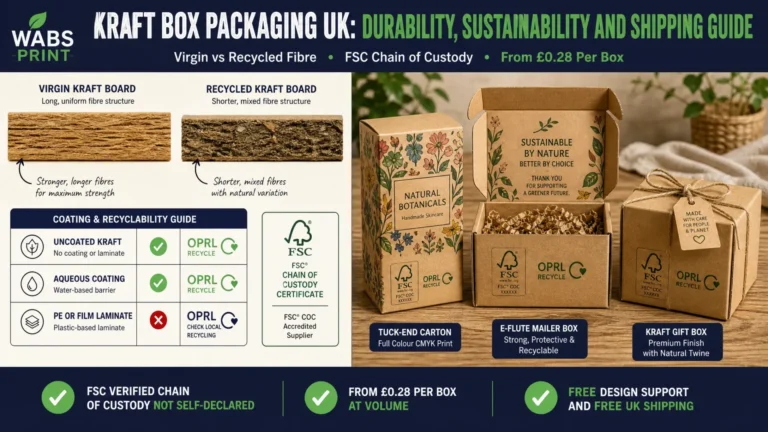
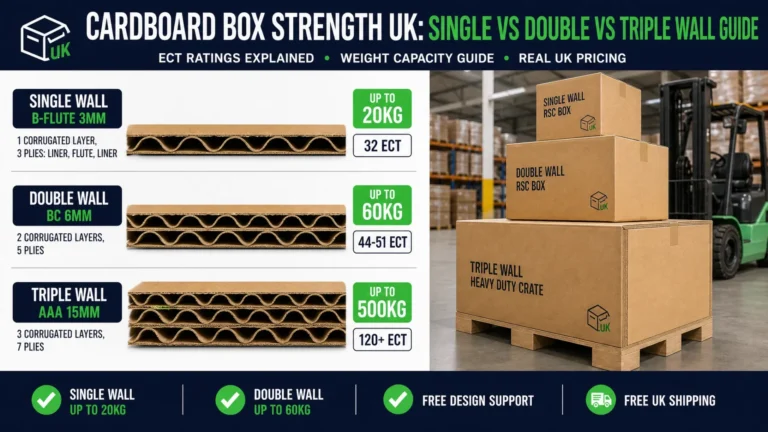
sector guide covers everything indie beauty makers need: premium packaging finishes like foil stamping, spot UV, and soft-touch coatings that elevate perception, tuck-end box design that provides structural elegance, protective
Paying for. If you want to see the full range of finish options that influence this decision, our luxury packaging finishes guide covers foil stamping, soft-touch laminate, and embossing in more depth than we can fit
Works well combined with a matte finish for a brand mark that you feel before you see clearly. Our luxury packaging finishes guide breaks down the cost and application differences between these finishes in more detail than
Into the board, pairs particularly well with a matte kraft finish for a tactile brand mark. Our luxury packaging finishes guide breaks down the cost and application differences between these finishes in more detail than
More at low volumes and are worth saving for once you are ordering at 500 units and above. Our luxury packaging finishes guide covers the full range of finish options and what each one actually costs in more depth than
Banking on a customer ordering again, which is where the next section gets more concrete. Our luxury packaging finishes guide covers the full range of finish options and what each one actually costs in more depth than
These are being presented as a gift rather than a shipment. For luxury packaging more broadly, our luxury packaging finishes guide covers how tissue selection fits within a wider finish strategy that includes foil stamping,
Will check your file, set it up correctly, or build the design from scratch, at no extra cost. Our luxury packaging finishes guide covers the full range of finish options and what each one does to the perceived value of premium
The retail price premium the premium finish commands is measured in pounds, not pence. Our luxury packaging finishes guide covers the full range of finish options and their cost-to-perceived-value relationship in more
The finish upgrade cost £0.31 more per box. That is the mechanism in practice. Our luxury packaging finishes guide covers the full range of finish options and their cost-to-perceived-value relationship across all