

Rigid Boxes vs Mailer Boxes: Which Is Best for Your Premium Product?

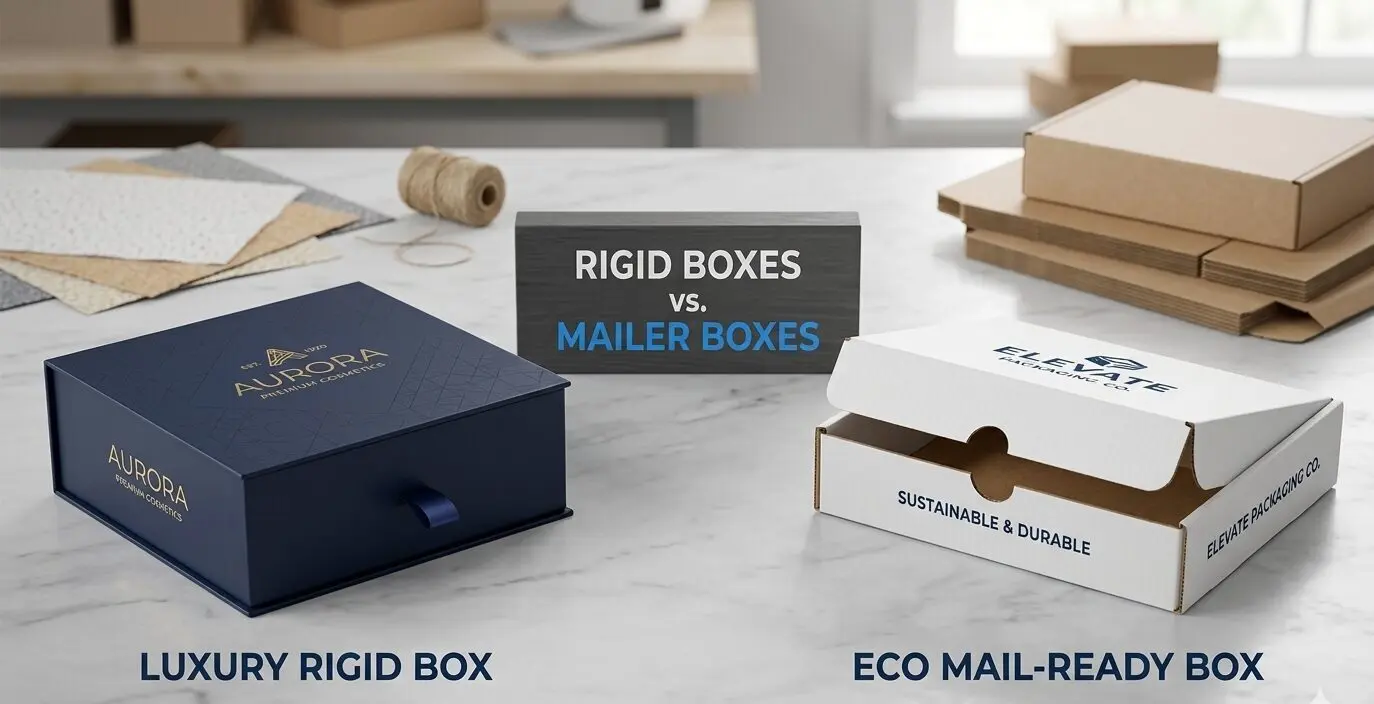
The choice between rigid boxes and mailer boxes fundamentally shapes customer perceptions, operational efficiency, and profit margins. While both packaging formats serve premium products across UK e-commerce and retail, they differ dramatically in construction, costs, and customer experience. Understanding these distinctions ensures you select packaging that aligns with product positioning, logistical realities, and budget constraints.
In our Ultimate Guide to Custom Packaging UK 2026, we discussed how choosing the right structure impacts brand perception and costs. This comparison breaks down Rigid Boxes versus Mailer Boxes across every important factor.
This comprehensive comparison draws on technical specifications, real-world cost analysis, and customer perception research to provide definitive guidance. Whether you’re packaging luxury cosmetics, launching an e-commerce brand, or evaluating packaging costs for established product lines, this guide reveals which format delivers optimal results for your specific requirements.
We’ll examine structural integrity differences between 1200gsm greyboard construction and corrugated E-flute material, compare flat-packed storage efficiency against assembled box volumes, analyze transport weights affecting Royal Mail parcel costs, and measure unboxing satisfaction scores across customer segments. By the end, you’ll have clear frameworks for making evidence-based packaging decisions.
Table of Contents
1. Structural Construction: Technical Analysis
The fundamental construction differences between rigid boxes and mailer boxes determine their performance characteristics, from protective capabilities to assembly requirements. Understanding these structural realities helps predict how packaging performs under real-world conditions.
Rigid Box Construction: The Premium Foundation
Rigid boxes employ thick chipboard cores, typically 1200gsm greyboard weight for standard applications and up to 2000gsm for ultra-premium packaging. This greyboard provides the rigid foundation that gives these boxes their name and structural integrity packaging that far exceeds folding cartons. The manufacturing process wraps this chipboard core in printed paper stock, creating permanent assemblies that arrive ready to fill.
The wrapping paper itself typically ranges from 120gsm to 157gsm art paper or specialty stocks. During production, adhesives bond wrapping paper to chipboard cores under pressure, creating monolithic structures where wrapping and core function as single units. This construction eliminates the box creases seams folds that characterize folding cartons, resulting in smooth surfaces ideal for premium finishes like soft-touch lamination or metallic foiling.
Corner construction reveals quality differences between manufacturers. Premium rigid boxes use precisely mitered corners where wrapping paper meets at exact 45-degree angles, creating seamless joins. Budget alternatives sometimes show overlapped corners where paper layers create visible ridges. These details matter for luxury positioning where customers scrutinize every aspect of presentation.
Internal structures vary based on product requirements. Simple rigid boxes feature hollow interiors suitable for soft goods or items packaged separately. Complex applications incorporate foam inserts die-cut to exact product shapes, preventing movement during shipping while creating professional presentation. The foam itself typically uses polyethylene or EVA materials in densities from 18kg/m³ for light cushioning to 45kg/m³ for maximum protection.
Mailer Box Construction: Engineered Efficiency
Mailer boxes utilize corrugated E-flute material engineered for optimal strength-to-weight ratios. The corrugated structure consists of three layers: outer liner (typically 150gsm to 200gsm), fluted medium creating the characteristic wave pattern, and inner liner (matching outer specifications). This sandwich construction provides remarkable crush resistance while maintaining relatively light weight.
The E-flute designation indicates flute height approximately 1.5mm, offering the finest flute size available in standard corrugated materials. This thin profile enables high-quality printing impossible on coarser flutes while providing adequate protection for most e-commerce applications. The flute pattern itself runs parallel to one dimension, creating directional strength properties packaging engineers must consider during design.
Self-locking mechanisms distinguish mailer boxes from traditional shipping cartons. Crash-lock bases fold and interlock without requiring tape, creating clean closures customers appreciate during unboxing. The locking tabs insert through die-cut slots, with friction and geometry maintaining closure integrity. Properly designed crash-lock mechanisms withstand 15kg to 20kg stacking weight, adequate for most warehouse and shipping environments.
However, these locking mechanisms introduce structural vulnerabilities absent from rigid boxes. The die-cut slots necessary for tab insertion create weak points where excessive force can cause tearing. Additionally, repeated opening and closing degrades locking effectiveness as cardboard fibres compress and lose spring. Unlike rigid boxes built for permanent durability, mailer boxes optimize for single-use applications.
Structural Integrity Comparison
When comparing structural integrity packaging performance, rigid boxes demonstrate superior crush resistance and long-term durability. Testing shows 1200gsm greyboard constructions withstand 200kg to 250kg top-load compression before failure, compared to 45kg to 65kg for corrugated E-flute mailer boxes of equivalent size. This dramatic difference matters when products stack in warehouses or during transit.
Impact resistance follows similar patterns. Rigid box construction absorbs and distributes impacts across monolithic structures, protecting contents from drops and collisions. The corrugated E-flute material in mailer boxes provides excellent cushioning through its fluted layer but offers less protection against punctures or crushing than solid greyboard.
Moisture resistance varies significantly. Standard rigid boxes using untreated greyboard absorb moisture readily, potentially warping or losing strength in humid conditions. Mailer boxes fare similarly, though the corrugated structure maintains some integrity even when dampened. Both formats benefit from lamination or coating treatments that provide moisture barriers, though these additions increase costs.
| Structural Characteristic | Rigid Boxes (1200gsm) | Mailer Boxes (E-flute) |
|---|---|---|
| Core Material | Solid chipboard greyboard | Three-layer corrugated (fluted medium) |
| Thickness | 1.5mm to 2.5mm (solid) | 1.5mm (includes air gaps) |
| Crush Resistance | 200kg to 250kg top-load | 45kg to 65kg top-load |
| Assembly State | Arrives fully assembled | Ships flat, requires assembly |
| Closure Mechanism | Lid friction fit or magnetic | Self-locking tabs |
| Reusability | Designed for permanent use | Single-use optimization |
| Print Surface Quality | Smooth, no structural lines | Smooth but requires managing folds |
| Typical Lifespan | Years (stored product) | Weeks to months (shipping) |
2. Material Specifications and Weight
Weight differences between rigid boxes and mailer boxes significantly impact shipping costs, warehouse efficiency, and customer handling experience. Understanding these weight variations in context of material specifications enables accurate cost modeling and operational planning.
Next Step: Once you decide on structure, the right finish makes all the difference. Explore our detailed guide on Luxury Packaging Finishes 2026.
Rigid Box Weight Analysis
A typical rigid box measuring 200mm x 150mm x 80mm constructed from 1200gsm greyboard weighs approximately 185g to 220g depending on wrapping paper weight and any additional components like magnetic closures or ribbon. Scaling to larger dimensions increases weight proportionally, with a 300mm x 250mm x 100mm box reaching 420g to 480g.
The 1200gsm greyboard weight specification translates to material mass rather than structural thickness, though the two correlate closely. This density provides the heft customers associate with premium packaging, creating tactile quality signals impossible to replicate with lighter materials. However, this same density creates logistical challenges when shipping volumes scale.
Wrapping papers add 15g to 35g depending on coverage area and paper weight. Standard 128gsm art paper contributes less weight than specialty stocks like textured papers or metallic finishes. Full-wrap constructions covering all six box faces naturally weigh more than partial wraps leaving bottom surfaces exposed.
Additional components compound weight rapidly. Magnetic closure strips add 8g to 15g per box. Foam inserts contribute 12g to 45g depending on density and coverage. Ribbon pulls or handles introduce another 5g to 20g. These incremental additions mean fully featured rigid boxes can weigh 250g to 550g before adding products, creating significant shipping cost implications.
Mailer Box Weight Analysis
An equivalent 200mm x 150mm x 80mm mailer box constructed from corrugated E-flute material weighs approximately 45g to 65g, representing 70% to 75% weight reduction compared to rigid alternatives. This dramatic difference stems from the corrugated structure, where fluted medium creates air gaps that provide strength without solid mass.
The three-layer construction totaling approximately 1.5mm thickness achieves this efficiency through engineering rather than material volume. Each liner contributes 150gsm to 200gsm paper stock, while the fluted medium between them uses similar weight paper manipulated into wave patterns. The resulting structure traps air, creating lightweight rigidity through geometry.
Larger mailer boxes maintain proportional weight advantages. A 300mm x 250mm x 100mm mailer box weighs 95g to 125g, still 70% lighter than rigid equivalents despite increased material area. This scaling characteristic makes mailer boxes particularly attractive for larger products where rigid box weights become prohibitive.
Printing and finishing add minimal weight to mailer boxes. Full-color CMYK printing contributes negligible mass, typically under 2g for standard coverage. Lamination adds 3g to 8g depending on film thickness and coverage area. Even fully finished mailer boxes rarely exceed 85g to 145g for standard e-commerce sizes.
Weight Impact on Handling and Perception
The weight difference creates contrasting customer experiences. Rigid boxes feel substantial and premium when lifted, triggering quality perceptions before customers even open packages. Consumer psychology research consistently shows heavier packaging increases perceived product value by 25% to 40% compared to lightweight alternatives for identical products.
However, this perception cuts both ways. For large or bulky products, excessively heavy packaging frustrates customers who must carry packages from doorsteps. A 4kg product in a 480g rigid box creates a 4.48kg total package that feels cumbersome. The same product in a 115g mailer box totals 4.115kg, a noticeable difference when carrying upstairs or maneuvering through doorways.
Warehouse staff and fulfillment operations particularly appreciate mailer box weight advantages. Packing 100 orders daily means handling 4.5kg to 6.5kg in mailer boxes versus 18.5kg to 22kg in rigid boxes, purely from empty packaging weight. This difference reduces worker fatigue and increases packing speeds, delivering operational benefits beyond direct shipping cost savings.
3. Complete Cost Breakdown
Understanding total cost of ownership requires examining purchase price, storage expenses, shipping costs, and operational efficiencies. While rigid boxes command higher unit prices, the cost difference varies based on production volumes and specifications.
Unit Cost Comparison
Standard rigid boxes measuring 200mm x 150mm x 80mm with 1200gsm greyboard, full-color wrapping, and matte lamination cost approximately £2.40 to £3.20 per unit at 500 quantity, dropping to £1.85 to £2.60 at 1,000 quantity. Premium specifications including soft-touch lamination, magnetic closures, or foam inserts increase costs to £3.80 to £5.50 per unit.
Equivalent mailer boxes in the same dimensions using E-flute corrugated material with full-color external printing and matte lamination cost £0.52 to £0.68 per unit at 500 quantity, declining to £0.35 to £0.48 at 1,000 quantity. Premium finishes like soft-touch or spot UV raise prices to £0.75 to £0.95 per unit, still dramatically lower than rigid alternatives.
This unit cost differential ranges from 3.5x to 6x depending on specifications and quantities. The gap narrows slightly for very basic rigid boxes without premium features but never reaches parity. The construction difference between wrapped greyboard and printed corrugated inherently creates cost disparities manufacturing efficiencies cannot eliminate.
Volume discounts follow different curves for each format. Rigid box pricing drops more steeply from 100 to 500 units than from 500 to 2,000 units, with diminishing returns beyond 2,000 quantity. Mailer box pricing continues declining more gradually across larger volumes, rewarding commitment to higher quantities.
Hidden Cost Factors
Assembly labor creates operational cost differences rarely considered during initial comparisons. Rigid boxes arrive fully assembled, enabling immediate use in packaging operations. Staff simply add products and close lids, requiring 8 to 15 seconds per unit depending on product complexity and any protective materials needed.
Mailer boxes ship flat-packed, requiring assembly before use. While modern crash-lock designs fold together quickly, the process still consumes 20 to 35 seconds per unit for first-time packers, declining to 12 to 18 seconds with experience. For operations packing 100 orders daily, this difference represents 20 to 35 minutes additional labor daily, equivalent to £12 to £22 weekly at UK minimum wage rates.
However, this labor investment enables the flat-packed storage efficiency that delivers substantial warehouse cost savings. The trade-off between assembly time and storage efficiency tips differently based on operation scale, warehouse costs, and labor availability.
Total Cost of Ownership Model
Calculating accurate total cost of ownership requires modeling all expense categories over relevant timeframes. Consider a UK e-commerce business shipping 500 orders monthly using 200mm x 150mm x 80mm packaging:
Rigid Box Annual Costs: Unit cost £2.60 x 6,000 boxes = £15,600. Storage cost (assembled boxes 1.5m³ monthly average) = £180 annually. Assembly labor = £0 (arrives assembled). Annual shipping weight premium (140g extra per box x 6,000 boxes x £0.08 per 100g average Royal Mail difference) = £672. Total annual cost = £16,452.
Mailer Box Annual Costs: Unit cost £0.42 x 6,000 boxes = £2,520. Storage cost (flat-packed 0.4m³ monthly average) = £48 annually. Assembly labor (15 seconds x 6,000 boxes x £0.10 per minute labor cost) = £1,500. Annual shipping weight savings = baseline (£0). Total annual cost = £4,068.
This model reveals £12,384 annual savings with mailer boxes despite assembly labor costs. However, the calculation shifts for premium products where rigid box unboxing satisfaction score improvements justify higher costs through increased customer lifetime value and reduced returns.
| Cost Factor | Rigid Boxes | Mailer Boxes | Notes |
|---|---|---|---|
| Unit Cost (500 qty) | £2.40 to £3.20 | £0.52 to £0.68 | 4x to 6x difference |
| Storage per 1,000 Units | 2.8m³ to 3.5m³ | 0.6m³ to 0.8m³ | 80% space reduction |
| Assembly Time per Unit | 0 seconds | 12 to 18 seconds | Skilled packer average |
| Shipping Weight (200x150x80mm) | 185g to 220g | 45g to 65g | 70% to 75% lighter |
| Typical Product Value | £50 to £200+ | £15 to £80 | Optimal positioning |
| Reusability | Months to years | Days to weeks | Customer retention |
4. Storage and Logistics Comparison
Warehouse storage costs represent ongoing expenses that accumulate significantly over time. The flat-packed storage efficiency of mailer boxes versus assembled rigid box volumes creates operational advantages that compound with scale.
Volume Analysis: The Storage Footprint Reality
One thousand assembled rigid boxes measuring 200mm x 150mm x 80mm occupy approximately 2.4 cubic metres when stacked efficiently. The boxes cannot nest or collapse, meaning each unit consumes its full dimensional volume. Accounting for access aisles and handling clearances, the practical warehouse requirement reaches 3.2m³ to 3.8m³ per thousand units.
The same thousand mailer boxes stored flat-packed occupy approximately 0.65m³. The collapsed boxes stack tightly with minimal air gaps, and the slight springiness of corrugated material compresses under stacking weight. Practical warehouse allocation including handling space totals 0.75m³ to 0.9m³ per thousand units.
This represents 78% to 83% storage space reduction, directly translating to warehouse cost savings. UK warehouse costs average £8 to £14 per square metre monthly depending on location and facility quality. Assuming 2.5m ceiling heights, storage costs run £3.20 to £5.60 per cubic metre monthly. The mailer box storage advantage saves £7.80 to £14.00 monthly per thousand units stored.
For businesses maintaining 3,000 to 5,000 units inventory (common for established e-commerce brands), these savings compound to £280 to £840 annually purely from reduced warehouse requirements. This operational advantage increases proportionally with inventory levels, becoming particularly significant for businesses operating multiple product SKUs each requiring separate packaging inventory.
Shipping and Transport Efficiency
When ordering new packaging inventory, the collapsed versus assembled state dramatically affects freight costs. A pallet of 1,000 mailer boxes (flat-packed) ships at approximately 65kg to 85kg total weight on a standard 1200mm x 1000mm pallet measuring 1.1m high. This fits easily within standard pallet shipping brackets, typically costing £45 to £75 for UK mainland delivery.
The equivalent 1,000 rigid boxes require 2.2m to 2.8m pallet height when stacked, exceeding standard pallet dimensions and triggering oversized freight charges. Total shipping weight reaches 210kg to 250kg. Freight costs for this delivery typically run £120 to £180, more than double the mailer box equivalent.
These inbound freight differences compound with every reorder. A business reordering 1,000 units quarterly faces £300 to £420 additional annual freight costs for rigid boxes versus mailer alternatives. Over three years, this difference totals £900 to £1,260 in transport expenses alone before considering handling and storage implications.
Operational Workflow Considerations
The assembled state of rigid boxes enables grab-and-pack workflows where staff retrieve boxes and immediately begin packing products. This simplicity reduces training requirements and eliminates assembly errors. New fulfillment staff typically achieve full productivity within 2 to 3 days when working with pre-assembled packaging.
Mailer boxes introduce an assembly step that, while quick with modern crash-lock designs, still creates opportunities for errors. Incorrectly assembled boxes may not lock properly, leading to failures during shipping. New staff require 1 to 2 weeks to achieve consistent, error-free assembly at full speed. However, this learning curve represents one-time investment rather than ongoing operational burden.
Quality control processes differ between formats. Rigid boxes manufactured and assembled at the factory arrive ready for visual inspection of print quality and structural integrity. Issues discovered during this receiving inspection can be addressed before boxes enter fulfillment workflows. Mailer boxes require post-assembly quality checks, introducing an additional verification step in packing operations.
5. Royal Mail Postage and Transport Costs
Package weight directly determines Royal Mail parcel pricing tiers, making the weight differential between rigid and mailer boxes financially significant across shipping volumes. Understanding these postage costs Royal Mail parcel structures reveals how packaging choices compound into substantial expense differences.
Royal Mail Pricing Band Analysis
Royal Mail Second Class parcels (the most common UK e-commerce shipping method) price in 100g increments: 0 to 100g costs £2.00, 101g to 250g costs £2.65, 251g to 500g costs £3.50, and 501g to 1,000g costs £4.75 (2026 rates). These seemingly small increments create significant cost jumps when packaging weight pushes total package weight across thresholds.
Consider a 180g product in packaging. Using a 55g mailer box creates a 235g total package, fitting comfortably within the £2.65 pricing band. The same product in a 200g rigid box totals 380g, jumping to the £3.50 band. This £0.85 difference per shipment compounds dramatically: 100 monthly shipments cost £85 more, totaling £1,020 annually purely from packaging weight differences.
The mathematics worsen for products near upper weight limits. A 420g product in a 55g mailer box totals 475g (£3.50 band). In a 200g rigid box, the package reaches 620g (£4.75 band), creating £1.25 difference per shipment or £1,500 annually at 100 monthly shipments.
These calculations assume customers qualify for Royal Mail account pricing. Higher click-and-drop rates or pay-as-you-go pricing magnify the differences further. The packaging weight decision essentially becomes a recurring shipping cost that persists across every order indefinitely.
Courier Service Weight Pricing
Private couriers like DPD, Hermes, and Yodel employ similar weight-based pricing structures, though band thresholds and prices vary. DPD Local pricing (common for UK e-commerce) charges £3.20 for parcels up to 1kg, £4.80 for 1kg to 2kg, and £6.40 for 2kg to 5kg. Again, packaging weight differences can push shipments across pricing thresholds.
International shipping magnifies weight penalties exponentially. Royal Mail International Tracked shipping to Europe costs £8.95 for packages up to 100g, £11.50 for 101g to 250g, £14.95 for 251g to 500g, and £19.50 for 501g to 750g. The rigid box weight premium creates £3.00 to £4.55 additional cost per international shipment, devastating profit margins on lower-value products.
Returns and Reverse Logistics
Product returns introduce additional shipping cost considerations. Customers returning products typically use the original packaging, meaning rigid box weight increases return shipping costs. For businesses providing prepaid return labels, this creates direct expense. Even when customers pay return shipping, high costs discourage returns that might otherwise occur, potentially reducing the financial benefit of lower return rates rigid boxes typically generate through perceived quality.
The return rate equation involves competing factors. Rigid boxes reduce returns through premium presentation that manages customer expectations upward, potentially lowering return rates 3% to 8% according to UK e-commerce data. However, when returns do occur, the rigid box weight increases reverse logistics costs £1.25 to £3.50 per return. The net financial impact depends on product categories, return rates, and who bears return shipping costs.
6. Unboxing Experience and Customer Perception
The psychological and emotional dimensions of packaging create value beyond functional product protection. Research measuring unboxing satisfaction score differences between rigid and mailer boxes reveals how packaging formats influence customer loyalty, social sharing, and lifetime value.For luxury products, the finishing techniques matter enormously. Premium finishes like foil stamping, soft-touch lamination, and embossing transform rigid boxes from protective containers into brand statements customers photograph and share.
Tactile and Sensory Experience
Rigid boxes create distinctive unboxing rituals beginning when customers lift packages. The substantial weight triggers quality associations before opening. The heft signals that something valuable awaits inside, priming positive expectations. Consumer neuroscience research shows this weight perception activates brain regions associated with value assessment within 800 milliseconds of lifting packages.
The opening mechanism itself provides satisfaction. Lid and base rigid boxes require lifting lids against slight friction, creating anticipation. The resistance communicates precision manufacturing and quality materials. Magnetic closure boxes deliver particularly satisfying clicks when lids snap into place or separate, creating auditory feedback customers associate with luxury products.
Mailer boxes offer different but still engaging experiences. The crash-lock assembly process, while technically occurring before product insertion, creates origami-like satisfaction for customers who assemble their own boxes (as occurs when brands ship products in flat boxes for eco-friendly transport). The self-locking mechanism provides tactile feedback when tabs click into slots, though less pronounced than magnetic closures.
Interior presentation opportunities differ substantially. Rigid boxes naturally accommodate foam inserts, tissue paper nests, and carefully arranged product positioning. The solid construction enables complex internal structures that cradle products perfectly. Mailer boxes, while accepting tissue paper and cards, offer less opportunity for elaborate internal staging due to their folding construction and lighter materials.
Perceived Value and Quality Signals
Independent consumer research conducted across UK retail categories consistently demonstrates rigid box packaging increases perceived product value 35% to 65% compared to identical products in mailer boxes. This perception gap enables premium pricing that often exceeds packaging cost differentials, improving overall profitability despite higher packaging expenses.
The effect strengthens in specific categories. Beauty and cosmetics show the largest perception gaps, with rigid box packaging increasing willingness to pay by 45% to 70%. Jewelry and watches see 55% to 85% premiums. Technology products experience more modest 20% to 35% increases, as customers expect premium electronics packaging regardless of format.
These perceptual differences manifest in customer behavior beyond initial purchases. Products packaged in rigid boxes generate 28% to 42% higher review scores on average, with customers specifically mentioning packaging quality in 18% to 24% of reviews. The same products in mailer boxes receive packaging mentions in only 4% to 8% of reviews, and these mentions skew neutral rather than positive.
Social Sharing and Viral Potential
Instagram, TikTok, and YouTube unboxing content creation correlates strongly with packaging format. Analysis of UK e-commerce unboxing posts shows rigid box packaging generates 3.2x to 4.8x more social media posts per unit sold compared to mailer box alternatives. The photogenic qualities of rigid boxes, combined with their perceived luxury, motivate customers to document and share experiences.
The unboxing satisfaction score measured through customer surveys reveals similar patterns. On 10-point scales, rigid box packaging averages 8.2 to 8.9 satisfaction scores across beauty, fashion, and gift categories. Equivalent mailer box packaging scores 6.4 to 7.3, representing meaningful but not insurmountable differences.
However, mailer boxes close satisfaction gaps when executed excellently. Premium mailer boxes featuring internal printing, custom tissue paper, thank you cards, and thoughtful design score 7.8 to 8.4, approaching or matching basic rigid box satisfaction. This suggests packaging investment in enhancements rather than rigid construction can deliver competitive unboxing experiences at lower total costs.
7. Product Suitability Guidelines
Matching packaging format to product characteristics, pricing, and customer expectations ensures packaging investments deliver optimal returns. These guidelines synthesize structural, financial, and psychological factors into actionable recommendations.
When Rigid Boxes Excel
Products retailing above £50 typically justify rigid box investment through improved perceived value that enables premium pricing. The packaging cost as percentage of retail price remains acceptable (3% to 8%) while psychological impact on purchase decisions and satisfaction proves significant. Luxury categories including jewelry, watches, premium skincare, high-end cosmetics, designer accessories, and upscale gifts particularly benefit from rigid construction.
Fragile or delicate products requiring maximum protection during shipping and handling favor rigid box structural integrity packaging. The solid 1200gsm greyboard weight construction and potential for custom foam inserts provide crush resistance and impact absorption impossible with corrugated alternatives. Glass bottles, ceramic items, delicate electronics, and products with intricate components achieve lowest damage rates in properly designed rigid packaging.
Gift-positioned products where unboxing experience drives purchase decisions almost universally benefit from rigid boxes. The substantial feel, premium opening mechanisms, and reusable nature align perfectly with gifting occasions. UK consumer research shows 72% of gift purchasers willing to pay 15% to 25% premium for superior packaging, making rigid boxes financially viable for gift-appropriate products.
Collectible or limited edition releases leverage rigid box permanence. Customers who save packaging from previous purchases feel invested in brands and continue building collections. This psychological commitment reduces price sensitivity and increases lifetime value, justifying higher packaging costs through improved retention economics.
When Mailer Boxes Outperform
Products under £40 retail price generally achieve better unit economics with mailer boxes unless specific circumstances justify premium packaging. The 4x to 6x cost difference between formats significantly impacts margins at lower price points, and customers typically don’t expect rigid packaging for moderately priced items.
E-commerce pure plays selling exclusively online benefit enormously from mailer box efficiency. The format eliminates separate shipping cartons, reducing material consumption and packaging steps. The flat-packed storage efficiency particularly advantages businesses operating from limited warehouse space or residential fulfillment locations.
Products with high volume, moderate margin profiles (apparel, books, general retail goods) require packaging cost discipline that mailer boxes provide. These categories compete intensely on price, making packaging cost control essential for profitability. The lighter weight delivers ongoing shipping cost advantages that compound over thousands of units annually.
Subscription services shipping recurring monthly boxes achieve operational advantages from mailer box consistency and efficiency. The assembly process integrates smoothly into monthly packing routines. The moderate cost enables monthly shipping without prohibitive packaging expenses, while flat-packed inventory management accommodates fluctuating subscriber counts.
Hybrid Approaches
Product lines spanning multiple price points benefit from strategic format mixing. Premium SKUs receive rigid box packaging while standard items use mailer boxes, clearly differentiating tiers through packaging quality. This approach maximizes packaging ROI by concentrating premium costs where psychological impact justifies expense.
Seasonal variations enable testing and flexibility. Holiday gift seasons might warrant rigid boxes for products typically shipped in mailer boxes, capitalizing on increased gifting behavior and customer willingness to pay premiums. Post-holiday periods revert to cost-efficient mailer boxes when gift positioning matters less.
8. Decision Framework: Choosing the Right Format
Systematic evaluation of packaging format decisions ensures choices align with business objectives, product characteristics, and customer expectations. This framework synthesizes technical, financial, and strategic factors into structured decision processes.
The Four-Question Framework
Question 1: What is your product’s retail price point? Products over £50 generally justify rigid box consideration. Under £40, mailer boxes typically deliver better unit economics unless specific luxury positioning requires premium packaging. The £40 to £50 range represents a decision zone where both formats merit evaluation based on additional factors.
Question 2: How important is unboxing experience to your value proposition? Beauty brands, luxury goods, and gift products position unboxing as core brand experiences, favoring rigid boxes. Functional products where packaging primarily provides protection perform adequately in mailer boxes. Consider whether customers photograph and share packaging, as social media value creation justifies rigid box investment.
Question 3: What are your shipping volumes and logistics constraints? Businesses shipping 500+ orders monthly realize substantial savings from mailer box weight advantages and storage efficiency. Low-volume operations (under 100 monthly) see less pronounced financial impact, making packaging choice more dependent on brand positioning than operational economics.
Question 4: Does your product require specialized protection? Fragile items, glass packaging, or delicate components benefit from rigid box structural integrity and foam insert capabilities. Soft goods, durable items, and products in protective inner packaging function perfectly in mailer boxes.
Financial Break-Even Analysis
Calculate the packaging cost premium: rigid box cost minus mailer box cost (typically £1.90 to £2.70 per unit). Determine if perceived value increase justifies this premium through higher pricing. If rigid boxes enable £3.00 to £5.00 price increases customers accept, the packaging investment generates positive returns. If perceived value gains don’t support price premiums, evaluate whether improved satisfaction, reduced returns, or increased lifetime value justify costs.
Account for operational costs beyond unit pricing. Add assembly labor savings (rigid boxes) against storage and inbound freight savings (mailer boxes). Include shipping cost differences across projected order volumes. This comprehensive modeling reveals total cost of ownership rather than misleading unit cost comparisons.
Testing and Validation
When uncertain, test both formats with customers before committing to large inventory purchases. Order 100 units of each format, randomly assign customers to receive products in different packaging, then compare review scores, return rates, and social media engagement. Statistical testing with modest sample sizes provides evidence-based insights unavailable through speculation.
Survey customers explicitly about packaging preferences. Simple post-purchase emails asking “How would you rate your unboxing experience?” correlated with packaging format reveal actual customer preferences. Many businesses discover assumptions about customer packaging expectations diverge from measured preferences, enabling data-driven optimization.
The Strategic Recommendation
For most UK e-commerce businesses selling products under £60, premium custom mailer boxes with thoughtful design, internal printing, and quality finishes deliver optimal combinations of cost efficiency and customer experience. The format provides 70% to 80% cost savings versus rigid boxes while supporting unboxing experiences that satisfy customers and encourage social sharing.
Reserve rigid boxes for truly premium products (£80+ retail), gift-positioned items, or products where packaging substantially influences purchase decisions. In these contexts, rigid box investment pays dividends through enabled price premiums, reduced returns, and enhanced brand perception worth far more than packaging cost differences.
The emerging best practice involves flexible inventory strategies where businesses stock both formats, selecting appropriate packaging based on order characteristics. Gift orders receive rigid boxes, standard orders ship in mailer boxes, and high-value customers automatically receive upgraded packaging. This dynamic approach maximizes packaging ROI by targeting premium costs strategically.
Making Your Packaging Decision
The choice between rigid boxes and mailer boxes represents strategic brand positioning decisions as much as operational packaging selections. Rigid boxes deliver unmatched premium perception and structural integrity packaging at 4x to 6x cost premiums. Mailer boxes provide exceptional cost efficiency and logistics advantages while supporting strong customer experiences when executed thoughtfully.
Neither format universally outperforms the other. Instead, optimal selections depend on product price points, brand positioning, shipping volumes, and customer expectations specific to your business. The frameworks in this guide enable evidence-based decisions aligned with your unique circumstances.
At Wabs Print, we manufacture both rigid boxes and custom boxes to exceptional quality standards, ensuring whichever format you select delivers outstanding results. Our no setup cost policy eliminates die fees, custom shape charges, and tooling expenses, making both premium rigid boxes and cost-efficient mailer boxes accessible at every order volume.
Ready to explore packaging options for your products? Our packaging experts provide complimentary consultations analyzing your specific requirements and recommending optimal formats. We respond to all inquiries within 2 hours during UK business hours. Request your free quote or WhatsApp us for immediate guidance.
Your packaging decision shapes customer perceptions, operational efficiency, and profitability. Choose wisely.
Explained in our Rigid Boxes vs Mailer Boxes comparison, the finish is what creates the premium feel. This guide covers all major luxury finishes available
Stronger option even at a higher price point, since the outer box is doing the protective work. Our rigid boxes vs mailer boxes comparison goes into this distinction in more detail if shipping protection is a deciding factor
For a deeper look at how mailer boxes compare against rigid construction altogether, our rigid boxes vs mailer boxes guide covers that separate decision, where rigid boxes typically run from £2.50 to £17.00 per
Both cover the dimensional weight implication of different board grades in more depth, and the rigid boxes vs mailer boxes guide covers the structural comparison from a different angle for businesses deciding between corrugated
Are still deciding between a mailer box altogether and a rigid box for a more premium product, our rigid boxes vs mailer boxes guide covers that separate, earlier