

Corrugated Box Grades Explained: A, B, C, E and F Flute Guide UK

Every corrugated box quote you receive mentions a flute grade, usually just a letter, B-flute, E-flute, C-flute, without explaining what that letter actually means for your product or your delivery costs. Most businesses pick whatever their supplier defaults to and assume it is fine. Sometimes it is. Sometimes it is costing them money on every single shipment.
This guide comes from the team at Wabs Print, a UK-wide packaging supplier that has produced custom corrugated boxes for UK businesses since 2008, working with 8,500 plus brands across food, e-commerce, retail, and industrial categories. The flute grade question sits at the centre of decisions about dimensional weight costs, damage rates, print quality, and warehouse stacking strength, and it is one of the most underspecified choices in packaging. Wabs Print supplies custom corrugated boxes to businesses across the UK, from FMCG manufacturers in Glasgow and Belfast to e-commerce brands in Nottingham and Newcastle upon Tyne. By the end of this guide you will know what each flute does, which one fits your product and courier, and what it costs. If you want a price now, custom corrugated boxes UK will get you a quote within 24 hours, no minimum order, free design support on every order, and free UK-wide shipping.
What Is a Corrugated Flute Grade?
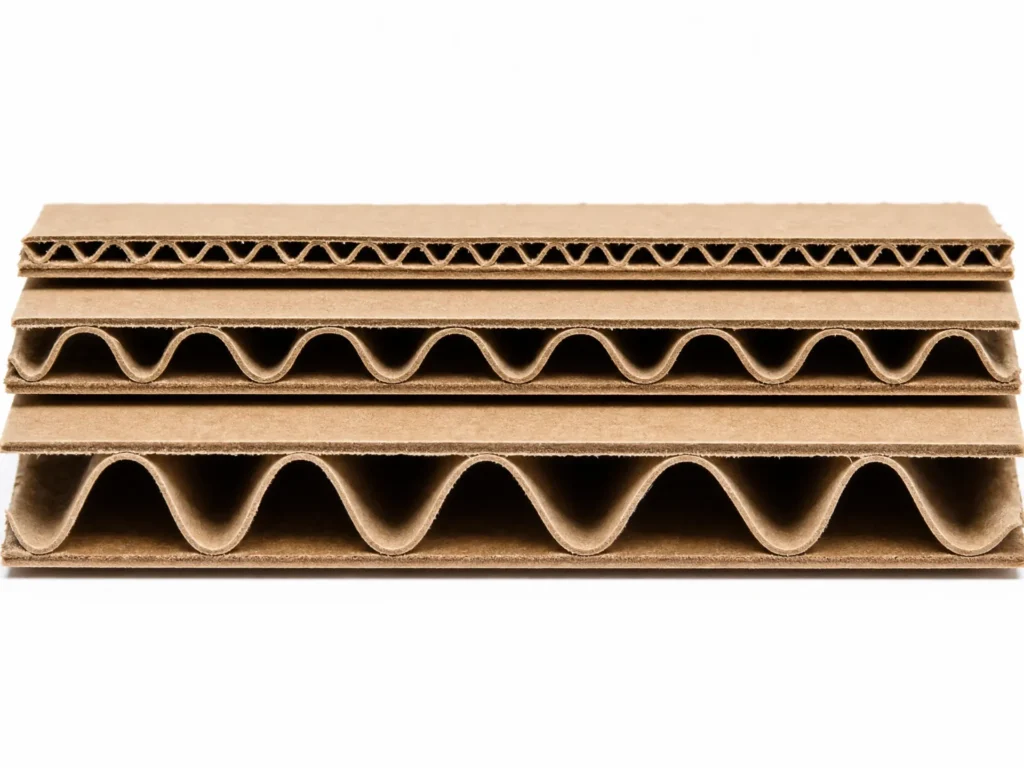
A corrugated flute grade refers to the specific wave profile of the fluted medium, the S-shaped paper layer sandwiched between two flat linerboards inside corrugated board. The flute is what gives corrugated its structural strength: the wave shape creates rigid air columns that resist compression from above, impact from the side, and puncture from external objects without the weight or material cost of solid board.
The grade letter, A, B, C, E, or F, describes how tall those waves are and how many fit per unit length of board. A taller wave (A-flute) creates more cushioning air space between the liners. A shorter wave (E or F flute) creates a flatter, denser board that prints more cleanly. Neither is universally better. The right grade depends on what your product weighs, how fragile it is, how it will be printed, and how it will be stacked in transit and storage.
The most important thing most guides on this topic miss: corrugated board loses 40 to 70 percent of its rated stacking strength when exposed to moisture, regardless of flute grade. A B-flute box rated at 32 ECT in dry warehouse conditions may be performing at effectively 10 to 19 ECT after several hours in a humid delivery vehicle or cold-chain environment. Grade selection matters, but so does moisture resistance, and that is a separate specification decision on top of the grade choice.
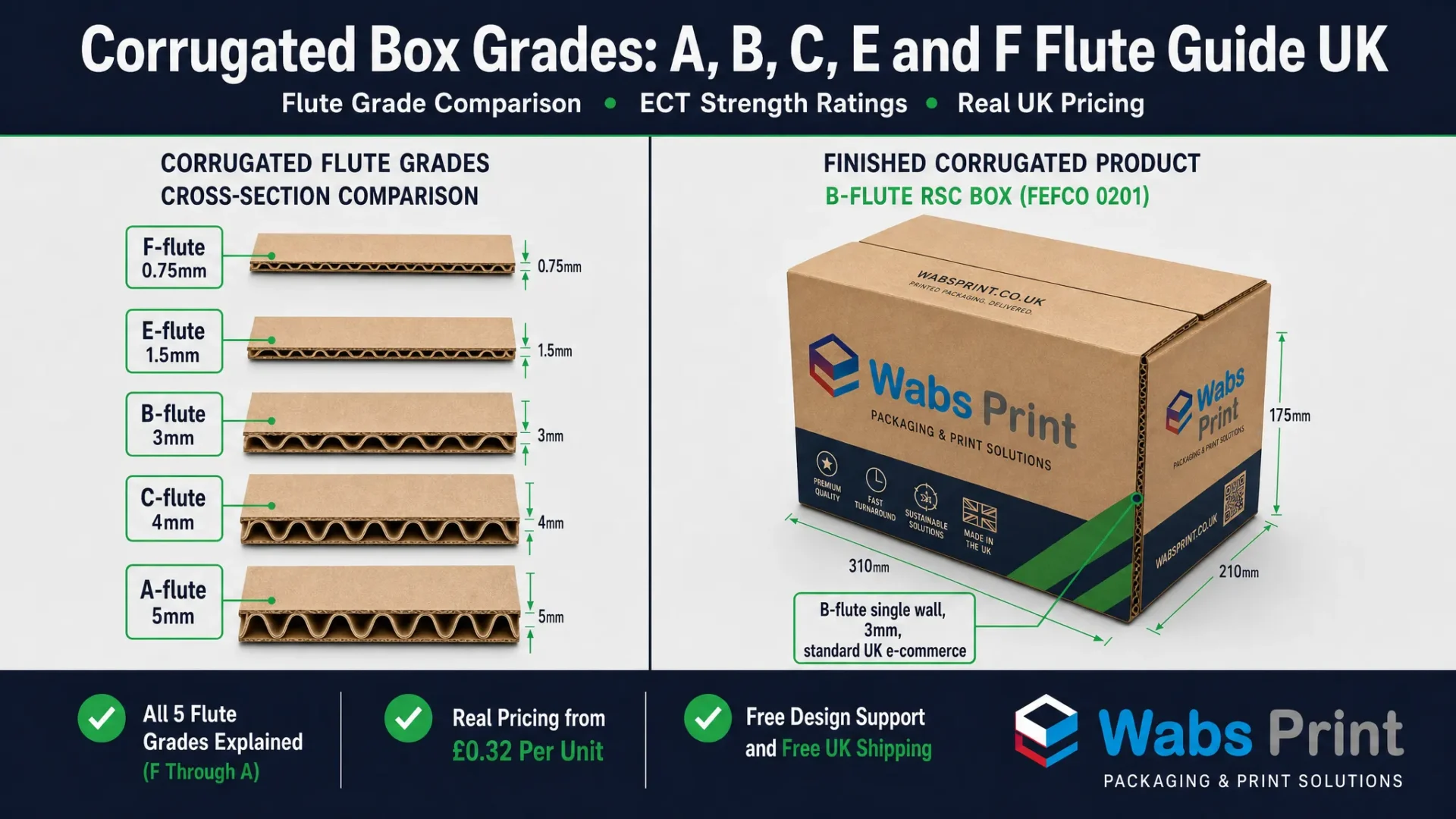
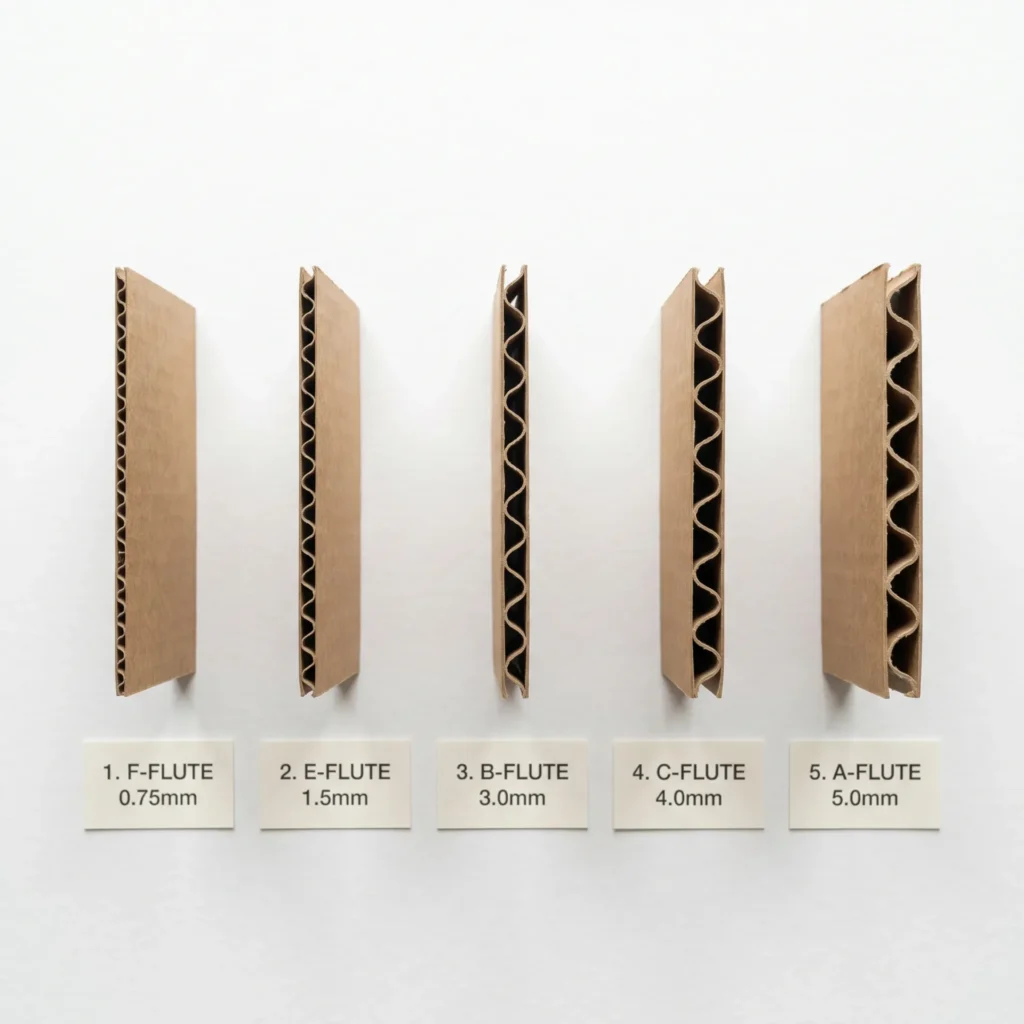
The Five Corrugated Flute Grades Compared
These are the standard grades you will encounter in UK packaging, from thinnest to thickest.
| Flute Grade | Thickness | Flutes Per Foot | Print Surface | Strength | Best For |
|---|---|---|---|---|---|
| F-flute | 0.75mm | 125 plus | Excellent, comparable to solid board | Light, rigid | Retail folding carton replacement, cosmetics, small boxes |
| E-flute | 1.5mm | 90 plus | Excellent, finest corrugated print surface | Moderate | Premium D2C mailers, cosmetics, subscription boxes, display |
| B-flute | 3mm | 47 to 50 | Good | Good crush and puncture resistance | Standard UK e-commerce RSC and crash-lock, retail display, SRP |
| C-flute | 4mm | 39 to 41 | Moderate | Excellent stacking strength | Standard shipping cases, glass products, dairy, heavier D2C |
| A-flute | 5mm | 33 to 36 | Poor | Best cushioning of any single wall | Fragile goods, glassware, ceramics, long-distance transit |
C-flute is the most widely used corrugated grade globally, accounting for roughly 80 percent of all corrugated boxes worldwide, since its combination of stacking strength and cushioning suits most general shipping and FMCG distribution applications. In UK e-commerce specifically, B-flute has become the dominant choice for branded D2C boxes because its slightly thinner profile prints more cleanly than C-flute while still providing adequate protection for most consumer goods under 20kg.
E-flute is the grade we specify most often for premium branded mailers and cosmetic outer boxes, since the fine flute profile, at 90 plus flutes per foot, creates the flattest, smoothest surface of any corrugated grade and produces print quality close to what a folding carton achieves. We covered E-flute’s role in mailer box construction specifically in our mailer box materials guide, where it sits as the standard single wall spec for our mailer box range.
F-flute: The Grade Most UK Buyers Have Not Heard Of
F-flute (approximately 0.75mm thick, 125 plus flutes per foot) is the thinnest standard corrugated grade and the one most businesses outside food and cosmetics packaging have not come across. It sits below E-flute in the grade hierarchy and is used primarily as a replacement for solid board folding cartons, since at 0.75mm it adds very little thickness over a plain card box while still providing the structural benefit of a corrugated layer between the liners.
F-flute is common in high-end cosmetics and pharmaceutical packaging, where a brand wants the visual quality of a folding carton on the outside but needs a slightly more structurally rigid box than solid board provides. It is also used for smaller retail boxes that need to fit within tight space constraints on a retail planogram without the thickness of even E-flute pushing the pack outside its allocated shelf slot. Its primary limitation is weight capacity: F-flute is not a transit box material and should not be used for products requiring stacking strength in a warehouse or courier environment.
E-flute and B-flute: The Practical Choice for Most UK E-Commerce
For the majority of UK D2C and e-commerce brands, the real decision is between E-flute and B-flute. Everything else in the grade table is either too thin for transit use (F-flute) or better suited to heavy goods and fragile products than to standard consumer goods shipping (C-flute and A-flute).
E-flute wins when print quality is the priority. Its 90 plus flutes per foot create a surface flat enough to reproduce fine text, photography, and detailed illustration at a quality level close to solid board print. If your brand’s packaging needs to photograph well, if it will feature small type, complex illustration, or photographic imagery, E-flute gives you those results at a corrugated price point rather than a solid board one. It also saves dimensional weight compared with B-flute, since a 1.5mm board adds less to the external box dimension than a 3mm one does across all six surfaces.
B-flute wins when the product is heavier or when the box will face rougher handling. Its 3mm thickness and 47 to 50 flutes per foot give it noticeably better crush resistance and puncture resistance than E-flute, without the step up in cost and dimensional thickness that C-flute would add. It is the standard grade for our RSC (FEFCO 0201) and crash-lock (FEFCO 0427) boxes, and the most commonly specified single wall grade across UK standard e-commerce applications.
Crestwood Tools, a hardware and hand tool supplier based in Belfast, came to us after a run of corner damage on a compact hand plane range they were shipping in E-flute crash-lock mailers. The planes themselves weighed around 1.2kg each, well within E-flute capacity, but the cast iron corners were concentrating impact force on a single point of the box wall whenever a parcel dropped, which E-flute’s thinner wall could not always absorb cleanly. We moved them to a B-flute crash-lock with a corrugated cell insert at the four corners to isolate the tool from the box wall. The corner damage rate dropped from roughly 6 percent of shipments to under 0.8 percent over the following two quarters, with no change to the outer box dimensions that would have affected their courier banding.
C-flute and A-flute: When to Specify Heavier Grades
C-flute (4mm) is the standard choice for products above approximately 15 to 20kg, distribution cases for food and grocery, and products in glass primary packaging like jars, bottles, or ceramic vessels where cushioning during transit matters as much as stacking strength. It is slightly harder to print than B-flute due to the coarser flute surface, but for standard distribution cases using one to three colour flexographic print for product codes, brand colour, and handling text, that limitation rarely matters in practice.
A-flute (5mm) is the specialist grade for genuinely fragile products and long-distance transit. Its larger wave profile creates more air space between the liners than any other single wall grade, which means better cushioning of impact energy. The trade-off is the same one that appears throughout the grade table: the coarser surface prints poorly for anything beyond simple functional text, and the additional board thickness adds to the external box dimensions and therefore to dimensional weight in courier billing. A-flute is specified for glassware, high-value ceramics, medical devices, and products being shipped through courier networks with unusually rough handling characteristics.
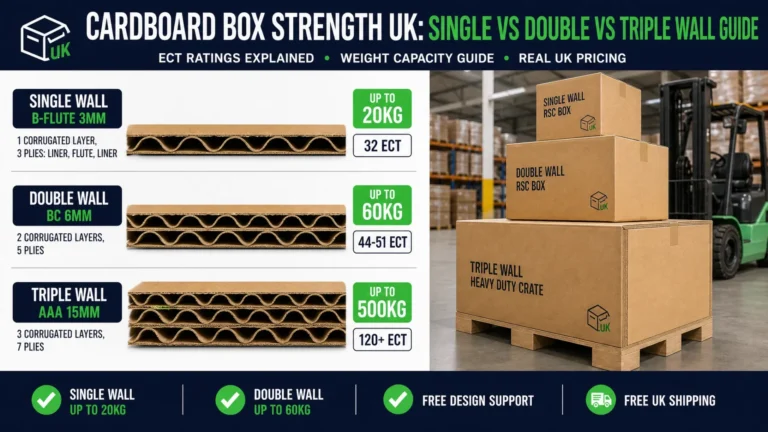
For genuinely heavy goods above 20 to 60kg, the answer is not a heavier single wall grade but double-wall construction, which adds a second fluted layer for a total board thickness of around 5 to 7mm depending on the flute combination. BC double-wall (B-flute combined with C-flute in a single board) is the most common heavy goods UK specification and handles approximately 20 to 60kg depending on the ECT rating. We cover how display boxes use B-flute in the context of retail environments in our display box packaging guide, where the grade choice affects print quality as much as structural performance.
The Hidden Cost Nobody Talks About: Flute Grade and Dimensional Weight
Choosing the wrong flute grade for your courier network can cost more per year than your entire packaging budget, not because the box fails but because an oversized box creates dimensional weight surcharges on every single shipment.
UK couriers including Evri, DPD, and Royal Mail charge dimensional weight when length times width times height divided by a standard divisor exceeds the actual product weight. An E-flute wall adds 3mm to the external dimension (1.5mm each side). A B-flute wall adds 6mm. A C-flute wall adds 8mm. Across all six surfaces of a box, the grade choice affects the total external volume by enough to push a parcel into a higher courier band or past a dimensional weight trigger, particularly for products packed in smaller boxes near a band boundary.
This is the calculation we run on every corrugated box quote: confirm the product dimensions, calculate the internal box size needed, add the wall thickness for the specified flute grade on all six faces, check the resulting external volume against the customer’s courier banding, and flag any cases where a lighter flute grade would drop the parcel into a cheaper band without compromising protection. The analysis is included in every quote at no charge. Our custom box dimensions guide covers how to provide your product measurements accurately so we can run this calculation correctly the first time.
Cost and Pricing Guide
All prices below are for our standard RSC (FEFCO 0201) at 310mm x 210mm x 175mm internal dimension with free UK-wide shipping included. Prices confirmed from our live corrugated boxes page.
Single Wall Corrugated Pricing by Volume and Grade
| Volume | Plain Brown RSC, B-flute | Crash-Lock 0427, B-flute | Litho-Laminate, E or B-flute |
|---|---|---|---|
| 100 to 249 units | £1.88 | £2.40 | £6.80 |
| 250 to 499 units | £1.42 | £1.82 | £5.20 |
| 500 to 999 units | £1.02 | £1.32 | £3.90 |
| 1,000 to 2,499 units | £0.76 | £0.98 | £2.95 |
| 2,500 to 4,999 units | £0.58 | £0.74 | £2.28 |
| 5,000 to 9,999 units | £0.44 | £0.58 | £1.75 |
| 10,000 plus units | £0.32 | £0.44 | £1.40 |
Double-Wall and Heavy Grade Corrugated Pricing
| Volume | Double-Wall BC, plain | Double-Wall with print |
|---|---|---|
| 100 to 249 units | £3.20 | Contact us for quote |
| 500 to 999 units | £1.82 | Contact us for quote |
| 1,000 to 2,499 units | £1.36 | Contact us for quote |
| 10,000 plus units | £0.60 | Contact us for quote |

White liner adds approximately 15 percent over the brown kraft price. FSC certified board adds approximately 7 percent. Interior print adds £0.06 per box. Die tooling and flexo plates are completely free on every order including first orders, which is worth knowing since most UK corrugated suppliers charge plate setup fees that add meaningfully to low-volume print costs.
If your artwork is not yet print-ready when you enquire, our design team can check your file, set it up to the correct dieline, or build the design from scratch, at no extra charge. Delivery is free to any UK address on every order regardless of volume or grade.
How to Choose: A Decision Framework for Your Product
Work through these in order rather than choosing a grade based on what looks familiar from a previous supplier quote.
- What does your product weigh, and how fragile is it? Under roughly 5kg with no particular fragility, E-flute is usually the right call. Between 5kg and 20kg for general goods, B-flute. Above 20kg or for genuinely fragile items like glass or ceramics, C-flute or A-flute, or double-wall. For anything above 60kg, contact us directly.
- How important is print quality? If your box will feature photography, fine illustration, or small text, E-flute and F-flute give you the flattest surface for that level of detail. If you only need simple brand colour and a logo, B-flute handles that fine.
- What is your storage and transit environment? If your boxes will sit in an unheated warehouse, go through cold-chain distribution, or be shipped to humid climates, moisture-resistant board is mandatory regardless of grade, since standard corrugated loses 40 to 70 percent of its stacking strength when wet.
- What courier are you using and what is their dimensional weight formula? The grade you choose affects your external box dimensions and therefore your courier costs. Tell us your courier when you request a quote and we will run the dimensional weight check before confirming the grade.
For the connection between corrugated grades and how they affect the packaging format choices across your range, our rigid boxes vs mailer boxes guide covers the structural comparison from a different angle, comparing corrugated construction with the solid board construction used in rigid boxes for premium packaging applications. Our EPR Packaging UK guide is worth reading alongside this if you are making a material choice between corrugated and plastic alternatives, since from 2026 corrugated’s Green RAM rating under UK Extended Producer Responsibility rules makes it the lowest-cost structural transit packaging option on a total cost basis including EPR fees. And our sustainable food packaging guide covers the FSC certification and recyclability claims that apply to corrugated food packaging specifically.
Corrugated Box Delivery Across the UK
Wherever your business is based, the grade specification, pricing, and free delivery policy stay the same. A food manufacturer briefing a corrugated SRP case from Glasgow works to the same 7 to 10 working day turnaround as a D2C brand ordering branded crash-lock mailers from Edinburgh, and delivery is free to any UK address regardless of order size, grade, or box style.
We get a steady run of enquiries from e-commerce businesses in Nottingham asking specifically which grade is right when they are borderline between E-flute and B-flute for a product around the 3 to 5kg range. The honest answer is: tell us the product dimensions, the weight, and your courier, and we will run the dimensional weight check as part of the quote rather than asking you to guess. Whether you are packing from a unit in Newcastle upon Tyne or a warehouse in Belfast, the specification process is the same, and the no minimum order policy applies across all grades.
Compliance and Sustainability for Corrugated Grades
Plain corrugated board, regardless of grade, is among the most straightforwardly sustainable transit packaging materials available. The UK household corrugated recycling rate is 74.3 percent, the highest of any packaging material, and standard corrugated board carries an OPRL “Recycle” label without qualification. The one exception is litho-laminate corrugated, where the laminated outer layer means an OPRL “Check local recycling” label is the correct designation rather than “Recycle.” Under CMA enforcement guidelines from April 2025, applying a “100 percent recyclable” claim to a laminate-coated corrugated box is a legally exposed claim. We apply OPRL-correct labelling to every corrugated box based on its actual specification at no extra cost.
Corrugated board carries a Green RAM rating under UK Extended Producer Responsibility rules, the lowest EPR fee band, which from 2026 makes it materially cheaper than plastic transit packaging alternatives on a total cost basis including EPR fees. We supply FSC Chain of Custody documentation with all FSC orders and per-order carbon data (board weight in tonnes multiplied by 491 kg CO₂-eq per tonne, per FEFCO 2025 data) for Scope 3 ESG reporting on orders above 1,000 units. This reflects packaging compliance guidance as of June 2026. Always verify current requirements at gov.uk before making compliance decisions for your business.
FAQ
What is the difference between E-flute, B-flute, and C-flute corrugated?
E-flute is 1.5mm thick with 90 plus flutes per foot, giving the flattest, most print-friendly surface of the three. B-flute is 3mm with 47 to 50 flutes per foot, balancing good crush resistance with a reasonable print surface. C-flute is 4mm with 39 to 41 flutes per foot, offering the best stacking strength of the three single wall grades for heavy or dense products.
Which corrugated flute grade should I use for D2C e-commerce?
For most UK D2C products under 5kg, E-flute gives you the best combination of print quality, dimensional weight efficiency, and protection. For products between 5kg and 20kg, or for anything with sharp corners or concentrated weight, B-flute is the safer choice. Tell us your product dimensions, weight, and courier when you enquire and we will confirm the right grade as part of the quote.
What does ECT rating mean on a corrugated box?
ECT (Edge Crush Test) measures how much vertical compression a corrugated box can support before the walls collapse under stacking weight. A standard B-flute single wall box typically carries a 32 ECT rating. Double-wall BC construction typically starts at 44 to 51 ECT. The critical point: corrugated can lose 40 to 70 percent of its ECT rating when wet, so cold-chain and outdoor storage applications require moisture-resistant board regardless of which grade you specify.
Do you deliver custom corrugated boxes to Glasgow and Nottingham?
Yes. Wabs Print delivers custom corrugated boxes to businesses across the UK, including Glasgow, Nottingham, Edinburgh, Belfast, Cardiff, Newcastle upon Tyne, and London, with free UK-wide shipping on every order regardless of grade or volume. Standard production is 7 to 10 working days from artwork approval.
Is there a minimum order for corrugated boxes?
No minimum order. You can order a single box or ten thousand and receive the same print quality and specification care either way. For context, pricing at 100 to 249 units runs from £1.88 for a plain brown B-flute RSC, dropping to £0.32 per unit at 10,000 plus units for the same specification.
What is F-flute corrugated and when is it used?
F-flute is approximately 0.75mm thick, the thinnest standard corrugated grade, with 125 plus flutes per foot. It is used primarily as a replacement for solid board folding cartons in applications like high-end cosmetics, pharmaceutical packaging, and small retail boxes where the extra rigidity of a corrugated layer is valuable but the thickness of even E-flute would push the pack outside its retail shelf space allocation. It is not suitable for transit shipping or stacking.
Does corrugated board type affect my courier charges?
Yes, significantly. Each additional millimetre of board thickness adds to your external box dimensions and therefore to the dimensional weight your courier calculates for billing. Moving from C-flute to B-flute on the same box saves 2mm per wall, or 4mm per external dimension. On a box close to a courier dimensional weight threshold, that 4mm can be the difference between two pricing bands. We run a dimensional weight check against your courier’s formula on every corrugated box quote.
Making the Call
Corrugated box grades UK decisions come down to four things: your product weight and fragility, your print quality requirement, your storage and transit environment, and your courier banding. Get those four inputs right, match them to the grade that suits, and the rest of the specification follows logically. E-flute for lightweight D2C with strong print requirements, B-flute for standard UK e-commerce and retail, C-flute or A-flute for heavy or fragile goods, double-wall for anything above 20kg or requiring maximum protection.
Whether you are an e-commerce brand in Nottingham, a food manufacturer in Glasgow, or a D2C business shipping from Edinburgh, Wabs Print delivers custom corrugated boxes across the UK with no minimum order, free UK-wide shipping, free design support on every order, and the same 7 to 10 working day turnaround regardless of grade or volume. If you are ready to get a price, custom corrugated boxes UK and you will have a quote within 24 hours.

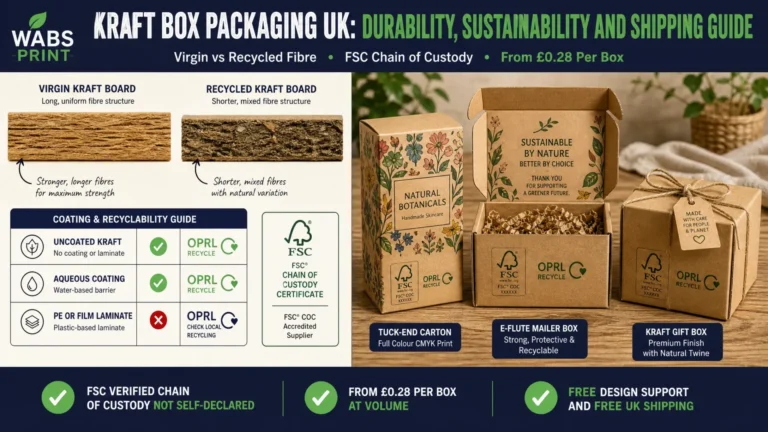
From B-flute at 3mm, which holds its structure better under sustained load and moisture. Our corrugated box grades guide covers the full flute grade decision in more depth for operations specifying across a range
boutique, or D2C box strongly favours a printed carton. Our display box packaging guide and our corrugated box grades guide cover the structural options in non-blister retail formats in more depth if the retail environment
A higher band unnecessarily before you commit to production. Our mailer box materials guide and our corrugated box grades guide both cover the dimensional weight implication of different board grades in more depth, and the
Oof up to 10kg per box. This is the same general construction category covered in more depth in our corrugated box grades guide, where B-flutes balance of stacking strength and print surface makes it the standard choice